blending an assortment of thoughts and experiences for my friends, relations and kindred spirit

blending an assortment of thoughts and experiences for my friends, relations and kindred spirit
By Alison Hobbs, blending a mixture of thoughts and experiences for friends, relations and kindred spirits.

Sunday, September 6, 2009

Sails-n-Whales


Day 2, Sunday

Today we were on the water, our friends riding the ferry from Grand Manan to Blacks Harbour and back while Chris and I were on board the Elsie Menota from Newfoundland, seeing whales! Apparently pods of whales circled the ro-ro ferry, too, but we saw them more or less at their own level as they came up for air, spouting on the horizon and close by. With Captain Sarah at the helm and the owner of last night's restaurant, who also runs this enterprise (Whales 'n Sails), on board himself, along with a zoologist from the whale research station making notes in her electronic notebook who could identify the wildlife for us, we sailed for four and a half hours, the length of the island and out into the mouth of the Bay of Fundy. We could see the New Brunswick coast in the distance and could make out the edge of Nova Scotia as well, under the line of cumulus over there. Capt. Sarah observed that there was “a bit of a swell running” after windier conditions last night so that our inclinometer rocked to 10 degrees either side for most of the voyage -- and where we eventually slowed right down and turned around we were in white crested waves that splashed us in the bows -- but during the return to the harbour at North Head the surface calmed down to silky ripples. The sun has shone and the sea has sparkled all day. I wore five layers of clothing on the cruise, by the way, and still got cold hands, except when I got them around a mug of complimentary hot chocolate in the galley below decks.

What did we spot? A prodigious variety of sealife: a school of harbour porpoises, then seals, their heads just out of the water, swimming along like dogs, and further out, a blue-fin tuna. They can grow to 9ft long and weigh 200 lbs. There were a couple of puffins with their coloured beaks, many Manx Sheerwaters, blackback gulls and flocks of Wilson's storm petrels who come to the Bay of Fundy for a rest. They migrate all the way to the Azores and thence to the Canary Isles, the Southern Atlantic and even into Antarctic waters where they venture ashore only to mate and hatch their eggs... before they return to Canada. They are only little and skim the water, flying in “ground effect” the whole way.

As for the whales, we saw fin back whales, humpback whales and several of the rare ones, right whales. I noticed as on the other whale watching cruise we once did (from Riviere du Loup), that when we came close to them, everyone on board was as quiet as in church and the Captain cut the motor so that all we heard was the wash of the waves against the sides of the yacht and the whales breathing. The “bonus” moment, as Chris called it, was one when of the right whales came up right alongside and greeted us with a low mooing or whinnying like a land animal, only much deeper and with more of a vibrato. It's impossible to describe that sound. Then it humped its back and said goodbye to us with its tail.

Chris and I came on shore at 4 o'clock very hungry for our missed lunch, so despite the fact that we have meals booked at the Shorecrest Lodge for this evening he and I have just indulged ourselves with a bowl of seafood chowder for me and a club sandwich with fries for him at Gallaways, the restaurant next to our motel. I am now on the lawn between our bedrooms and the motel's beach, the others around me wondering what I'm typing as they help themselves to the drinks on the picnic table, soaking up the last of the warm sunshine along with the equally relaxing alcohol.

Saturday, September 5, 2009

Flying to Grand Manan

We made a 9 a.m. start from Rockcliffe and an hour and a half later we were over Sherbrooke airport coming in to land for brunch. All the way we'd flown through smooth air, passing Montreal and seeing the Adirondack, Green and White Mountains to the south, with small clouds forming from the early morning mist.

On the ground at Sherbrooke we had a two hour break for lunch in the fresh air before our second leg, on an IFR flight plan taking us through the U.S. airspace over Maine. Because we were spending a couple of hours at 9000 feet Chris tested us for hypoxia with his oximeter. My blood-oxygen variably read between 87% and 90% up there, which meant that I was slightly hypoxic with a tendency towards euphoria, which comes on in any case when I'm flying like a cloud over beautiful landscapes in smooth air. At the Millinocket VOR, Boston Centre ATC gave us permission to fly “direct 6-Echo”, i.e. straight to Grand Manan, so that there were only 40 minutes more en route. We were making good time anyhow, at 130 knots with that tailwind. Mount Katahdin and White Cap Mt now behind us we continued southeast over the Penobscot River, the other aircraft in our party already ahead and talking to Bangor ATC. The scattered cu beneath us dwindled to “few” at the coastline and the sea itself, beyond Big Lake and Pocomoonshine Lake, was free of cloud.

Landing on the island was enormous fun, with a crosswind and superb views of the bays and headlands near the airport. As we taxied in, half of our friends were climbing into the taxi that was to return to pick up the rest of us once we'd tied down. We drove to the motel past a deer farm, the taxi driver being a seaweed farmer as well, who told us that this area boasts three kinds of seaweed—rockweed (used as a substitute cattle feed during the mad cow disease scare) dulse and kelp (the latter two harvested further from shore). He also told us about the 20ft tides, particularly noticeable while there's a full moon, i.e. now.

When we arrived here, Holly, the very friendly proprietress, handed me the keys for our sea-view room which the advance party of our friends had had her set aside for us. The motel has a black Labrador retriever called Zoe who, when you take her down to the beach, goes fishing, head down and tail up, for rocks, fetching them back to shore in her mouth.

We had supper at the very comfortable restaurant at Sailors Landing to which Robert and Francine contributed four carafes of white wine, so, after the bottles of beer on the motel lawn, we were quite merry under the full moon and stars and me none too capable of composing my blog. We'd seen the floodlit fishing boats in the harbour afterwards, down in the seaweed at low tide, with names like a poem: Fundy Gem and Nantucket Lady, Silver King, My Dear Boy, Second Wind.

Setting off

The sky is full of balloons (Gatineau balloon fest) and the valleys are full of mist. We are setting off for Grand Manan now, four aircraft, ten friends, and staying at the Surfside Motel on the island, probably for three nights. On Tuesday night Chris and I will be further north, at Monsieur Gagnon's Centre d'Art, in Ste Flavie, Quebec.

Friday, September 4, 2009

Osmosis

Susan Stromberg-Stein who created Osmosis from brass and steel, a sculpture to be found in the grounds of Rideau Hall near the cherry trees, says that by this word she means

a life process that goes on whenever two or more elements inpenetrate [sic]

and that

People, their customs and ideals go through a form of osmosis as they adapt ... to each other.

She's not only thinking of couples like Chris and me who've been adapting to each other for forty years or so, but also of the different elements in Canadian society. It's true that after a while people tend to start taking on the characteristics of the company they share. Teachers often acquire the childishness of their protégés and I'm afraid police or prison wardens risk becoming as aggressive as the criminals they're employed to control. I must confess I catch myself in old-ladyish mannerisms and ways of thinking after spending time with old ladies!

Not only have I just spent a month with a 90 year old; I have also been visiting some octogenarians recently. Chris sang (with me at the piano) to Jack a few times, I sang to Melita and Alec and I showed Claude my photos of my grandson. Of the relatively younger generation, since this time last month I've been associating with Tanya, Peter, Greta (had those three round to supper this week), Elva, Laurie, Carol, Don, Francine, Roger (going to see them all again tonight), John, Jill, Liz, Adele, Darlene, Sandy, Isabel, Pat, Barbara, Carys, and Rosemary, Alan and Sue, not forgetting Vivien, Ray and their daughter Suzie who's a music prof at Harvard. Plenty of different influences to be mixed and merged among that little crowd.

Of course willingness has to be part of it. At the Bytowne Cinema Liz, Mum and I watched a dark comedy, Easy Virtue, (based on a Noel Coward play) about an American girl's absolute refusal to be assimilated by a 1930s upper class English household. They couldn't accept her, either!

osmosis |äzˈmōsis; äs-|
noun Biology & Chemistry
• a process by which molecules of a solvent tend to pass through a semipermeable membrane from a less concentrated solution into a more concentrated one, thus equalizing the concentrations on each side of the membrane.
• the process of gradual or unconscious assimilation of ideas, knowledge, etc. : what she knows of the blue-blood set she learned not through birthright, not even through wealth, but through osmosis.

Wednesday, September 2, 2009

Off to see puffins

We're off on holiday this weekend. The plan is to leave on Saturday and spend a few days on Grand Manan Island with our aeroplane. I've booked two nights' accommodation for six of our friends, and two other couples may join in, so that there could be a dozen of us in a fleet of six aircraft. We'll see. So far, so good. The weather forecast promises sunny skies.

Tuesday, September 1, 2009

Origins of the postman

Something I meant to record was my visit to the Canada Postal Museum on the day Mum and I also went to see the IMAX film, Mysteries of the Great Lakes, at the Museum of Civilisation across the river.

The Postal Museum—apart from an eye-catching mosaic made of stamps by an artist working with a team of young helpers on their March break from school (V'là le facteur!)—exhibited means of communication through the ages.

Around 2000 BC, before papyrus had been thought of, people wrote with a reed stylus on soft clay. The characters written or drawn by the Assyrians or Mesopotamians were cuneiform. According to Heroditus, ancient Persians used a relay system for sending messages, their staging posts, hippones, each a day's journey by horse from the next. There's no real difference between that and the stage coaches of the 19th century. In Roman times postmen had to carry passports, diplomata, which is where the word diplomat comes from. A Pompeii fresco shows a woman writing on a wax tablet with a stylus pen, a startlingly modern image (see above), like me writing in a notebook.

Between the 10th and 15th centuries A.D. monks in Europe would carry rolls of parchment from one monastery to another which would convey the news of an abbot's death, for example. It was the medieval equivalent of a blog post or news article published on the Internet, because every time someone read it he or she would be able to add a Comment at the bottom; one such scroll was 9.5 metres long and included a poem perhaps by Héloïse in its comments. The Italian nobles of Mantua later organised their own courier service, a more secular one.

A Swiss post horn like the one depicted musically in Schubert's song, Die Post, was in one of the display cases. The Swiss, in 1874, were instrumental in founding the Universal Postal Union for the standardization of international postal services.

In Canada, they didn't have an official postal system until 1763 and mail was still being delivered by sleigh in 1919 which made sense, given the Canadian winters. When the mail had to be delivered on foot, the postmen needed spikes issued for their shoes, but this wasn't thought of until the 1970s.

I was surprised to learn that for over 30 years in the 19th century mail clerks were employed to cross the Atlantic where they spent all their time on board a ship sorting out some 15000 letters per crossing until in 1887 the sailors got tired of these land-lubbers making a nuisance of themselves and had the practice stopped, although the Titanic had a team of them, it seems.

We saw pictures of Canada's first mail men in 1874, of trams and of mail trains where the clerks who were banished from the ships must have worked. (Mum said she remembered Darlington's tramlines in England, dangerous if you got your bicycle wheel stuck in them.) In the 1920s a primitive airmail service was established.

Sunday, August 23, 2009

Second Life

Je sais l’art d’évoquer les minutes heureuses ...

This is the quotation from Baudelaire that I was trying to remember as we sat in deck chairs on the deck of Jill's cottage yesterday, talking about Second Life. A a pod-cast in the Philosophy Bites series, mentioned by Chris, had got us arguing about the revolutionary nature of Second Life technology on the Internet, and its unprecedented escapist appeal, but I claimed that there was nothing new about this whatsoever; the technology might be new but the concept is not. On the contrary. Human beings have been creating avatars of themselves and / or imaginary worlds ever since we began to walk about on this planet.

Religion, to give an obvious example, which has been around since the year dot, is all about the promise of a Second Life that will occur after this first, inferior one.

"...and when we find ourselves in the place just right,
'Twill be in the valley of love and delight."

Look at Moses encouraging his tribesmen and women to envision a land flowing with milk and honey, a Second Life for the exiled Israelites, and I'm quite sure that there were other people like Moses, in other parts of the world, well before his lifetime.

Look at Sir Thomas More's Utopia (1516), in book form. Printed books were a relatively new invention in More's day, but the concept of Utopia was not. Most of Gulliver's Travels and other such science fiction, ancient and modern, is an invention of different, parallel, universes good and bad, and so is regular fiction for that matter. I remember my French literature tutor at university, Dr Mein, saying that a novelist (she used Proust, Flaubert and Mauriac as examples) has the imagination to create in his characters and their settings other possible versions of his own life. I'm sure Jane Austen did that; if her heroines seem rather interchangeable, it's because they're all variations on the theme of her own inner life (within a rather restrictive and limited First Life environment).

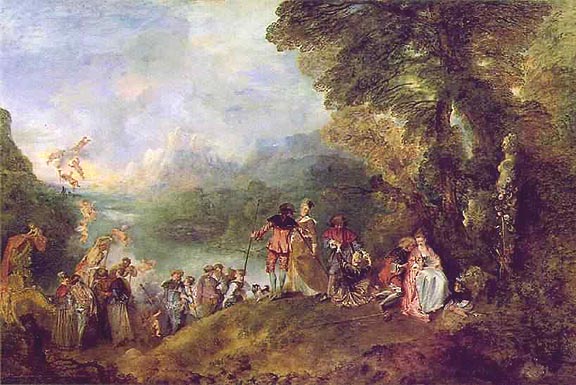
Aren't paintings the creations of an alternative world as well? An obvious example are Watteau's landscapes and the fêtes gallantes that take place there. Significantly some of the faces in these pictures wear masks. In our discussion about Second Life yesterday Jill was reminded of Venetian masked balls and I hardly need mention theatre, the stage. In the old days unfulfilled people yearned for the Land of Cockaigne or what the Germans call Schlaraffenland. Nowadays they imagine themselves in Yoville.

I mean to say, what's the difference?