blending an assortment of thoughts and experiences for my friends, relations and kindred spirit

blending an assortment of thoughts and experiences for my friends, relations and kindred spirit
By Alison Hobbs, blending a mixture of thoughts and experiences for friends, relations and kindred spirits.

Wednesday, April 14, 2010

Tuesday in Barcelona

A leisurely hotel buffet breakfast con mucho cafe among the flowering cacti because waking up had not been so easy. Took the S2 train one stop then lost my way in S. Cugat trying to find the Rambla del Celler on which the other hotel is situated, but, muttering to myself, caught sight of it eventually. Sha, waiting for me in the lobby, led me confidently back to the station by a more direct route and we bought T-Dia "tiquets" entitling us to every means of public transport within 2 zones. We took the FGC train to Pl. de Catalunya where a busker was giving a terrific performance of Bach's 1st 'cello suite from memory, surely a professional. Then we took the metro to Valcarca, nearest stop to the Parc Güell. A passerby pointed us down the correct street, from which we found signposts to the park up the narrow Baixada de la Gloria. There were 240 steps (counted them later) but for the way up a series of escalators have been installed.

The Park Guell, its excentric design by Gaudi, swarmed with tourists, a large proportion of whom were young school groups from France. It's fun for both children and adults, with passages through leaning tree trunks carved from stone and many a hairpin bend among the pines and cacti. The sandstone cliffs draped with flowering wisteria hid pigeons' nests and caves such as the one where we queued for the WC. Gaudi's house is here as are other colourful ones with murals, turrets & mosaics, and one has a luxuriant flower garden dotted with orange trees. The view of the city, mountains and the coast from the top of the hill was absolutely stunning. We saw an even taller, steeper hill in the distance, the Tibidabo, topped by a huge church: the Temple del Sagrat Cor.

Eventually, having done an adequate tour of the winding paths & the buskers on Chinese fiddle, steel pans, guitars ... we came back down the hill and hopped onto the metro, getting off on impulse at Fontana. Disappointing in that there were no fountains but we took the opportunity to sit down in a tapas bar for coffees and a pasta de manzana (no English spoken) where most other people were enjoying cigarettes and alcoholic drinks with a great variety of tapas. Back on the metro to Barceloneta for another long walk round the harbour, to one of the beaches: Platja Sant Sebastian. There beyond a row of palm trees we saw a building like a giant green glass sail and a metal sculpture Homenatje a la Natacio by Alfredo Lanz, 2004. Waves were breaking on the sand and a games club was playing a sort of volleyball game. We passed a cable car and the dock for cruise ships, one, the AIDA, being cleaned by its crew. Then we caught a 17 bus from the quayside back into town.

Where we got lost beyond redemption in the Barri Gotic. (To be continued.)

Monday, April 12, 2010

In Sant Cugat

I've arrived, and am writing this in the lobby of the Novotel at Sant Cugat on the outskirts of Barcelona. It's an attractive area, especially (despite this afternoon's rain) at this time of year with the trees in bloom.

On first impression, Barcelona was like California, bare rock under the scrubby steep hillsides, beaches (Mediterranean) lined with palm trees, enormous cacti growing on the railway cuttings. My second impression, once my bus from the airport arrived in the centre (Placa de Catalunya), was of a city like Paris, pollarded plane trees, wide boulevards, little balconies and shutters on the windows, fountains in the square. I found some lunch at a nearby restaurant, ordered lasagne, spelled correctly; it was very well presented and "hit the spot" as my Canadian friends would say. Supper was at a quiet Catallan cafe with Sha and George near their hotel. The waitress could only communicate with me in Spanish but I managed it. We enjoyed our cervezas and crispy sandwiches. I was too busy chatting to take notes on the vocabulary, a failing which I now regret.

George's hotel is posher than mine but the Novotel is good enough for me and only a three minute train ride (towards Sabadell) on the S2 line. I buy my ride from the automatic ticket dispensers, following the instructions in Catallan of course (!) We walked round the outside of the beautiful old monastery and danced on the tune-making paving stones in the playground, in the rain. The elegant street, recently paved and cobbled by this obviously prosperous municipality, glistened in the rain and were slippery underfoot. George and Sha took many photos which I'll attach here later.

I only have 2 minutes left so will pause till tomorrow. Very tired after the 20 hour journey, but very happy to be reunited with George. I need to sleep next.

Monday, April 5, 2010

La vie en rose

We spent Easter Sunday in old Montreal, a foretaste of Paris where we'll be together with George and Sha, the weekend after next. On a bright and breezy morning we flew PTN to St. Hubert on the southern edge of the city, parking at the Esso FBO, then took a taxi to the "Université de Sherbrooke" campus where the Longueuil Metro Station is to be found. From there it's a two station hop on the yellow line to Berri-UQAM, walking distance from the Vieux Port.

Although many places were shut, it was still not too late for lunch at a stylish place called the Crêpe Café which, for future reference, is at the corner of Notre Dame and Bonsecours. Inside it felt like being on the set of the film Amélie, even to the extent of the waiter and waitress, a charming, very French couple, being as interested in one another as in their customers, if not more so. The waiter also kept popping outside to check the condition of his bright red motor bike parked against the kerb. Accordion music (La Vie en Rose) was softly playing in the background as we took our table by the window to watch the passers by, and the crêpes, without question, lived up to our expectations.

It being a public holiday, most of the city streets were deserted, but once we came to the waterfront and the Place Jacques-Cartier we realised where all the people had got to.

Home again above the city and across Pierre-Eliot-Trudeau Airport whence I'll take off for Paris and Barcelona ... next Sunday! Chris—whose latest blogpost is less escapist than mine!—will fly over to join George, Sha and me in Paris five days after that.

Tuesday, March 30, 2010

Plenty of juxtapositions on the old Silk Road

Today, Barbara and I went to the Musée des Civilisations to find some of the hidden treasures that had been brought there from Afghanistan. We did not expect to find such a variety.

The richest part of Afghanistan from a cultural point of view seems to have been the Hindu Kush in the mountainous north east of the country, through which the Silk Road ran. Along it came itinerant merchants from China and Mongolia in the east, also from Persia, Mesopotamia and India, and from what is now Turkey and Greece in the west; they brought their artifacts with them and deposited them in various places along the way. From the west they carried glass and bronzes; from the central countries precious stones (rubies, garnets, lapis lazuli) and Persian carpets. Horses from Siberia, ivory from India, silk from China.

At one time northeastern Afghanistan was known as Bactria, colonised by followers of Alexander the Great; they founded the city of Ai-Khanum (meaning "Lady Moon") around 300 BC, building imposing Grecian columns topped with stone capitals which were later toppled by the Mongolian hordes under Genghis Khan. The central edifice was a temple, perhaps to Zeus, with images of the (Phrygian) Goddess of Nature, Cybele, besides. Among the exhibits in the hall showing Ai-Khanum was an animated model of the temple shown on a screen, computer generated ghosts wandering about in it. They had stone sundials, some of them almost identical to ancient sundials from Italy or Grecian Egypt; others were apparently Indian in design. Beautifully coloured ointment bowls were on display as well.

Two thousand years before Ai-Khanum, in the Bronze or "Oxus" Age the area was Mesopotamian and golden bulls with beards have been unearthed to prove it.

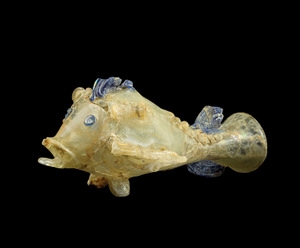
Bagram was another such city, where an astonishing cache of treasures was discovered, Chinese, Indian, Egyptian and Roman, presumably either made by itinerant craftsmen or transported from those parts of the world. The cache had been bricked up and sealed in an underground storage room in the foothills of spectacular, pointed mountains. A few items—Chinese laquer ware and ostrich eggs—were too fragile to be displayed in this exhibition, but we did get to see the alabaster dishes and amphorae, and the wonderful glass-blown fish. The fish are presumed to have been vessels for cosmetics; glass blowing had begun in Egypt around 1500 BC. There were goblets from Roman Egypt too, painted with animals and people and plaster medallions, moulds from Roman silverware, perhaps intended as samples to be shown to buyers.

We were intrigued by the ivory models of mythical beasts, such as the leogryph (ridden by a voluptuous woman) with its lion's body, eagle's wings and the beak of a parrot. Likewise there was the makara, the beast traditionally ridden by the goddess Ganga, part crocodile, part elephant, part fish. Most fascinating were the three ivory table legs in the form of three women, two of them (partly) dressed in Indian garb, but the third in a Grecian robe.

The most spectacular of the exhibition rooms was the one showing the finds at Tillya Tepe, from the tombs of a tall nomadic chieftain (1.8 m) and his five wives, perhaps sacrificed at the time of his burial along with his horse. The horse's skeleton was alongside, anyhow. These tombs were full of golden jewellery mostly set with turquoise or lapis lazuli, although there was also a stunning collection of hair pendants (sic) and a headdress ornament shaped like a tree, hung with tiny pearls. Headdresses seem to have been the women's crowning glory and there was indeed a proper crown, but collapsible—hinged in sections for ease of packing in a saddle bag. Its golden leaves would have rustled in the breeze, interspersed with flowers with silver centres. A miniature ram was found, made of pure gold, another headdress adornment.

All these treasures are the property of the National Museum in Kabul which was bombed and looted by the Soviets. Fortunately in 1978 someone had had the foresight to remove the most portable artefacts to a hiding place in the Presidential Palace, so these were saved from destruction. The vault was re-opened in 2003. Afghanistan is still not exactly a safe country, but the people have access to their treasures. On more than one wall of the exhibition halls was written:

A nation stays alive when its culture stays alive.

Sunday, March 28, 2010

Arnie and the mothers

Although I often have to label myself on forms as a "home maker", I soon get tired of home improvements and, for example, can only bear to think about our on-going kitchen renovation in short bursts. This weekend we shopped for backsplash tiles, not finding such a wide choice as advertised at Home Depot, so the next day we went to Lowe's.

I have no desire to describe this in my blog.

Otherwise I have been trying to work on the creation of two very different books, one being an illustrated story for my grandson about the ice breaking machine that was recently set to work on the Rideau River. I've named the character Arnie Amphibex and although "he" is officially known as an amphibious excavator I've called "him" a Water Digger. With our small camera we took some video footage of the ice breaking operations and mailed this to Alexander ahead of the story which will now follow (I've just finished printing it), illustrated by stills from the movie.

The other book in production is not mine but the brain child of a Caribbean diplomat living in Rockcliffe, homesick for her island in the sun, I believe, who is compiling a collection of narratives, or eulogies, about people's mothers, all of these ladies from her part of the world. I volunteered to help her with the layout and editing of her book, a fiddly task, quite time consuming. I'm using the Pages application on my Apple Mac for this (although Chris thinks I should be using LaTeX) while my diplomat friend tries to locate the illustrations—photos—of the individuals described. Each story has been submitted during the last few years by a worthy islander, and it's interesting for me, an outsider, to discover how similar they are. Nearly every contributor mentions his or her mother's piety and strictly disciplined, principled approach to child rearing. Several of these people born at the start of the 20th century were the children of slaves who had worked "on the plantation" before they were freed, but the details and general atmosphere of the stories remind me of my great aunts and grandparents in Britain.

In my friends house hangs an oil painting of a typical island shack, with little boys and chickens roaming outside. The shack sits in the sun on a pile of rocks. Apparently this was a typical former slave hut that had been moved bodily to the place where the occupant wished to live.

My friend wants her book to be tribute to all the mothers of the Caribbean, of all origins, in particular her own mother, the end of whose life inspired the start of this project.

Monday, March 1, 2010

Outside / Outsiders

Suffering from cabin fever, we went flying again on Sunday, intending to make it to Lachute for lunch, but low clouds hung over the hills north of the Ottawa River and thickened mistily over the flat country to the east of Papineauville, so that made it too risky. We can't penetrate too much cloud in winter for fear of icing. It is springlike at ground level with ice and snow thawing rapidly, but above 2000 ft. the air temperature falls below zero. We circled back and landed at Gatineau for lunch, where a hulking great Hercules dwarfed all the other aircraft on the apron.

Saturday night we had stayed out late at Gareth's and Greta's house, meeting a number theorist (cryptographer) at the dinner party, who with his wife had once entertained the world famous Paul Erdös at their home in California, and later in Calgary. Chris was in awe of this and keeps talking about it. Erdös was a man without possessions, an outsider who "turned caffeine into theorems", living from day to day off other people's charity. When his welcome grew thin he would simply pack his suitcase and move on to the next colleague's house.

That is the single-minded way a genius gets things done.

Yesterday afternoon we met another one-tracked man, an artist who wants to be nothing else and who lives in a laundrette, or buanderie, which he has converted into a studio and filled with his paintings. Marc Brzustowski (we know his parents) has been painting prolifically and the walls of the laundrette are hung with his recent winter landscapes, plus a few that I recognised from last summer at The Cube gallery, of his nightscapes. Marc has also painted more personal, anti war pictures on large canvasses, some of which hung in the foyer of the Great Canadian Theatre Company's premises during a recent performance.

It was most interesting talking to Marc and his parents. We'd spent an hour walking to the rue Frontenac through the showers so appreciated the wine and cheese provided. We bought a sketch in oils of MacGregor Lake, painted in situ north-east of here, the paint on it still not quite dry. Marc paints with gloves on, out of doors, and says the paint becomes more viscous in the extreme cold; he has to be careful not to add too much thinner. I also liked his sketches of the stretch of the Ottawa River under Parliament Hill at night time, featuring the floodlit Supreme Court or Chateau Laurier, the moon in the wintery sky and the reflections of lamplight in the pools of rainwater that sit upon the melting ice. He'd enjoyed painting the tumbling water under the Chaudiere Falls as well.

I can identify with people who live on the outside, looking in.

As non-native Canadians, Chris and I were both amused by how quiet the city became towards the end of the afternoon while everyone else had their eyes glued to various TV screens, watching the Olympic final hockey match between arch-rivals, the Canadians v. the Americans. As we walked home through the empty streets, we could hear from the pubs we passed the cries of GO CANADA! and when the winning goal was scored in extra time at the end of the game the city rang with a great cheer from the fans in the pubs, all on their feet. Then the cars began to roll, honking their horns, and the parties repaired to Parliament Hill to carry on celebrating. I'm not sure they were as patriotic on the Quebec side of the river where we had seen some graffiti saying F... the Olympics!

Friday, February 26, 2010

An Olympian torch bearer

In the 1956 an athlete called Jackie MacDonald (b. 1932) took part in the Melbourne Olympic Games, competing in the discus throwing and shot put events. She had won a silver and a bronze medal for Canada in the Commonwealth Games. She is still regarded with respect for these achievements and for this year's lead up to the winter Olympic Games in Vancouver she was one of the famous Canadian sportspeople allowed to carry the Olympic Torch. Apparently there were about 12000 of these people across the provinces and as many torches too! The bearers had the option of buying their own torch (I hadn't realised that) which they could then keep. Each of these elegant objects was made by Bombardier and did not come cheap. There were words engraved on the side, quoting from the National Anthem:

with glowing hearts/ les plus brillants exploits

At the Nigerian Ambassador's house this morning a group of us met Jackie MacDonald; she told us about her experiences bearing the torch and passed it around so that we each got to hold it. It felt heavier than expected, weighing 1.6kg.