blending an assortment of thoughts and experiences for my friends, relations and kindred spirit

blending an assortment of thoughts and experiences for my friends, relations and kindred spirit
By Alison Hobbs, blending a mixture of thoughts and experiences for friends, relations and kindred spirits.

Sunday, August 5, 2012

Mist along the cliffs

Tonight we have 8 octas of fog, visibility at the airport an eighth of a mile, vertical vis. 100 feet, temperature 20, dewpoint 20, which means that we cannot see a thing from our bedroom window on the 11th floor of the Hilton except by looking straight down; the lighthouse on the dockside adjacent is slightly visible. It reminds Chris of the Fens (of his youth).

Till late afternoon today the sky was blue and cloudless. We ate our breakfast at a Cora's restaurant with toast, eggs and fruit galore. Orange juice and no coffee for me. Then we took the car up the road to Loch Lomond, the lake just past the airport, and beyond. Road 111 leads to St. Martin's, a fishing village at the mouth of the Irish River where the tides rise and fall by as much as 27 feet. We had a long stop there sitting by the harbour, buying icecream. Nothing else for lunch because too many other tourists were parked by the restaurants near the rust-coloured sea caves round the corner, so we carried on up to the Fundy Trail Parkway entrance, 7km further along the cliffs.

The Flowerpot Rock
It cost us $4.50 apiece to enter the park, warmly welcomed by uniformed park wardens. Once in, we stopped at several of the lookouts along the parkway to see the views of the shoreline. At the first one we wandered off for a hour's easy walk on the grassy "Flowerpot Trail" punctuated with lookouts like the road above. The Flowerpot is a thin, tall rock in the bay, eroded at its base by tides and topped with fir trees, very photogenic, as was the Fuller Falls, a delicate waterfall we saw later on, where crowds of people, mostly friendly Chinese families from Philadelphia, were climbing down the ladder steps to the viewing platform, with cables for railings.

The midpoint of our visit to the Fundy Trail was at the mouth of the Big Salmon River where we sat on the beach chewing energy bars before tackling the wooden stairway to the Interpretive Centre on the site of a former saw mill. The old wharf that belonged to it is dimly visible like an underwater ghost in the stony river below.

We drove a couple of miles further along the winding road to a high point (Chris rather anxious about our gears) from which we could see a roll of sea mist forming; it seeped its way in and up through the treetops, coming and going in wisps, mysterious and beautiful.

The parkway and pathways are well labelled with plaques that describe various species of flora and fauna, including ospreys and kingfishers. No sighting of those today, but I did sample the wild raspberries and found cloudberries, too. We drove back to the city along a very lonely back road with the mist, fog rather, now settling in for the night and giving us increasingly blurry views of the mudflats, crossed by covered and uncovered bridges, and endless conifers.

Damp in the cloud and very hungry we relished our supper at A Taste of Egypt up the hill on Union Street. The room was decorated by sphinx and mummy replicas and rows of shisha pipes: chickpea soup with lime juice in it for me followed by Nefertiti's Touch (this was skewered chicken on clove-flavoured rice) with hibiscus tea. Afterwards we looked at the monuments in King's Park (the King being Edward VII--there's a fountain playing in his honour). Saint John was established in 1784, as a Loyalist settlement. We saw one of the original Loyalist houses built on top of a floor of rock.

Saturday, August 4, 2012

Down east

Today we flew to New Brunswick, not thinking of the change of time zone until after 8 in the evening when we suddenly realised it was getting late, here.

"PTN departing from Rockcliffe straight out to the east," announced Chris on the airwaves, as we took off with a squawk code from Gatineau Flight Services. Our IFR flight plan was cleared as filed: maintain 5000', direct Lafit, Rabik, CYSC. CYSC is Sherbrooke airport where we have been before, and the waypoints were just triangles on the map, invisible on the ground. It was a hazy, hot day with no lightning strikes within a 200 mile radius. That was lucky. At St. Jean airport (not to be confused with Saint John, today's destination, we crossed the Richelieu River, packed with pleasure boats.

Shadows over the Maine-New Brunswick
border, from 9000 feet up
(our wing strut visible in bottom r h corner)
After a good lunch at the Resto de l'Aeroport at Sherbrooke, we were sent up to 9000'-- it took us half an hour to climb to that altitude and we stayed there, skimming through the tops of the fluffy cumulus clouds for another hour and a half, on the Victor 300 airway towards Millinocket and, before we got there, onto a direct course for another invisible waypoint called MOWND, thence to Saint John. Many wind turbines could be seen in the wilds, besides the usual rivers, lakes and forested steep hills. It was cool and smooth up there, but not so smooth on the descent to warmer air. We could see the estuaries of the rivers that pour into the Bay of Fundy, and Grand Manan Island on the horizon beyond St. Stephen's. It was easy to spot the Saint John airport beyond the city and its harbour, impossible to spot the fact that nobody was around to man the FBO which in fact had been closed for the long weekend since lunchtime. They won't be reopening till Tuesday! We arrived at supper time and had to make a phone call to ask where to park, how to get out of the airport, how to buy fuel before Tuesday. Supplied with answers to all these questions, after the FBO manager's wife had found her husband at home to answer the call, we managed to rent a car and drive into town, past the Irving Oil refinery and an amazing number of petrol stations by the roadside.

Evening view from our window at the Hilton, Saint John
I had booked us a room at a remarkably reasonable rate at the Hilton; what's more they upgraded us on arrival to a room with harbour view, high up and very satisfactory.

We took an evening walk around the town whose heyday was the 1880s, when a third of Britain's sailing ships were built here. The redbrick buildings look old; the hills down to the docks are steep. We sat on a bench on the boardwalk opposite a cluster of fishing boats starting to rise up the harbour wall with the incoming tide and watched a freight train go by. It had 56 carriages, mostly oil trucks.

Wednesday, August 1, 2012

"Mein Herz! Mein Herz!"

That's a line from Schubert's song, Die Post (No.13 of the Winterreise cycle). I performed it once for my A-level music exam. and now my husband sings it sometimes.
Was hat es, dass es so hoch aufspringt, mein Herz?... Was drängst du denn so wunderlich, mein Herz?
I've thought of that this week, while I've not been feeling well, suffering from a virus I must have picked up on the flight home from California, coughing a lot, and my heart pulsing like the accompaniment to that song where it modulates into the minor key (... dum-da-dum-da-dum ...) which is not its normal beat. On Sunday morning I was so alarmed by this erratic rhythm that I told Chris I thought I'd better go to a walk-in clinic to see a doctor––he promptly drove me to the Emergency Services Unit at our nearest hospital. It turned out to be an Interesting Experience, paid for by OHIP, of course, not me.

The triage nurse took a look at me (she wrote "colour, good" on the admission form), took my temperature and blood pressure and decided that I wasn't a particularly worrisome case. That was good, but it meant I had to wait my turn. Anticipated waiting time, 4-5 hours, so it said on the notice board. In a corner of the waiting room was a TV showing the beach volleyball games at the Olympics. This was a quiet day; we were lucky. Recently, so one of the hospital orderlies told me, the Emergency Unit had been so packed that at one point 40 people had been lying on gurneys in the corridors, waiting to be seen, and only two doctors on duty.

While waiting to be seen myself, I had four phials of blood taken to test my iodine, sodium, potassium levels, etc., a preliminary ECG test, and a cream cheese bagel from Tim Hortons. I thought I'd better avoid the coffee. Then a doctor took me briefly aside to go through my admission notes and tell me to wait a little longer before another doctor could examine me. After a couple of hours I was assigned a bed with privacy curtains around it (not that the curtains conceal any sounds!) where I could wear a hospital gown and be hooked up to the combined heart-, blood pressure- and oxygen-monitor. Luckily again, I'd made a point of asking whether Chris could come with me to this area, and he could––the nurse even brought him a chair, which was just as well, since we stayed there for another six hours. I'm also glad we'd both had the presence of mind to bring some books and such with us. The lady in the next bed along, also being tested for heart problems, had nothing to read (as we could hear her complain through the curtains) so in the end Chris took pity on her and gave her our copy of a recent London Review of Books; she accepted it gratefully! Other emergency patients on my row were in no fit state to read. One was groaning piteously, hardly conscious, and another was being interviewed by a psychiatrist. Quite comfortable on my raised bed with the two big pillows, except for the fact that the sensors with their cables and the sticky pads all over my skin were a bit irritating, I began to feel like a fraud for being there at all. Chris was fascinated by the machinery, though, especially as he analyses the operating systems of heart monitors, these days. This experience has brought the task to life for him!

Eventually an "intern" came to talk to us. He seemed very young but had a nice bedside manner; I'm glad they teach them that, these days. Going through the details and giving me the results of my blood tests (all clear) he gave the impression that I didn't have much to worry about, but he would return soon with his supervisor ... also young and courteous, who said much the same. The trouble was, neither of them seemed to know what was wrong with me. The intern student had drawn me a picture of the electrical pulses in my heart and the second doctor gave the abnormality a name that sounded like "By Gemini!" (Bigeminy). To Chris, it looked like bigamy. To rule out the possibility of a blood clot, heart attack or defect in the lungs, the doctor recommended I have a second blood test six hours after the previous one and a chest x-ray, which reminds me of the book I'm currently (re)reading, Thomas Mann's Der Zauberberg: in which the hero is overawed by the chest x-ray pictures he sees––new to the world in the first decade of the 20th century when that story takes place. I was quite impressed with my own lungs, too, which I could clearly see on the computer screen in the doctors' room opposite my bed. I could recognise my shoulders, even though just bones. Those extra tests also turned out to give reassuring results (clear, normal).

I was finally released from my cable attachments and sticky pads and the hospital itself at around 9:30 p.m. and we thankfully drove back home.

My heart is still skipping. In a couple of weeks I'll have a Holter monitor fitted for a 24-hour assessment and shall see a cardiologist in mid-September. We still haven't a clue what has caused the problem.

Monday, July 23, 2012

Nice coincidence

Still thinking about California, San Francisco, its artistic communities and its extraordinary clouds,  I notice that the blogger of one of the "Blogs I follow" (Some Landscapes: see left hand column of this page) has just published a post about a piece of contemporary music that's inspired by the mists that linger over the San Francisco area. It's entitled Fog Tropes and you can click on the audio links to hear the music. It's good!

Talking of music, I've had an email from the Music and Beyond team boasting of the success of this year's festival in Ottawa:
Attendance this year surpassed 35,000, an increase of over 11% from 2011. Feedback from our surveys was overwhelmingly glowing with 99.7% stating they were satisfied with the event this year and 96% reporting a high level of satisfaction.
I didn't participate in the survey myself this year, but I'm pleased to hear about that.

In high cloud over the Rockies

July 21st
Written en route from San Francisco to Charlotte over the eastern end of the Nevada and Colorado deserts. We're in cloud; either we're flying low or this cloud is very high, probably the latter. It has been a noteworthy flight so far, with views of the long bridges over San Francisco Bay, of Oakland airport, the coastal ridges with their pale grassland, and the flat San Joaquin Valley, then the Sierra Nevada, beyond which are desert sands and rocks with occasional salt pans. At times, no roads are visible. Now we're emerging from the desert area, over Utah or Colorado, I think; I could see what looked like the Colorado River just then, flowing south and cutting deep canyons in the landscape.

During the last two days, we've been travelling around on the ground, in a car rented in San Pablo. Chris had finished work (talking about software for medical robots) on Wednesday, so successfully that his presence will be required in California again before the summer's out. In order to relax we drove across the Richmond Bridge to the Sausalito side of the Bay, twice making the mistake of joining the freeway in the wrong direction. so that we had to backtrack and try again. Not so relaxing after all, with the big trucks to contend with. Once off the busiest roads, heading in a more appropriate direction towards the Mt. Tamalpais State Park on Highway 1, we found a narrow road with with precipitous bends leading to Muir Woods. Chris didn't mind this kind of driving but it made me nervous, especially as some sections of the road had collapsed, reducing it to a single lane for traffic in both directions.

Muir Woods, justifiably well advertised as a place of wonder, had plenty of visitors, but parts of the trail system were quiet. The giant redwood trees there (Sequoia sempervirens) grow more than 100m tall. Birds were calling, but we didn't spot any animals other than dragonflies until reaching the café at the end of the trail where a chipmunk took an interest in our sandwiches. A stream that runs through the steep, mossy forest hardly seems to supply enough water for all that vegetation; in fact much of the moisture comes from that misty cloud we kept seeing, that's formed by damp air rising up the hillsides near the ocean. The phenomenon is known as fog drip. Tourists were taking photo after photo of the trees, especially in Cathedral Grove, awed by the size and age of them, but it's impossible to get adequate pictures.

Highway 1, between Muir Beach and Stinson Beach
On to Muir Beach, a rocky, sandy cove at the mouth of a creek supposedly inhabited by sea otters and bobcats––no sign of them; we'd have to come back at a quieter time of day. I found small jellyfish on the shore and a few people were in the cold water trying to surf on the turning tide. An opportunity for me to go barefoot, lovely. Driving over the cliffs from there, we dropped down towards a longer beach, Stinson Beach, more populated. We only stopped for ices before wandering on past Bolinas Lagoon and along Francis Drake Boulevard (another windy road with pitfalls) over the watershed in the Samuel P. Taylor State Park, through attractive scenery, a mixture of forest and grassy rolling hills which appealed to me very much, although I'm sure there are snakes in that grass. And so down the valley to Fairfax where people shop for organic veg., organic coffee, hempen clothing and magic cures for their ailments––you can picture it, I'm sure, a pretty little suburb of San Anselmo. No bookshops, however, and the same applied to Napa in the vineyard country where we stopped the following afternoon.

A blur of vineyards, on the way to Napa

Painted on a wall on First Street, Napa: famous inhabitants

To reach these places, unless you're an extreme sort of cyclist, it's obligatory to use a car and pay the tolls to cross the impressive bridges over the estuaries in the Bay. We risked a detour up the Napa Valley on Friday afternoon to see the famous vineyards and the rocky, Provence-like hills above them, but nearly didn't get our rental car back in time because of the slow-moving traffic on Highway 29 ... luckily we picked up speed on the I-80, the main road from Sacramento.

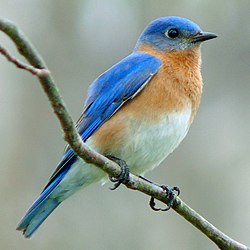
Wikipedia picture of a bluebird
I also took Chris for walks through the eucalyptus trees on Point Pinole on both the Thursday and the Friday. To my delight we saw herons (grey and white), low-flying hawks, jays, junkos, a hummingbird, goldfinches and bluebirds (the first time I've ever seen those) and we picked ripe blackberries by the shore.

We never made it to the Golden Gate Bridge ferry ride we'd planned for Friday, due to trouble with our on-line bookings and the printing of our boarding passes for this flight. The hotel's computer, running a Microsoft OS, kept breaking down and held us up too long to catch the boat. Never mind. It was a satisfying trip, even so.

Wednesday, July 18, 2012

Point Pinole

I have just come back from a 4 mile hike under the eucalyptus trees on Point Pinole, the nearest Regional Park to our hotel; though it cost me $30 in taxi fares to get there and back, it was well worth it. The weather's very fine and warmer, today. The eucalyptus trees were planted in the 1920s as a safety measure to reduce the effects of explosions from the production of dynamite at the plant once situated here.

To go further back in the history of the headland, it used to be where the Native Americans camped on fishing expeditions for crabs and shellfish until they began to die of cholera and smallpox in the 1830s. The Spanish called it the Punta de Concha and Francisco Maria Castro was given the first land grant in this area, raising longhorn cattle and sheep on the grass here, with his residence, the Rancho San Pablo, some way inland. (The part of Richmond where our hotel is situated is still called San Pablo.) Then Irish-American farmers bought the land and in the 1870s a Croatian fishing village established itself. Until World War I this was a popular weekend fishing retreat for wealthy gents from San Francisco.

The explosives manufacturing began in the 1880s, with the powder companies building a shipping wharf at the end of the Point, the remains of which I saw on my hike, next to the pier, which is still there (used now for fishing, again). From here, barges were loaded with dynamite that was carried to freighters and hence exported to the Philippines, to Central and South America and to Alaska. During the first World War, Point Pinole, under the jurisdiction of the Giant Powder Company, had its own railway station, school, bungalows and boarding houses for the explosives workers, many of them women and some of them Chinese; they were given "a privately owned recreation area called Giant Park with a dance hall, saloon, barbecue pits, bocce ball court, playground and picnic gazebos." After the stock market collapsed in 1929 the owner lost his fortune and closed the recreation area.

The Atlas Powder Co. then took over, planted the eucalypts and dismissed the female workers; the only women seen here after this were the so called "Dynamite Dorothys" of World War II.

Very quiet, it was, today, with very few other hikers and the wind blowing in the pale yellow grass and the leaves, the scent of eucalyptus and seaweed wafting over. I saw hawks, jays and goldfinches and a small lizard raised its head at me over a log. The views from the point of cliffs, beaches, marshland and the hills across the Bay were splendid.

Next door to the parking lot is the entrance to a large Detention Centre (prison).

Thought-provoking variety

I took the No. 76 bus from the Hill Top Mall through Richmond to El Cerrito del Norte station; the ride took nearly an hour and took me on an educational tour. Around the hilltop shopping area, which is predominantly extensive parking lots, are cosy, residential streets with irises, roses and palm trees in the small gardens of the bungalows. The bus winds around many street corners to Contra Costa College, a large secondary school complex surrounded by playing fields and Afro-American or Mexican faces. The Mexican people here, the slightly better off, perhaps, all speak Spanish and the girls, elaborately coiffeured, wearing tight patterened leggings and carrying puppies and prettified, pink cellphones, enhance their eyelashes in the bus. There are young mums too, very young, with less time or inclination to apply the makeup. A main thoroughfare through this area is called El Portal and the shops have names like Chico's Market & Meats and Fiesta Latina. Catholic churches abound and there's a big Catholic cemetery, also several casinos and liquor stores. In the Afro areas near the freight rail tracks, are "Missionary" and Baptist churches. I think religion must be what keeps people going here; observed from where I sat, the poverty was very apparent and the black people on the bus were very courteous to one another. I noticed a Foreclosure Help Centre and what looked like a junk yard, with a notice outside saying "Pick 'n Pull--freshest cars in town!" There were several warnings on the streets about a $1000 fine for littering, not a very effective threat, it seems. The houses round here, tiny clapboard shacks, reminded me of the houses on First Nations reservations in Canada; here they have a wealth of morning glory in bloom over their fences. I rode through a Drug Free (I hope) School Zone and passed an elementary school that was shockingly ugly, a sort of concrete warehouse with hardly any windows. However, it had a large poster on its wall promising a renovation job on this building: "Your bond dollars at work."

San Francisco seen from the train on the other side of the bay
The people on the bus were in a friendly mood and I don't think I need have worried about hanging around Richmond Station (though I'd been warned to avoid this area) because it looked renovated too, with quite attractive architecture and a clean concourse. I stayed on the bus a little longer and caught the San Francisco train at El Cerrito, getting out at Montague on Market Street in the heart of downtown. I didn't need to walk far to reach the San Francisco Museum of Modern Art, opposite the Yerba Buena Center for the Arts and Yerba Buena Gardens. I spent a long time on the various levels of the SFMOMA, seeing a wonderful variety of paintings, photographs and sculpture, discovering work by artists from Klee to Kahlo to O'Keefe.


Painting by Miro
The atmosphere in the galleries was serious and studious, with visitors, a young man with pink hair and metal studs, for instance, taking notes and gazing intensely at the exhibits. I learned something about the American abstract artists Mark Rothko and Clyfford Still, Picasso / Dali imitators, and that Philip Guston and Jackson Pollock had been teenaged school friends in LA. Their early style, under the influence of the European surrealists, was classified as Abstract Expressionism. I learned that Frida Kahlo and Diego Rivera had lived in San Francisco for a year and a half in the 1930s; the Mexican gallery had some striking canvasses, including a close up of faces of Mexican soldiers (Zapatistas) in sombreros, carrying guns. There was also a significant painting of a revolver placed on a bare window sill: The Window, by Tamayo. A less disturbing pair of paintings by Rivera depicted flower carriers and tortilla makers, monumental peasant figures.
Portrait by Matisse

I found some of my favourite European artists again, a semi abstract painting of mountains (Gebirge) by Marc, several Matisse portraits and scenes from the 1900s and a shiny bronze sculpture by Brancusi: La negresse blonde, whose pursed lips made her look like a fish. Luckily I was allowed to take photos on my way round the collection, which is an unusual pleasure these days.

Special temporary exhibitions featured the structures created by Buckminster Fuller, a series of rooms of Cindy Sherman photos (I don't like these--they do reveal something about the USA though) and a documentary collection of sketches and information relating to the invention of the XO laptop computer that's been designed for school children in the developing world; the photos showed them being used in Rwanda, Afghanistan, Peru and Uruguay.

After the art, I shopped for stamps in Macy's, walked across Union Square, climbed the steep hill on Powell Street with tourists hanging on to the ancient streetcars on their way up and down, passed the Ritz, the Intercontinental and other posh hotels at the top and started walking down the other side of the hill with a view of the water again, turning right to come through China Town on my way back to the BART station. The journeys to and from the city took me nearly 2 hours each way, so I had to keep my eye on the clock.

After the meal at Fonda's, photo by Hasnat Aqil
For the last two evenings we've been driven out to supper by Chris' QNX colleague who's the field engineer in this area. On Monday night we ate at the Ajanta Indian restaurant on Solano Avenue in Albany and last night we returned to Solano Avenue to eat at Fonda's, a tapas meal. Both meals were excellent, and the diners at these places very, very different from the people whose lives I'd glimpsed in Richmond. The little bungalows in Albany sell for a million dollars or more; obviously, it's the location that one pays for.