blending an assortment of thoughts and experiences for my friends, relations and kindred spirit

blending an assortment of thoughts and experiences for my friends, relations and kindred spirit
By Alison Hobbs, blending a mixture of thoughts and experiences for friends, relations and kindred spirits.

Saturday, March 23, 2013

A Nowruz table

I learned something this week; it was the Iranian New Year. A much more appropriate time of year than ours, with the days lengthening and the sky brightening. Nowruz, or No-rooz, occurs at the Equinox, and is full of symbolism. It is a Zoroastrian festival.

If I hadn't noticed the table in Jack's apartment (Chris' singing teacher) and if I hadn't asked why it was so beautifully decorated, I'd never have found out. Jack lives at the home of an Iranian lady who for this occasion had cleaned the place from floor to ceiling, as is traditional. Another custom, apparently, is to buy new clothes to wear on New Year's Day. It's all about a fresh start.

The "Haft Seen" table was laid with a red, embroidered cloth, on which a remarkable collection of objects was assembled, among which were:
  • 3 tall white candles, lit
  • a bowl of apples
  • a bowl of oranges swimming in water
  • a dragon fruit in a glass jar
  • a pot of green grass, sprouting seeds
  • silver dishes containing home made sweets
  • a garlic head and a couple of coins on another dish
  • a bowl of coloured eggs
  • white hyacinths
  • white tulips in a tall vase
  • a carafe of water (or perhaps vinegar)
  • a blue lamp
  • a small cup of red spices
  • a mirror on a stand, resting on pile of Persian poetry books
The importance of these items is explained on this page.


Sunday, March 17, 2013

Italian supper, and not a strand of spaghetti in sight!

Gianluca, our Italian friend, cooked for nine of us a casa con Nicola e Maha, yesterday evening, and it wasn't just a snack supper. We arrived at 6pm and left well after midnight, after six courses which I'll describe below. By 10pm, we hadn't reached the main course yet, and though I don't normally make a habit of eating so late, this meal was taken at such a leisurely pace that it was thoroughly digestible and Chris and I slept very well afterwards (after a brisk walk home at -20ºC under a starry sky... maybe that helped too).

Gianluca, with Maha's help, had been planning the menu and shopping for the ingredients all week. In the kitchen he was assisted by Dan and Nicola. It was such a noble production that I kept thinking of the film Babette's Feast!

We guests, Chris and I, Michael, Steve and Mary, were settled into the living room to snack on olives, walnuts and crackers, washed down with glasses of wine, while the preparations took place in the kitchen. The three cats and the turtle in its tank kept us company. Then we were summoned to the table for the four antipasti:

Bruschetta with strips of roasted peppers.
Quails' eggs garnished with truffles.
Prosciutto crudo with slices of pear.
Deep fried strips of zucchini rolled in flour.

After a decent interval we went on to the most filling (perhaps I ought to say sustaining) part of the meal, the risotto. I'm not certain of my Italian here but I think I ought to write risotti, because there were five different sorts, arranged on one plate, in balls:

A green risotto flavoured with asparagus.
A mushroom risotto, brown.
A pale yellow, saffron risotto.
A pink risotto flavoured with strawberries and onions, tasting quite sweet!
A white risotto with pink peppercorns.

Then came the main course, the veal in a white sauce containing tuna and anchovies, decorated with capers. This came with slices of potato garnished with parsley. In between courses, by the way, we talked about poetry and kitsch, but not at the same time. Steve and Mary had given Nicola a glow-in-the-dark Madonna after their visit to Spain, and to much merriment, she was brought out for a "show and tell." I was disappointed that she didn't walk across the table, though. We browsed through some of Nicola's books that lined three walls of the dining room and Mary wanted us to try making shadow puppets with our fingers, but none of us was up to it. We "found Waldo" in the children's book, from time to time.

A salad followed, a delicious combination of arugula leaves, fresh heart of artichoke petals, and cherry tomatoes in a balsamic dressing. I liked the texture of the artichokes––I thought they were sliced almonds.

We had two desserts! The first was a generous slice of tiramisu, cooked in a huge, rectangular baking pan and sprinkled all over with cinnamon. The final course, our second dessert, was a tall glass of asti spumanti with a dollop of lemon sorbet within.

Compliments to the master chef, and thanks to all the company for a super evening!

Tuesday, March 12, 2013

A children's champion

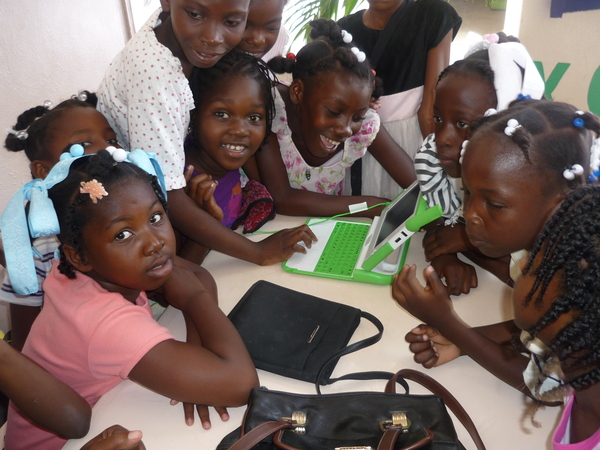
Wikipedia photo of Haitian school girls
Landon Pearson, whom I heard speak at the event mentioned in my previous blog post, is "only 82 years old." She is known in Canada as the Senator for Children, having served in the Senate from 1994 to 2005. Mrs. Pearson has 5 children, and twelve grandchildren. She is the daughter-in-law of Lester Pearson, the Nobel Peace Prize winner.

Her father, she said, was her "most significant driver"––she had a privileged upbringing, growing up unaware of other people's struggles. She comments that one's education can be narrow and is always culturally biassed. Today however, the outside world penetrates more readily, so adolescents now see different male and female stereotypes.

Married to Lester Pearson's son Geoffrey, a diplomat, she lived in India for a while and got involved in educating poor children of migrant workers in India,setting up crêches for them, for example on the construction site of the new Canadian High Commission in New Delhi.

As a delegate to the Fourth World Conference on Women in Beijing, September 1995 she advocated the right to an education free from discrimination. She insists that education must be based on a child's rights. Primary education should be compulsory and higher education accessible to all. The challenge of implementing this is more cultural than economic, the problems compounded by natural disasters. But in Haiti there is more schooling now than there was before the earthquake. Speaking of girls, in certain parts of the world, such as Niger, too much child marriage is still taking place.

Our job now, she said, speaking to a room full of grandmothers, is to support our idealistic grandchildren.

Sunday, March 10, 2013

Songs with messages

Since I qualify as an International Woman, I went to an International Women's Day event last week on the theme of educating girls and empowering women. The entertainment was musical, some parts of it more stirring than others. In the early 20th century there had been plenty of evangelism by women of G.B. Shaw's Major Barbara stamp, keeping their minds fixed on what they wanted with the aid of songs like Bread and Roses:

[...] As we go marching, marching, we bring the greater days,
The rising of the women means the rising of the race.
No more the drudge and idler, ten that toil where one reposes,
But a sharing of life's glories: Bread and roses, bread and roses.
The Bread and Roses processional was repeated last week by a group of older ladies from Kanata in red T-shirts, eight of them wielding guitars. In the glory days there was a point to this song, female workers having to put in 54 hours a week at the factories without fair pay. The need for protest is less obvious now, unless you happen to live in more challenging parts of the world than Canada.

Keep your eyes on the Prize, hold on! continued the ladies of Kanata (and the one who was their leader extemporised, "... and get in the groove!"). That one was a civil rights liberation song from the '50s and 60s. We were all a lot younger then, of course, as was Bob Dylan, whose Blowin' in the Wind we all joined in with next, the only song of the evening that I knew, a picture of the young Mr. Dylan for inspiration alongside the words on the big screen. It was in much too low a key for me.

One song was by an environmentalist who calls herself Earth Mama, purporting to heal the planet one song at a time; it didn't grab me at all.
I am standing on the shoulders of the ones who came before me [...]
And my shoulders will be there to hold the ones who follow me.
Do these platitudes ever do any good? Reverting to the 1960s we finished with Walt Disney's excruciating tune and lyrics It's A Small World––notre monde est tout petit (en français).

Then followed a change of atmosphere, the Cantiamo Girls' Choir of Ottawa coming forward in elegant long dresses. They began by performing "I dreamed of rain" by Jan Garrett, followed by a Hebrew part song and then the setting of Jack Layton's Letter to Young Canadians by James Wright that I'd heard sung at the City Hall last summer, accompanied by the Orkidstra. This is genuinely moving.


My friends, love is better than anger. Hope is better than fear. Optimism is better than despair. So let us be loving, hopeful and optimistic. And we’ll change the world.
 
The last two items impressed me: the accompanist's own composition, an experimental setting of the Irish folksong Maid on the Shore and another inspirational number composed by Gwyneth Walker, called The Tree of Peace, with the almost obsessive refrain, "Listen to one another, listen to one another..." (such an important command), "...Then shall the shackles fall!" That's right, and good to have impregnated into the minds of young women at that impressionable age.

Here they are singing it.

Saturday, March 9, 2013

Seen in Bristol

February 7th, 2013

St. Mark's (The Lord Mayor's) Chapel at the bottom of the hill on Park Street was full of interesting decorations, including fan vaulting in the ceiling. The misericord carvings on the choir stalls included the head of a Green Man and, what seemed to be the head of an African, not a man of Somerset origin anyhow. There were 16th century Spanish floor tiles in front of the altar and, in the Poyntz Chapel to the south side, German stained glass panels in the windows.

Poyntz or Poins means fist, like the French poing. Sir Robert Poyntz was a friend of Henry VIII.

One of the tombs had the stone carving of a family on it. The husband and wife (who died very young) were gazing at one another with clasped hands. The wife held a baby in her arms.

The Green Man misericord carving


Spanish tiles

Jesus and the Elders in the Temple

St. Anne and St. Mary teaching Jesus to read

Jonah and the Whale


I'd intended to make a very brief, in-and-out visit to this chapel, but by the time I left it, half an hour had gone by!

Other time-consuming distractions on Park Street are such places as a music shop full of ukulelis and tin flutes, the owner being a folk music specialist, and a bookshop selling £2 books, some of those very good value indeed, but on my way to the top of the hill I took a detour onto Brandon Hill, the steeply sloping park around the Cabot Tower, which is a 19th century lookout and landmark more than 30m high. The plaque says:
This tower was erected by public subscription in the 61st year of the reign of Queen Victoria to commemorate the fourth centenary of the discovery of the continent of North America, on the 24th of June 1497, by John Cabot. Who sailed from this port in the Bristol ship Matthew, with a Bristol crew, under letters patent granted by King Henry VII to that navigator and his sons Lewis, Sebastian and Sanctus
There are good views from there across the Avon valley and a large tree planted by King Edward VII in 1902.

In the Bristol Museum and Art Gallery, next to the University entrance on Park Street, I found some French Impressionists, Ming vases, stuffed animals including some from Australia and the skeleton of a prehistoric elk, looking like a moose. A painting by Ravilious of a tennis game caught my eye as did one of Winifred Nicholson's children looking sad on the Isle of Wight after their father had left them. A box kite aircraft was suspended from the domed ceiling of the museum, once used as a prop in the film Those Magnificent Men In Their Flying Machines (1965).

Inside the Bristol Museum


Monday, March 4, 2013

Spam comments

I have to reject a score of anonymous comments on my blogposts every day. My posts appear to be targeted at random. Interspersed with links to websites of the writers' choosing, for whatever reason (which I don't feel like investigating), most comments are utter gibberish, computer generated, most likely. Does Mr. or Ms. Anonymous search for key words in my blog? The latest nuisance, for example, purporting to be a comment on a post I published about clothes, says the following:
The dining area also converts to a further double by dropping the table, there is storage under the dining seats [...] prom dress uk [...] bgtbugml It is to God's Glory, through the redeeming love of Jesus Christ, that I dedicate this website. tizasziu [...]
Well that, for what it is worth, contains some curious juxtapositions, does it not? I left out the pesky weblinks.

Wednesday, February 6, 2013

In Cardiff, Bristol, Cardiff, Bristol, Cardiff ...

Park Street, Bristol
We're hopping back and forth.

Chris is at the 21st Safety-critical Systems Symposium here at the Bristol Marriott Royal, taking copious notes as he listens to the talks (on Day 3, tomorrow morning, he gives one) and I, as usual, am along for the ride. This evening he is at the conference Banquet, listening to a speech by the Hon. Sir Charles Haddon-Cave, QC, who told the uncomfortable truth about the tragic Nimrod case, calling it "a story of incompetence, complacency and cynicism," and who is consequently one of Chris' heroes. Instead of sharing the Banquet, I have just had a French supper for one at the Café Rouge, which in my own way I probably appreciated just as much, contentedly reading the Ottawa author Mark Frutkin's memoirs of a draft resister, "Erratic North," between courses and sips of red wine, and watching the people go by up the hill (Park Street) towards the university.

Inside the Wills Memorial
tower, on Park Street
Cardiff, at the weekend, was our first stop on this trip, because one of the reasons for flying over was to spend some more time with Mum. We also spent what's called quality time with Faith, Mel, Rhiannon, Justin and the baby Phoenix (visiting from Oxford) on Sunday, a low cloud day in Gwaelod-y-Garth. I saw the primroses and cyclamens in Faith's garden, though. Monday was far brighter, which meant that Mum could show Chris and me a favourite walk of hers on the edge of Whitchurch, to a bird hide by the canal. "It's like real country," she said. The expert watchers in the hide reported spotting a kingfisher, a snipe and a bittern, but we saw mostly robins, chaffinches, bluetits, coaltits (which are the same as chickadees, if you ask me), blackbirds, thrushes and mallard ducks. We had a good lunch in a Whitchurch eatery called Deli-a-go-go, which I mention here to remind myself that we ought to go-go there again when we can-can.

Monday evening, Chris and I took the train to Bristol, exploring the vicinity of the hotel after dark when it was mild enough to sit on a bench and look at the boats on the water, not something we can do in Ottawa at this time of year. We went for a walk up and down the hill as well, which walk I repeated yesterday (Tuesday) in the company of Faith, with a day return ticket from Cardiff, and her friend Ben, who lives in Bristol. We found the Clifton suspension bridge, near which Ben encouraged me to pick up a leaflet that proved most interesting, about the remains of a 500ft long cliff railway, presently being restored, that had been built inside the Clifton Rocks in 1891. The construction was quite ingenious.
If the lower car was heavier than the top car, water was allowed to flow into a tank underneath the top car until it was heavier than the lower car. Water had to be recycled from the bottom station constantly, as there was not a continuous supply at the top station. A Crossley gas engine pumped the water from a reservoir at the bottom station, some 230 feet to the top station.
I K Brunel's suspension bridge, spanning the Avon Gorge
After the train ceased operating in 1934, the tunnel's history became even more interesting. During World War 2 (when the port of Bristol was heavily bombed) it was used as a rehearsal space for the BBC Symphony Orchestra, conducted by Sir Adrian Boult, as a transmitting station for the BBC and as the BOAC's head office and as a workshop for barrage balloon repairs. Not only that, the central section of the tunnel became a shelter for civilians during air raids. Via the Royal York Crescent and other terraced cliff top streets, and through a picturesque little old cemetery, we also found some grassy parks at the top of Clifton hill with satisfying views of the bridge and the gorge.

Old cemetery near Victoria Square, Bristol
Detail on a gravestone
In the evening Chris and his two QNX colleagues Michael and Gary let me join them for supper at the Za Za Bazaar, an all-you-can eat place on the edge of the marina.

Today, I used a Bristol-Cardiff day return to meet Mum again, doing some shopping in Cardiff and taking a stroll through the old Arcades and past the snowdrops in Bute Park, the daffodils and magnolia trees not quite in flower yet. To my delight, in the chilly north wind, it was another fine, bright day.

I took the opportunity to participate in Evensong at the Cathedral, as I did this time last year, not once but twice, this time round, sitting in the "Quire" stalls on successive evenings, once on the south side, once on the north, hearing / watching both the girls' choir and the boys' choir sing under the carved stone arches. I listened to settings of the Magnificat and Nunc Dimittis by Moeran and Ridout, responses by Piccolo and Nixon, and anthems by SS Wesley and Holman. At this evening's service I joined in the Isaac Watts hymn O God Our Help In Ages Past (fine words), but I didn't know and can't remember the hymn I sang yesterday. I heard readings from Isiah, about the Beautiful Feet of them that preach the Gospel of Peace, and the passage about scapegoats and the Man of Sorrows, who is acquainted with grief. There was a tremendous pillar-shaking organ voluntary, which I haven't been able to identify, at the end of yesterday's service.

Bristol Cathedral

Tomorrow, once the conference is over, Chris and I return to Cardiff for the night.