blending an assortment of thoughts and experiences for my friends, relations and kindred spirit

blending an assortment of thoughts and experiences for my friends, relations and kindred spirit
By Alison Hobbs, blending a mixture of thoughts and experiences for friends, relations and kindred spirits.
Showing posts with label Australia. Show all posts

Saturday, January 11, 2014

Still remembering the beaches

Back to November 26th, 2013, which was the day we drove with George to Dee Why. Our time in Australia was running out; three days later we flew reluctantly back to winter in the northern hemisphere, but while we could, we revelled in that sunny day.

Dee Why beach is in the next bay up the coast from Curl Curl (which reputedly has less seaweed). The Australians chose unforgettable place names. We parked in the only available parking space on Oaks Avenue off the Pittwater Road, up a small cliff, where there was a tempting view:


Next to the oceanside pool were stone walled changing rooms; we wasted no time in getting our togs (as Chris calls them) off and our swimsuits on, and walked along to the sandy part of the shore, where parties of school kids were having surfing lessons:


That morning, the waves were perfect for this activity, though you had to watch out for the currents and know what you were doing. The back flow of the breaking waves had a powerful tug.


Chris and George stayed in the water for some time. I was more wary, hesitant to go out of my depth in case the currents and waves proved too strong for me. It was fun, but there was easier swimming to be had back at the rock pool, not at all crowded. I shared it with an elderly lady swimming freestyle and a family with a few months' old baby ... The photo below is now the backdrop on my computer screen! The dark shadows under the surface were patches of seaweed, rather than sharks.


Beyond the enclosing wall of the pool, the creamy surf tumbled and roared.


Before we left the beach to drive back to Marsfield we had time to sit under the parasols at a seafront café and enjoy a lunch of fish and chips.


Wednesday, January 1, 2014

Remembering the beaches!

The sky is blue outside on this New Year's Day but the air is cold in the extreme: "feels like -28ºC" at midday. Overnight it's forecast to feel like -38. This, I think, is a good day to recall November last year, when we were on Sydney's northern beaches, acquiring a suntan that still hasn't quite faded.

November 19th, 2013


Barrenjoey Headland and beach, ocean side
It was a 45 minute drive to Palm Beach, down a series of wide roads––skirting the Ku-Ring-Gai Chase National Park along Lane Cove Road, and past an extraordinary Baha'i temple at the top of the hill along Mona Vale Road, then along Barrenjoey Road. George drove, helped by the GPS map with Chris at its controls and I as back seat driver using the conventional street map for backup and confirmation. In case you wonder about the name Barrenjoey: in 1788, Captain (later Admiral) Arthur Phillip of the British Royal Navy, first Governor of New South Wales, he who founded Sydney, had named the headland at our destination "Barrenjuee" (i.e. little kangaroo or wallaby).

Pittwater estuary, Barrenjoey
Palm Beach is on an isthmus or "tombolo" with sandy beaches on either side. The Pittwater estuary on the western side has seaplanes, yachts and pleasure boats moored on it, and we walked along the sand there first, the water silky, clear and inviting, overtaking someone's blond puppy called Mango and buying icecreams at an old fashioned icecream parlour still with 1950s coke adverts on its walls.

Nice view through the wing mirror
 The eastern side of the isthmus has equally inviting, rolling waves. We parked in the shade under the Norfolk pines that grow by the shore. I swam first on my own in a salty rockpool bath beside the concrete changing rooms under the cliff, then with Chris and George in the breakers themselves, staying in the area between the flags in case of rip currents. The waves were small enough to enjoy diving through them as they broke over us, nothing too alarming. To keep watch over clothes and valuables we had to take turns to swim two at a time; none of us wanted to come out of the water though, once in.

After lunch George recommended we climb the Barrenjoey Headland up a path that was mostly steps, Smugglers Way. Half way up this hill, blackened by a bushfire so recent (end of September) that we could still detect the smell of burning, George went and sat cross-legged below an overhang in the mouth of a small pockmarked sandstone cave. From the Gledhill Lookout at the top where the Barrenjoey lighthouse was, we could enjoy a panorama of the mouth of the Hawkesbury River, Lion Island and the headlands to the north. Whales come this way on their migrations, but this wasn't the right season for spotting them.

Looking back the way we'd come we had another good view of the beaches and spit of sand with a path through the Dunes. We descended on a steep jeep track and walked in this red sand but it was none too easy going. It would make for good ankle and calf strengthening if you attempted this walk every day. A more relaxing way of passing the time on another occasion might be to take one of the ferries (Scenic Cruises) to Bobbin Head or Patonga or somewhere like that.

Wikimedia panorama from the Gledhill Lookout

View of Palm Beach from Barrenjoey Headland


We were game for a further walk at dusk that day, beyond the end of Vimiera Road down and up again through Lane Cove, to the creek and back.

Those were the days! Hardly more than a month ago, but distant now.

A month later, near Ottawa


Friday, December 13, 2013

The artists of New South Wales

What do you do if you want to understand a nation better? Sitting in a café and watching people interact is one way, or walking round the residential areas to make further observations, or riding on the slow, suburban trains, ditto, but the most direct way to the heart of things is to read their novels and stories (I bought a copy of Tim Winton's The Turning when I was in Australia, for that very purpose) or to see what they have painted and drawn.

On Sunday 17th November we had a walk before breakfast through the Lane Cove park and on our way back up the hill saw two wallabies in the wild, a mother and a young one. They were either swamp wallabies or rock wallabies, I'm not sure, but when they sat still they were well camouflaged against the sandstone outcrops. Then it started to rain heavily again, so we decided to go into town by train from Macquarie University in order to visit the Art Gallery of New South Wales. The picture above shows it in sunnier weather a few days beforehand.

We have visited this place before. It hasn't changed; it's still marvellous ... and free, and very popular. Other countries can take a lesson from that.

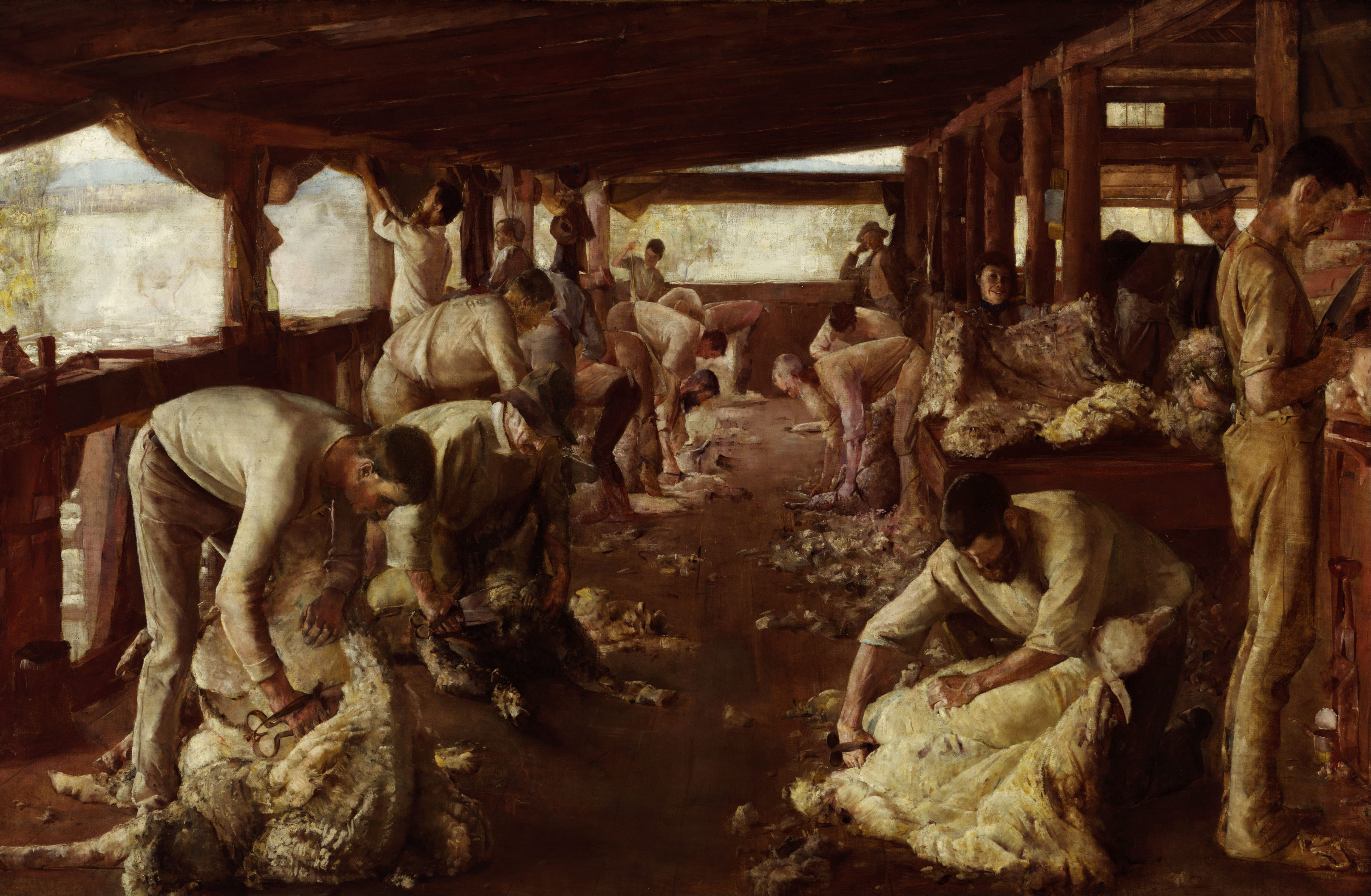
The Golden Fleece
Once inside Chris and I made arrangements to meet at a central point in an hour's time, and went off to explore in separate directions because we are interested in different things. I made a leisurely tour of the Victorians before homing in on the art that really grabs me, the mid-20th century canvasses. It's not surprising that the early Australian art is really homesick British art or documentary in style. There were paintings of settlers receiving letters from "home" in a "distant land," one portrait by Gordon Coutts of a decorously posed girl in a pink dress sitting in an outback railway station (the model actually posed in a studio and the background was added later)––this was entitled "Waiting"––and several large canvases depicting the NSW scenery, the creeks and beaches, the sheep shearers (Tom Roberts' "The Golden Fleece", 1891) and the gold prospectors. "Bailed Up" (1895) was another big painting by Roberts depicting an encounter with highwaymen in the outback. All somehow noble and grand. The artists who came fresh off the boat to this country were full of enthusiasm for it: "Sydney is an artist's city," said Arthur Streeton, "––glorious!"

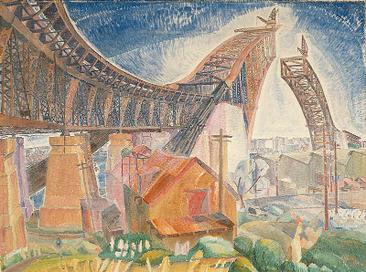
The bridge in curve,
G. Cossington Smith (1926)
The next generation of Australian artists are the ones who impress me, their styles changing as they developed, Roy de Maistre in particular (he was the mentor/ close friend / platonic lover of the novelist Patrick White, whose books have a powerful effect on me, too); on this visit I was also struck by the versatility and forcefulness of a woman artist, Grace Cossington Smith––The sock knitter (1915), Bonfire in the bush (1937), etc.

The Aunt
Roy de Maistre works that I want to remember:
The boat sheds in violet red key (1919), an example of "colour music"
Rhythmic composition in yellow green minor (1919) (ditto)
Botanical Gardens, Sydney (1918)
The red boat (1934)
Deposition (1952)––crucifixion picture, a masterpiece!
Figure in a garden (The Aunt) (1945)–– this faceless figure inspired Patrick White's novel "The Aunt's Story."

Then came the idiosyncratic school the 1930s to '50s painters: Arthur Murch, William Dobell, Margaret Olley, Russell Drysdale, Arthur Boyd, visionaries all. The famous Sydney Nolan is in a class by himself!

(I'll add more to this blogpost when I have time.)


Saturday, November 23, 2013

On the lagoon at Narrabeen

(Friday, November 15th)


With George's car at our disposal, we drove along the Pacific Highway and other highways through Chatswood to Narrabeen. The roads in and around Sydney always seem very busy, whether or not it's the rush hour, but there was a pretty stretch of the Lane Cove / Mona Vale Road that wound up and down through the Bush and crossed a ravine; then we started to catch glimpses of the Tasman Sea (Pacific Ocean) through the eucalyptus branches and beyond the tiled roofs and palm trees. The last stretch of road skirted the Narrabeen Lagoon. From the car park by the shops we could walk on the other side of that lagoon to a place that rented kayaks and other watercraft, such as paddle boards for standing on. Chris and I took a double kayak, left our shoes and valuables with the man at the desk, we set off to circumnavigate the island at the business end of the lagoon, getting increasingly wet from the drips off our paddles. Later, someone told us we'd have got less wet had we paddled more vigorously, but we preferred to drift slowly along and look for wildlife.

The water was clear. We saw fantails, a white-faced heron, cockatoos, ducks and a few fish. No jellyfish. On the shore of the island were tiny sandy beaches framed with palm trees.

After our kayak ride, we walked over the hump of land where Narrabeen's houses are, and had our first proper view of the sea, with rolling breakers and miles of sand, morning glory and yellow sea flowers (climbing guinea flowers?) growing in the dunes. There were no shops or lifeguard stations here, so this beach was fairly deserted. I don't know whether or not it would have been safe to swim here.

For lunch we discovered a really good South Indian curry place on the main road, that opened just for us, when they saw us coming.

Monday, November 4, 2013

Relevant numbers

We're flying from Ottawa to Vancouver on Thursday, in order to continue travelling from there across the Pacific Ocean (from Friday night to Sunday morning, over the International Date Line), to visit our youngest grandson and his parents. Here are the numbers to bear in mind:
The flight distance from Vancouver International Airport to Sydney Kingsford Smith International Airport is 7777 miles (12515 kilometres, 6758 nautical miles).
Estimated flight duration, 15h 13min.
Time difference between Vancouver and Sydney, 19 Hours.