blending an assortment of thoughts and experiences for my friends, relations and kindred spirit

blending an assortment of thoughts and experiences for my friends, relations and kindred spirit
By Alison Hobbs, blending a mixture of thoughts and experiences for friends, relations and kindred spirits.
Showing posts with label Beihai Park. Show all posts

Sunday, May 24, 2015

Back to Beihai Park, on my own

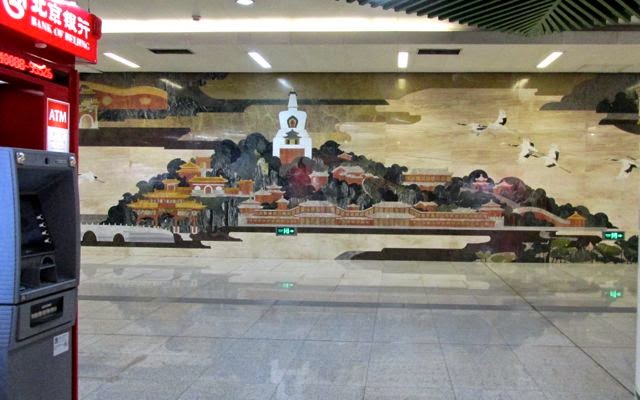
Mural and ATM at Beihai Bei underground station
Written May 12th, 2015

Chris went to work today, met by 3 young men in the lobby at 8:30am who accompanied him to the large, white Science building on foot. The day was cool, but rapidly warming up. Half an hour later, I set out myself, solo this time, and headed to Xizhimen zhan, the tube station, over the dangerous pedestrian crossings. I tried getting cash from an ATM but my card was rejected, probably because I tapped in the wrong PIN--some keypads are differently configured here. Then I also made the mistake of going through the security check at the entrance to the trains before buying my ticket (Everyone has their bags scanned, and in other places, the ticket machines are beyond this hurdle.). In my rudimentary Chinese, I had to explain to the security guard I'd have to repeat the procedure, but like most people in Beijing he smiled at me, mei guanxi, no problem. I was returning to Beihai Park, because I hadn't seen it all yet and thought it would merit a second visit. This time though, I took a far easier route to get there: Line 4 to Ping'anli, 2 stops, transfer to Line 6, 1 stop, and out at Beihai Bei zhan, which was almost diagonally opposite from the North Gate of the park. On the northern side of the road is the entrance to the “Hutongs” (old alleyways) near Qianhai lake which we'd visited in 2011 with our daughter-in-law-to-be, Sha.


Mudan
For my son George, Beihai Lake is his favourite spot in Beijing, and I can see why. Having seen the western side twice yesterday and ridden on the boat with Chris, no need for repetition; today I walked around the eastern side, which seemed even more attractive. Perhaps because it was sunnier, there were more people around, all of them looking blissfully happy, unless I was much mistaken. Singers, dancers and professional or would-be musicians were everywhere, taking advantage of this shadier side of the lake to keep cool, some of the dancers dressed up in clothes they'd packed for the purpose. The character of the people seems childlike; these were often men and women my age. No doubt they think the exercise is good for them besides. One of the dressed-up older ladies had a false moustache--she seemed to be acting a part in a dramatic scene and her troupe had attracted a large audience of all age. I snapped away with my camera, then joined the flow of pedestrians once more. Sometimes I followed the lakeside path, which was quieter than the main one. I passed many rose beds and a glorious mudanyuan, peony garden, in full bloom. (The mudan is the national flower of China.) Fish ponds are popular too.

Teaching their grandson to fish, in Beihai Park
This park, which has been here in some form or other since the 12th century, is highly landscaped, with rocks positioned vertically on the hillsides, perhaps to represent mountains. These carefully chosen rocks are cemented together and criss-crossed with rocky steps, great fun to explore. Away from the lakeside are hidden grottos with small pavilions where the Imperial family and courtiers used to gather for relaxation––feasts and story telling––very much as described in Dream of the Red Chamber (石头记), "permeated by an atmosphere of exquisite refinement" as the plaque put it, but absolutely out of bounds to commoners in those days. I began to have an inkling of what prompted the communist revolution: it can't have seemed fair to keep such things for the nobility alone. Now all can come and enjoy themselves here, young couples can smooch in the pavilions and older ones can bring their children, buy flasks of bubble mixture for them to play with or, like the grandparents I observed for a while, teach a very small boy to fish in a pond (“dangerous for drowning”).

Communist sculpture in Beihai Park
Bridge to the island
You pass public conveniences at every few 200 metres and a few of them even provide a special “Potty toilet” in case those usual holes in the ground are too intimidating. What you have to remember is that you need to help yourself (adequately) from the toilet paper dispenser before entering.

I crossed the arched, hump-backed stone bridges and near some lotus ponds came to the Jade Islet with its 17th century white pagoda or "Dagoba" at the top of the steep hill, some 160 steps up. There was an extra charge to see it at close quarters so I contented myself by looking at the views from the lookout points, could make out the three unmistakable skyscrapers with their curved tops where Xizhimen is, Beijing's TV tower, and many traditional-looking roofs in the near distance. At close quarters, their eaves are decorated with symbolic rows of dragons and Imperial personages. Back at lake level I walked right round the island, on one side of which is a long, curved outdoor corridor with red pillars, its ceiling painted very thoroughly and beautifully with flowers, birds, landscapes and story pictures. Pity I don't know the stories!

In the long corridor

In the long corridor, detail

The corridor is a place to take a rest
"Qiong dao chun yin"
On the shore of the island is a "stele," a carved stone erected in 1751 to display Emperor Qianlong's description of the spot: qiong dao chun yin, which means "jade island in spring shade." It's one of those four-character poems that typify Chinese thought. On the other sides of the erection are longer poems by the Emperor, to be read from top to bottom, and it has a relief of mythical figures round its base.

I sat on a stone step--the benches being fully occupied--to eat an improvised picnic from what I'd found in a supermarket this morning, including a tub of yoghurt with integral spoon. Dairy products are generally not so popular, but the Chinese do seem to like yoghurt. I'd failed to find any cheese; they prefer tofu. Then I slowly retraced my steps to the North Gate, leaving the cacophony behind (one man on a saxophone was teaching his fellows to play Auld Lang Syne ... over and over again) and the gentleman with his spinning top on a string, and the park's cats, sparrows, swallows and magpies, for the cacophony of the traffic on the street beyond the wall.

We'd walked so far yesterday that today my knees had started to hurt; I decided to take the tubes back “home” with a long stop at the Costa Coffee shop on the way and this time did manage to withdraw some more cash from an ATM at Beihai Bei station. In the mall, I also managed to locate the restaurant called "Tasty" whose advert Chris had noticed yesterday and where we ate tonight: steak and salmon, served in a very posh way, with a bread basket, vegetables, fruit tea, beer for Chris and desserts for us both, this whole meal costing the equivalent of a light weekend brunch in Ottawa, about $30. And they don't expect any tips.

Chris, having had a demanding but apparently satisfying day working with intelligent people at the university is in bed, fast asleep, as I type this. It's not yet 9:30pm.

Friday, May 22, 2015

Day 2 in Beijing: in Beihai Park

An Imperial Couple
Written May 11th, 2015

We both woke up at about 3:30am and I don't think I slept after that. At daybreak I read some further chapters of The 100-year-old man who climbed out the window and Disappeared, highly entertaining. After the hotel breakfast (I tried the toast and marmelade spread with a spoon, this time) we walked to the Xizhimen station for more, at a Starbucks, while the rush hour crowds diminished. How North American of us! The strong coffee woke me up. The sky got clearer and clearer as the day went by, although storm clouds came and went, and in the boat (see below), I donned my plastic disposable mac to keep some rain off.

We used up time and footsteps orienting ourselves around Xizhimen station, fairly adjacent to the Beijing Bei railway station, but had to go round plenty of corners and run the gauntlet of ticket touts trying to sell us exorbitant fares to Badaling where the Great Wall is. The police force was checking everyone at the entrance to the station so we went no further. I failed to find a kiosk selling sim-cards for my phone and began to wonder how I'd manage to do so before tomorrow, when Chris and I will be leading separate lives in the city, he at work, I exploring. Eventually we bought tickets for the underground at the easy-to-follow machine, for ¥3 each. The underground itself is also easy to use with directions in English everywhere and recorded announcements in English on the train as well. The British girl who got that commission did a good job. Having studied the map I thought we could walk from Xidan station to the Nan Hai and Zhong Hai lakes, then from there to the famous Beihai Lake park.

Along the long, red wall (Fuyou Street)
At the exit from Xidan station we were obviously in the big city centre, with imposing buildings all around us, and very wide roads. At first, not sure of the direction we'd need to take, we asked a girl the way to the parks and she confusingly said we'd have to walk for about 40 minutes in a direction I felt pretty certain was wrong, so I ignored her advice. The Nanhai lake looked much closer than that on my map. She was right, though. What I hadn't realised was that the first two of those three lakes were hidden within a high-security compound, surrounded by a long, high wall, painted red. I don't know who lived there *, but there were soldiers at every corner. We were waved through the first check, being foreigners, therefore no threat, but other people were being prevented from continuing along the pavement; there was a barrier to continuing along Xichang'an Jie on the northern side (the southern side, where a concert hall was, seemed miles away), and as we turned the corner down Fuyou Street, following the red wall for about a mile, people who got off at the bus stops were having their bags searched. Wow! There was a fence between the pavement (sidewalk) and the road, to stop cars from dropping people off. I could see from the map that we had no choice but to keep going in order to reach Beihai Park, in spite of Chris' blister from walking too far in wet feet the previous day and not having replaced his old shoes before we left Ottawa.**

In Beihai Park, near the South Gate
Near the North Gate of Beihai Park

At the Nine-Dragon Screen
Beihai Park was worth the effort: it costs ¥10 to get in and is lovely, with willow trees round the edge of the lake and roses everywhere, very reminiscent of West Lakein Hangzhou. The morning crowd consisted of elderly couples and young parents with their children, the mothers with their own mothers assisting, of course, as is the Chinese way. Groups of people and individuals were singing or carrying portable music; at the other end of the lake we found a group dancing. I like these habits! The birds were singing too. The pavilions where we sat "were built in 1602 during the Ming Dynasty and are connected by zigzagging bridges. In the old days the Emperor and his consorts came here to fish, watch fireworks or admire the moon." These days you can hire little electric boats here, so after lunch we did that too, for an hour on the water. The man in charge of the place were we had our outdoor lunch spoke English and served quasi-European food. I ate a bacon pizza and Chris had a plate of Kung Pao chicken with knife and fork provided! After we'd seen the “Nine-Dragon Screen” in one of the side gardens we went into a shop and were conned into wearing Imperial robes by a very pushy saleswoman while her assistant took embarrassing photos of us, the Chinese crowd looking on with much amusement. She wanted to charge me ¥50 for 5 prints but I refused––tai gui le!––too expensive. I haggled the price down by a third but had still been conned. Never mind, ones lives and learns. I think I earned some respect for the haggling, and we have the photos for a momento.


In Beihai Park, where we had lunch
You can find numerous public conveniences in China's parks and gardens, so no worries there, except that they're usually just holes in the ground for squatting over (Chinese people are better balanced while squatting than we are), and the translated admonitions within are always entertaining: "Please kindly stand closer and keep the urinal tidy ... Step up closer keeps it cleaner ... It is noble to conserve water ..."

We decided to return from the southern gate of the park to Xixi station which was less of a long walk away than Xidan would have been, just as well; I was exhausted. The new route turned out to be lucky in that we happened to pass a China Phone shop, just a hole-in-the-wall, but with a girl sitting there who spoke enough English to help: we managed to buy an international sim-card for my cellphone which would be good for 6 days, quite enough for our purposes, for about $30 worth of cash. That success revived me and after asking the way only once, at a jeweller's, we found the station, and the return trains were relatively quiet. On the escalators you are constantly reminded by a voice over the public address system to "Stand firm and hold the hand rail!"

Back at the hotel I promptly went to sleep but not for as many hours as yesterday's siesta. Our supper was at the mall, where the quality was good and the prices incredibly cheap. The restaurant was called Hollywood. "Your satisfaction is our eternal pursuit," proclaimed its slogan.


* An Internet search reveals that this is "currently the official residence and headquarters of the Politburo of the Chinese Communist Party, its high political leadership and their extended families." Zhongnanhai was once the Official Residence of Chairman Mao.

** In the evening we solved the problem of Chris' blister by covering it with a plaster, then cutting up one of his complimentary hotel slippers and turning it into an insole. The next day he bought some proper insoles at the nearest supermarket, as well.