blending an assortment of thoughts and experiences for my friends, relations and kindred spirit

blending an assortment of thoughts and experiences for my friends, relations and kindred spirit
By Alison Hobbs, blending a mixture of thoughts and experiences for friends, relations and kindred spirits.
Showing posts with label Bennewitz Quartet. Show all posts

Friday, July 5, 2019

The Bennewitz is back!

We heard the Bennewitz String Quartet from Prague play music by JS Bach, Mendelssohn and Beethoven, this afternoon. There was a linking theme in that Mendelssohn had promoted and revived Bach's music for audiences of his (Mendelssohn's) day, having discovered in his gifted youth how great it was. He had also admired and tried to imitate Beethoven's compositions, so the 2nd violinist (Štěpán Ježek) told us in his well thought out introduction. All four string quartet members were recognised by the Ottawa audience, having appeared in town before. Last time Chris and I had heard them play, at the hall in Landsdowne Park, they were competing with noisy air conditioners, but the Dominion-Chalmers' "Event Space" (as this large, decomissioned church is now called) had much better acoustics, not to mention effective air-conditioning on this very hot day, so they seemed more relaxed.

An extract from Bach's Art of Fugue came first, the theme appearing in three different tempi (although I couldn't follow this very well) and in a mirror image.

Mendelssohn's Quartet in A minor, Opus 13, was itself full of fugues or "fragments of fugalisation" as the 2nd violinist told us, giving us a thorough music appreciation lesson from on stage. Also fragmentary were the references at the start and end of the quartet of a song Mendelssohn had once written to a girl he'd loved.

Beethoven's "Heiliger Dankgesang eines Genesenen an die Gottheit", the long third movement (Molto adagio) in the Op.132 Quartet was particularly fine. I thought of my mother who deeply loved this music and used to tell me in her old age that she followed the composer's train of thought while listening to it. Our lecturer-violinist told us today that the Beethoven quartets mark a "watershed" in the history of music. In its day, Beethoven's music was unfashionably personal, subjective, a different kind of sound from what people were used to, this probably being a result of his deafness and consequent isolation. However, Beethoven explicitly did not care if he was liked or understood or not. He was rudely told, "No one wants to listen to your music!" The instrumentalists didn't even want to play it. A cellist once famously threw a new manuscript by Beethoven on the floor and stamped on it. But the composer retorted that he was not writing for his contemporaries but for future generations. Some of his actual pronouncements have survived because, being deaf, he was obliged to read what other people were asking and write everything down in reply. Many of these Conversation Books have been preserved.

*****
Added later ...

Hans Krása
I also attended the second concert in this year's series featuring the Bennewitz Quartet, at which they played music by Czech composers Suk, Krása, Janácek and Dvorak. Suk was a patriotic composer, Dvorak's pupil and eventually son-in-law. Krása was a Jewish composer who organised cultural events in the Theresienstadt ghetto, including the creation of an opera for children. He died at Ausschwitz in 1944. The Theme and Variations for String Quartet that we heard here in Ottawa had been premièred in the ghetto.

Leos Janácek's famous Quartet no. 1, known as the Kreuzer Sonata Quartet is his comment on tragedy of a more personal kind. "For some people" said the 2nd violinist who introduced everything again, "this [music] comes too close"; it is a depiction of male, sexual jealousy. The music (which I have described before, in a blogpost from 2008) was inspired by Tolstoy's novella by the same name in which a jealous husband catches his wife playing the piano for a young violinist as they practise Beethoven's Kreuzer Sonata together. The intimacy he sees there is too much for him and he murders her. As in Schönberg's Verklärte Nacht, inspired by a poem about lovers by Richard Dehmel, you have to use your imagination to follow the programme of emotions in the work. In fact the Janacek quartet is very similar in its painful intensity and dislocation at its worst moments, so to speak, the players scratching at their strings in a deliberate, symbolic disruption of the lyricism, but unlike the Schönberg, this one does not have a happy ending. The Bennewitz Quartet violinist said that Janacek was interested in "difficult stories" and in the arguments, common in Tolstoy's day, about whether a husband should have "a right" to murder his wife if she is perceived to be misbehaving. He pointed out that the music seems to end "with a question".

Thursday, July 27, 2017

Czech musicians and composers

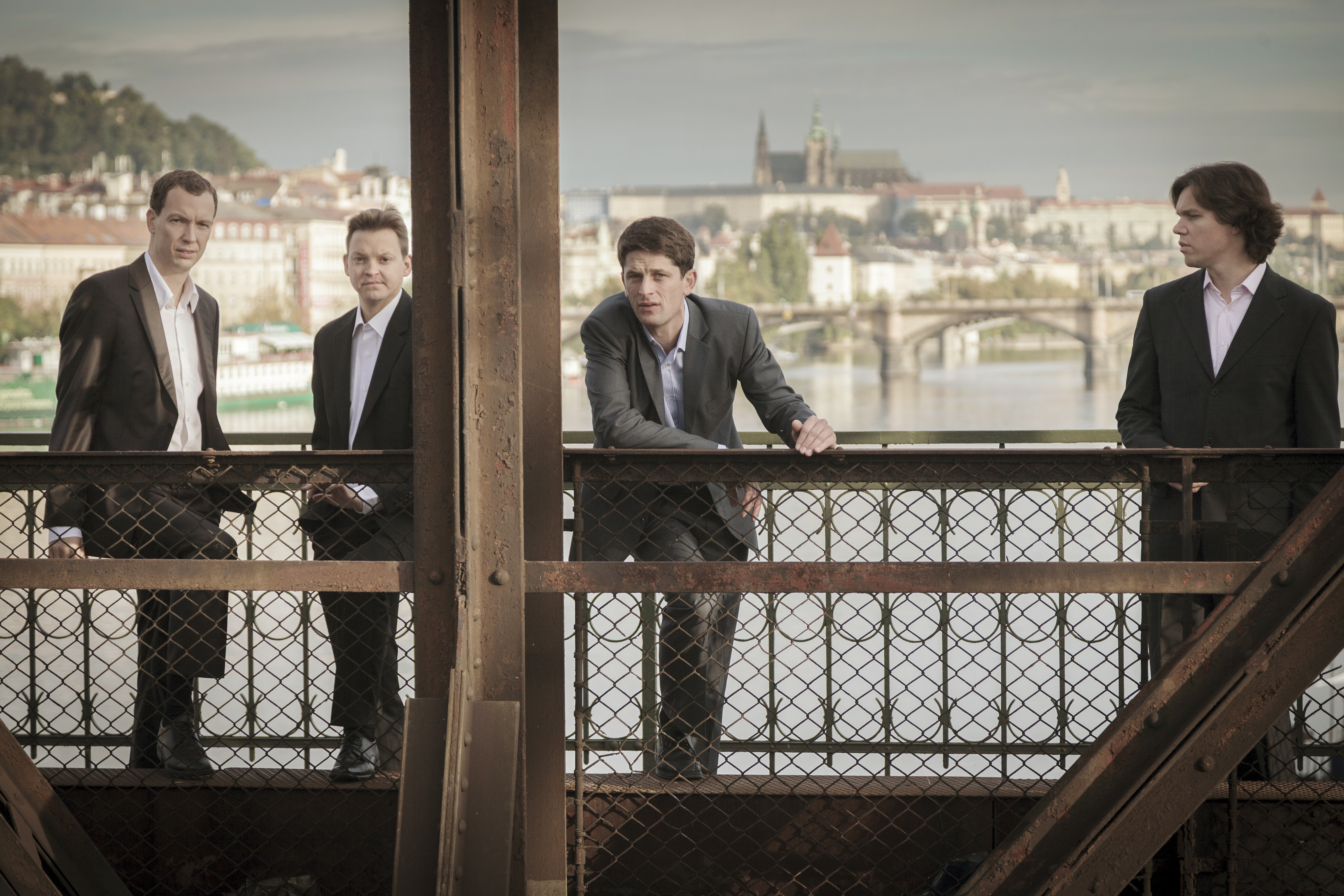
In the second week of the Music and Beyond festival we had the good fortune to welcome the Bennewitz Quartet to town, who are from Prague.

Photo: ©Kamil Ghaisption
I went to two of their concerts, the first one with Chris. This was held at the Horticulture Building at Lansdowne Park, but I don't think Music and Beyond concerts ought to be held there next year, because, despite the pleasant nearby surroundings, it wasn't the best venue. The underground parking is expensive and inside the hall, the intrusively loud hum from the airconditioners, working at full revs, compromised our appreciation and must have been quite off-putting for the musicians themselves. It was also very hot and humid in there.

Carping aside, the concert was still wonderful. If he were writing this blogpost, my husband would doubtless observe that the viola player in particular attracted my attention (as does the German actor Henry Arnold or the President of France for that matter, with their similar good looks).

Enough of that; let's concentrate on the music, which in this concert was all Czech. The Ambassador of the Czech Republic said a few words from the front row, the second violinist made the rest of the introductions, and the first piece we heard was Dussek's Quartet in E-flat major, Op. 60. Dussek (1760-1812) is better known for his piano music, but he also created a large output of other chamber music, including three string quartets. This was the last of these. We were encouraged to listen for the classical and romantic elements in this piece which can be classified as "pre-romantic".

Here's the Scherzo:


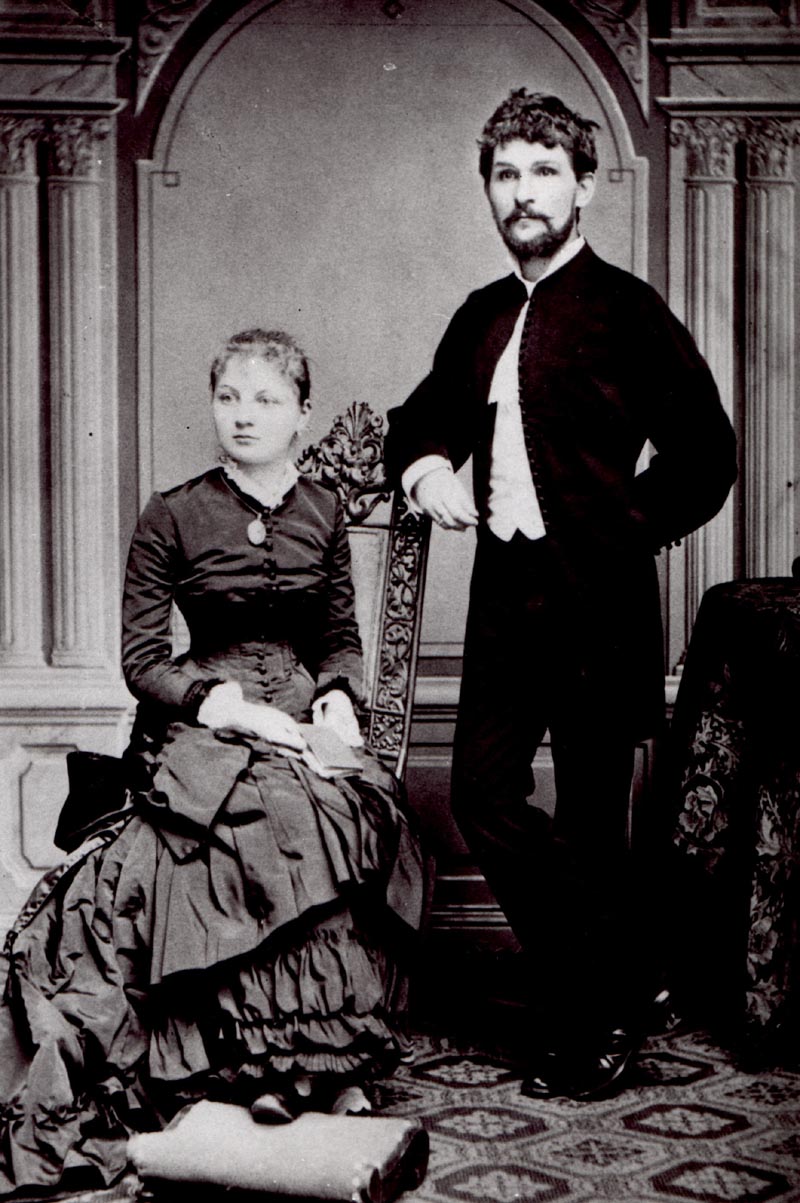
Janacek and his wife when young
A very different piece followed, Janacek's Intimate Letters (his String Quartet No. 2, 1928, written at the end of his life). This is programme music, or music as a secret code. The amorous feelings the elderly Janacek was attempting to convey were for a certain Kamila Stösslova, 38 years younger than he! They apparently exchanged about 700 real letters as well. Janacek's wife, unsurprisingly disgusted, obliterated his verbal references to the various intimacies in the original manuscript with a thick black pen, so performers simply have to guess at what he meant. These four performers made a most passionate job of it and deserved their break in the cooler fresh air during the intermission.

They had played so well that Chris and I decided to stay for the second half of the concert despite that noisy competition from the air conditioners. This time we heard Smetena's From My Life (Z mého života) Quartet, the work that first attracted my husband to chamber music. Czechs always feel that Smetana expresses their soul better than does Dvorak; especially when they hear his most patriotic, symphonic work Ma Vlast, Smetana is the Czech composer. Both Ma Vlast and From My Life were late works from the 1870s, after he had lost his hearing. The quartet expresses a personal turmoil, Smetana trying to come to terms with his tragic memories of the 1850s when three of his children and then his wife died. Although mostly in the minor, it is not unhappy music. The second movement is a Polka, the Czech (not Polish) national dance, and the gentle Largo was written in memory of his wife. The Vivace at the end first expresses his sense of triumph at having succeeded as a composer, but then comes the sudden long note, the harmonic high E on the violin that signifies the tinnitus he heard as he began to go deaf. Touchingly, the previous movement's wife-theme returns as a consolation after this fateful shock, and so the quartet ends, resolving gently into the major, on a soft pizzicato.

As the second violinist said, "It's a very beautiful music!"

Of course, the following day I was back in town to hear the Bennewitz Quartet perform again. At this event they offered only two pieces of music: Schubert's great Death and the Maiden Quartet followed by a quartet by Dvorak after the intermission. What sets professionals such as these apart is their mastery of pianissimo playing. I also noted their utter subservience to the music and their respect for one another. If you are going to do this properly, there is no room for egotism. A good lesson for all those in the public eye, if you ask me.

Once more, the second violinist stood up to tell us about the music. This Quartet in D minor, no. 14, was one of the last things Schubert ever wrote, knowing (in 1824, at the age of 27) that his life would soon come to an end, or so people claim. That's debatable, although he did know he had syphilis, but the solemnity and the emotion is certainly there, especially in the way the Bennewitz Quartet handled it. This piece of music is 40 minutes long. I have heard it several times before played live, but this was the best performance I've heard to date. The Andante movement is the one based on Schubert's song of seven years earlier, with five variations of that theme.


Dvorak's Quartet in G, Op. 106, No. 13, may also have been written with death in mind, or at least Dvorak thought of his end when he heard it rehearsed for the first time because on that occasion he abruptly left the hall during its Adagio movement in which all four strings are given highly melodic lines. When someone went out to find out what was the matter, and whether the instrumentalists had upset him with their interpretation, Dvorak was found standing by the river in an emotional state, and he said, "I just realised that I'll probably never write anything so beautiful again!"

We were told a little more about the composer. He had come from a a "gloomy, impoverished background" and music had been his escape. He became internationally famous, especially when asked by New York City to move there to direct its new Conservatory of Music. Travelling back and forth Dvorak also used to write his music aboard transatlantic steamships, including this and his previous (Op. 105) quartet. During the time he spent living in America he was also invited to visit a Czech settlement in Iowa constructed in the style of a Bohemian village, and wrote some of his "most enjoyed pieces" there, as Stepan Jezek of the Bennewitz Quartet put it.

Incidentally, in his last few years, Dvorak succeeded Antonin Bennewitz (for whom the ensemble is named) as director of the Prague Conservatory.