blending an assortment of thoughts and experiences for my friends, relations and kindred spirit

blending an assortment of thoughts and experiences for my friends, relations and kindred spirit
By Alison Hobbs, blending a mixture of thoughts and experiences for friends, relations and kindred spirits.
Showing posts with label Bernini. Show all posts

Friday, January 23, 2009

Startling the people that matter

I watched three brilliant teachers this week. What they had in common was self-assurance and a passion to share the ideas that drive them.
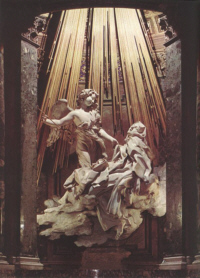
As I said I would, I went back to the National Gallery to watch the documentary film about Bernini, actually Part 2 of the BBC Series Simon Schama's Power of Art, entitled Bernini. In this production Schama presents a dramatised version of Bernini's life story, and shows us "the most daring sculpture in the history of art," the Ecstasy of St. Theresa. He talked about its "rippling cushions of stone," how the nun's habit, sculpted in this way, represents what's happening inside her: "a helpless dissolution into liquid bliss"—!

Schama doesn't pull any punches. Forget the euphemisms, he says, this is the face of sexual euphoria. Theresa was one of the barefoot Carmelites, says the narrator, depicted here, in "molten marble," not as a forty-something old maid, but as an unforgettably beautiful young woman. The artist, adept at "startling the people that mattered," shows spiritual ecstasy as something anyone can relate to:

What Bernini's managed to make tangible is something that we all, if we're honest, know we hunger for, but before which we're properly tongue-tied [...] No wonder when art historians look at this sculpture they tie themselves in knots to avoid saying the obvious, that is, that we're looking at the most intense convulsive drama of the body that any of us experience.

It is not a furtive piece, says Schama. Bernini "wants us to look, and look hard," witness the "audience" that he's incorporated into the ensemble (the faces painted on either side). He has set it up as theatre (apparently Bernini was also known as a playwright, painter and master builder) with "fake lighting", even. On the floor there's evidence that the earth has literally moved for St. Theresa, as there are the dead, arising from their graves. Bernini was not being "crude" however, understanding that for mystics, soul and body are one and the same. The Pope himself—Innocent X—liked it.

My second exposure to good teaching was when my daughter sent me a link to a presentation by Sir Ken Robinson, on the TED website, asking: Do schools kill creativity?, done as a sort of stand-up comedy that has the audience laughing out loud ... and thinking. He's highly provocative. Senior academics, he says, "look upon their body as a form of transport for their heads. It's a way of getting their head to meetings." Yet the modern education system puts this sort of people at the top of the intelligence tree, and treats the creative ones (musicians, artists, dancers) as less worthy of notice. Robinson tells the story of Gillian Lynne, choreographer, who was considered educationally subnormal, until a doctor realised that her lack of attention in school was a symptom not of deficiency but of her natural creativity. "Gillian isn't sick, she's a dancer..."

The third fine teacher this week was Barack Obama, whose Inauguration speech, if you ask me, was a lesson (not just to Americans) on how to think. I was taking notes!—noting that he mentioned the value of curiosity (hooray!) and of restoring Science "to its rightful place." As for national and international security:

Power alone cannot protect us, nor does it entitle us to do as we please ... Our security emanates from [...] the tempering qualities of humility and restraint ... We know that our patchwork heritage is a strength, not a weakness ... People will judge you on what you can build, not what you destroy ... we will extend a hand if you are willing to unclench your fist...

I was impressed by a story that came out in the Guardian about rather less famous Joe Favreau (27) who helps Obama to compose his speeches, working on the word-crafting in coffee shops for hours on end.

I can relate to that.

Friday, January 9, 2009

Bernini's Busts

Bernini, 1598-1680, was a genius. He was a child prodigy too, introduced at the age of 8 to the first of the many Popes he met, who told his father that this child would soon outstrip him as a sculptor. Like Leopold Mozart, the father didn't mind this comment, apparently.

Today I saw the exhibition of Bernini's portraits on display at the National Gallery along with a few pieces by his contemporaries. Aged nearly 82 when he died, Bernini had competed with a great many other Baroque artists. His was a period of European history when portraits came into their own, because they were status symbols—Louis XIV of France and his court had a great many done—as well as being a means of showing the both spiritual and the sensual side of humanity. What the exhibition notes called "naturalism" had a high priority in the taste of those days, Bernini having grown up under the influence of Caraveggio. Then there was the impetus from Rome, the Catholic Church galvanised into Counter Reformation by the Protestant opposition. Most of Bernini's busts seem to have been of Cardinals or Popes, the VIPs. One of the Popes, Urban VIII, said to Bernini (who'd had him under observation for ten years before giving his marble face and beard amazing vitality):

You were made for Rome and Rome for you.

In my ignorance I hadn't realised that Bernini was not only a great sculptor but a consummate painter too, who put his first ideas down as chalk sketches. In the first gallery was his self portrait at 25 years old, rather alarmed at the sight of himself in his mirror, it seems, but very alive. In the last gallery two other self portraits were juxtaposed, one of them a study in chalks (from the Ashmolean Museum at Oxford) of his young self, dated 1625, and the sketch beside it showing him as an old man in 1665 (this latter portrait came from HM the Queen's collection).

The marble busts in the show seem to sparkle, so white is the stone, and when you look at them closely you can see the lifelike detail that makes them so extraordinary: the pockmarks on the cheeks of a Cardinal who'd once suffered from acne or smallpox, the stubble of a growing beard. One bust depicted Bernini's elderly mother, a dignified lady with a Roman nose and a mole on her top lip, carefully rendered. You'd think the medium of marble would make the limbless figures stiff, dead looking; on the contrary, it's hard to believe this is not flesh itself, about to move. Of course, the sculptors of the day had standard ways of tricking the viewer into thinking their creations were alive. A wrinkled sleeve implied movement of the implied arm. A half open mouth signified that the subject was about to speak. When you think of the Ecstasy of S. Teresa di Avila and what that depiction implies, ... But that was a whole figure. Here in Ottawa we are limited to seeing busts. In one of the exhibition rooms a film was being shown about the Saint Teresa sculpture, but it was running on a 50 minute loop and I didn't have time to watch more than a short section. "Art is all about passion" said the narrator. I'll be back there shortly to watch the rest.