blending an assortment of thoughts and experiences for my friends, relations and kindred spirit

blending an assortment of thoughts and experiences for my friends, relations and kindred spirit
By Alison Hobbs, blending a mixture of thoughts and experiences for friends, relations and kindred spirits.
Showing posts with label Kingston. Show all posts

Monday, June 16, 2014

Picnic at Lemoine Point

We followed the Shore Trail,
walking back along Meadowlark Lane
Yesterday Chris flew me down to Kingston for a walk and a picnic near the airport, at Lemoine Point. The flying conditions were near perfect with no more than tiny clouds to contend with at 4500ft and marvellous visibility. We're so privileged to be able to fly this route, one of the most beautiful in Ontario, surely, following the line of the old Perth Road from above, over Westport or Portland where the many boats are moored and the locks between the lakes on the Rideau Canal. This time we had a tail wind from the north so the outbound journey took us less than an hour. As we landed at Kingston, we think we saw a young eagle sitting beside the taxiway. It was a huge and beautiful bird, anyhow, and the men at the FBO said some eagles had been seen nearby.

Walking conditions were good too; it was not too hot. The woods and wet meadows of Lemoine Point were full of flowers and dragonflies. I have never seen so many chipmunks at once; they were everywhere. In the farmland near the southern car park an adult goat had a following of little goats, bounding through the long grass, surely not all her own? A very tame squirrel made determined efforts to share our lunch at our picnic table.

Back in Ottawa, driving down the Rockcliffe Parkway to fetch Chris after he had lingered at the Flying Club before supper, a fox crossed the road ahead of me.

Friday, August 9, 2013

Nineteenth century pumping stations

My great-great-grandfather (my mother's father's mother's father) William Willis was an engineer, born in the north of England in 1825. His father was killed in the pit of a coal mine at Jarrow when he (William) was a baby. Moving to Durham, the boy was self educated, eventually becoming a railway engineer and then an engineer at the Darlington sewage works. He and his family lived at Sewerage Cottage (!) in those days. His last job was as superintendent of the pumping station which meant that he could live until his retirement at Tees Cottage, a place much loved by his younger relatives.

This week Chris and I visited a similar pumping station in Kingston, Ontario, now the city's Pump House Steam Museum (we had been there before). I picked up a leaflet telling its history, and this is what it says:
The City of Kingston Water Works Company was incorporated in 1849 ... Prior to this, residents obtained their water from wells or private carters, who would fill a cart from the lake and sell the water in the streets ... Originally, drinking water was collected at the waterfront, where the city also deposited its waste.

... Kingston was in the race to become the capital of the Province of Canada. In order to be considered for capital status there was a list of requirements, one of which was having a pumped water service ... Kingston became the capital from 1841-1844 ...

The water was drawn from Lake Ontario to the Pump House via an intake pipe. It passed through the pump to a water tower 1.5km away ... the company began to encounter problems in the late 1880s ... In addition, there was an outbreak of cholera in 1886 due to poor water quality [therefore] the City added three extensions to the existing intake pipe in order to reach the cleaner, fresher water offshore. The pipe was extended to a length of 760 metres and ... still lies on the lake bed today.
The restored steam engines that we saw in the pump room had been installed in the 1890s, replacing the older ones. One of these was able to pump 5 million gallons of water per day to the water tower on Tower Street. The facility was manned by two people, a fireman to shovel coal into the boilers and an engineer to keep an eye on the engines which quietly kept the pump in operation.

I'll add another juxtaposition to this post which brings the story full circle. My father-in-law was a water works engineer as well, employed by the British military. He began his working life as a boiler attendant, shovelling coal.

Saturday, April 6, 2013

Peterborough to Kingston, then home

Easter Saturday was a beautiful day. We launched ourselves into the air after saying goodbye to Don and Carol who had kindly given us a lift to the airport, Don interested in the modified Chipmunk that was parked there. A radial engine had been fitted to it, and an extra fuel tank underneath the fuselage that looked like a bomb.

The eastern part of Rice Lake
Chris found the oil very sluggish in the cold, so PTN was reluctant to start. He frightened me by saying that the engine would burst into flames if we primed it any more, but at the final attempt it worked. We had a lovely ride to Kingston––at least, I did. Chris was so engrossed in his GPS and other instruments he missed too much of the views, in my opinion––we were seeing less and less snow in the fields, the closer we got to Lake Ontario. The visibility was good enough for us to make out the Toronto skyscrapers to the west and the Oswego cooling tower on the American side of Lake Ontario, over 50 miles away. First, though, we crossed Rice Lake, startlingly white against its islands and the surrounding landscape, still unthawed. I leaned across and took a picture through Chris' window.

Beach near Trenton
Solar farm near Cobourg
Predictably, the shore of the great lake was  fascinating. I saw Port Hope and Cobourg, a goods train moving along, solar farms and wind farms. The water was transparent down to the lake bed. Near Trenton the long stretches of white sand on the beaches and the turquoise blue might give the illusion of a tropical shore, if it weren't for the remains of ice in the lagoons. I expect the military families of the Trenton airbase go swimming there in the summer. We kept the airfield in sight and had to talk to the ATC at Trenton "tower" on the way through their airspace. There was no other traffic, so we may have been a welcome relief to their boredom on that day.

Murray canal from the air, Chris' photo
Approaching Prince Edward County, the headland that juts out massively into Lake Ontario, we noticed an unnaturally straight waterway, a canal:
The Murray Canal was built between 1882 and 1889 providing a safer and shorter route for sailing vessels following the north coast of Lake Ontario between Niagara and Kingston. This saved time required to reach the communities in the Bay of Quinte from the west end of the lake, saving early captains the one hundred mile trip outside around Prince Edward County.
This canal effectively turns Prince Edward County into an island.

Like the "early captains" mentioned in the Wikipedia quotation above, we navigated straight towards Kingston, not following the coast proper, where the sandbanks are, but the long, thin Bay of Quinte, with Belleville off our left wing. I was entranced by the sight of the pack ice breaking up and fractals of ice shards in the bay. Nearer to Kingston, passing Amherst Island, we could see the controversial wind farm on Wolfe Island––86 turbines managed by TransAlta Energy now make their presence felt, and it looks as though they'll soon be cluttering up Amherst Island as well. (Later in the day we took the ferry from Kingston to Wolfe Island and back, a free ride both for foot passengers and vehicles. Our "cruise," Chris called it.)

On the descent, we heard John on the Kingston airwaves coming in to land from Ottawa. We'd arranged by email to meet him for lunch and when we arrived at the FBO he was getting a folding bike out of his 'plane, with the intention of cycling into the town instead of sharing a taxi with us, part of his keep fit strategy. He met us again at the new Marriott hotel where we were checking in, upgraded because of our early arrival or because the hotel manager wants to make a good impression on new visitors in the hope that they'll return. So for $123 (including the taxes) we had a nicely decorated suite with a complete kitchen (not that we needed it), a king-sized bed, a settee, free internet access, free breakfasts and a lake view. The Residence Inn also boasted a salt water pool that I made use of that evening: two swims in one day! We were very lucky with that price; from now on, with the tourist season beginning, it will rise. However, I shall add a note to self here that the people at the Esso FBO promise their customers an excellent deal at a rival waterfront hotel (the Holiday Inn) all summer long, if we book the room from their office at the airport.

Kingston Public Market
Everyone in town was appreciating the sunny afternoon despite a chilly wind. The marina was still covered in a thin layer of ice, but Queens University students in shorts were jogging along the lakeside trails and the Kingston market was back in business, selling spring flowers, maple syrup, pussy willow twigs, fruit and vegetables, beeswax products and honey.

Keeping the engine warm with plug-in heat and nose cover
Next day, the weather was forecast to deteriorate, so we flew back to Ottawa in the morning, making sure that PTN had a warm engine before start-up, this time. A stiff gusty wind was blowing at ground level but to my surprise and relief there was no turbulence at altitude although we were swept along by a tail wind, cutting 10-15 minutes off the usual journey time for this route. Both sky and scenery were grey, but interesting––I have mentioned and illustrated our view of the Rideau River meandering through Smiths Falls in my river blog.

Friday, April 1, 2011

"Poor" and "sad" in comparison

Perth, Ontario (photo by me)
The other day when I posted an album of photos on Facebook I got an interesting comment from Nadiia, a Ukrainian friend who used to live here but now lives in Romania. She said of the Ontario scenery in my pictures: "I did not like it though, kind of poor and it is sad."

I think she meant that Ontario looks pretty desolate at the end of winter. The landscape is certainly stark before the buds open and the spring growth starts. The grass that re-emerges from the receding snow has a brown, exhausted look, and the bush is grey and haggard like someone's face after a long and serious illness, without much sign of recovery yet. (It will come; only you have to be patient.)

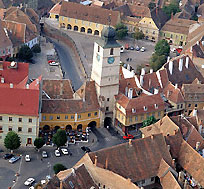
Sibiu, Romania (tourism website)
Or perhaps Nadiia was referring to the little towns between Ottawa and Kingston along the route we were flying when I took the photos. They look "kind of poor and sad" to me as well, before the bustle of activity during their all-too-short tourist season (June, July, August, plus a week or two before / after).

Compared with the lively and picturesque eastern European towns she knows, with their warm spring weather and centuries of cultural heritage, these places in Ontario can't compete. Kingston itself looks very run down at this time of year: shops and museums closed, a burst water main on King Street, a deserted marina still sheathed in ice, only one stall in the market (selling a few potted flowers). But I saw drifts of flowering crocuses and snowdrops in the lakeside gardens, which is more than can be said for Ottawa.

I do see a sort of attractiveness in the simplicity of these landscapes; the air is very clear too, in fine weather. From the air you can see how the little towns, still in the early stages of development, relatively speaking, have come into being around the rivers. Maybe in another two or three centuries they'll have become almost as appealing and historic as their European equivalents. Maybe the climate will have changed by then, as well.