blending an assortment of thoughts and experiences for my friends, relations and kindred spirit

blending an assortment of thoughts and experiences for my friends, relations and kindred spirit
By Alison Hobbs, blending a mixture of thoughts and experiences for friends, relations and kindred spirits.

Monday, July 22, 2019

A disconcerting experience

Usually I know what I am going to be listening to; this time I didn't. For some reason, getting exhausted or blasée after so many other concerts in the festival, I'd forgotten to bring a printout of their programme with me when I arrived at the concert hall to hear the prestigious Borodin Quartet play, last week. I had the vague recollection that something by Schubert was going to be performed.

When the four Russian gentlemen began playing the first item, my first (correct) impression was that this wasn't Schubert, or if it was, it must be early Schubert. Puzzled, I noted "multiple variations on a folksy theme, dance rhythms" but that didn't seem to be an adequate description of this music, during which the musicians kept stopping and starting with quite long pauses between the short movements, or whatever they were. Not a conventional string quartet by any means.

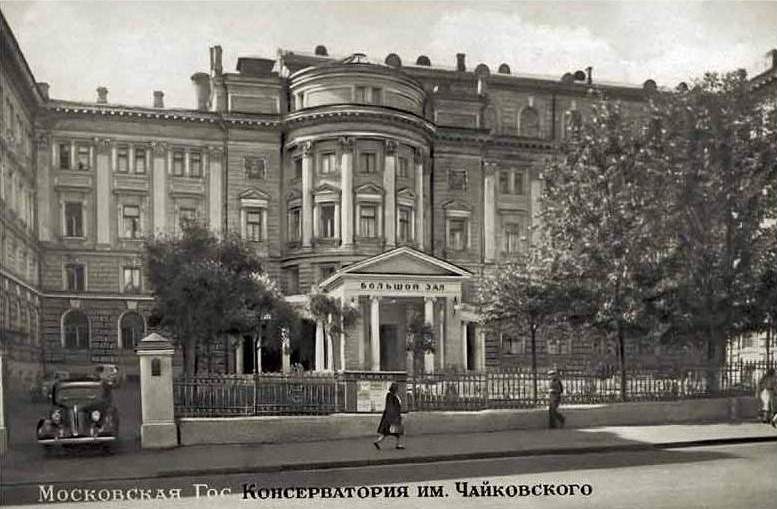
The Moscow Conservatory in 1940
The second item was similarly confusing, again with big pauses (no applause) between the mumerous sections of whatever we were hearing. They played faultlessly, but the music left me rather cold, perhaps because, sitting near the front, I was put off by the lack of eye-contact between the first violinist and the other quartet members on stage, so different from the way the younger Bennewitz Quartet had interacted with one another. In general, the body-language of the Borodin Quartet is severe: very little swaying to the music, no smiles. Either the leader of the group is emotionally inhibited, or it is not the done thing to be demonstrative in their milieu (the Moscow Conservatory). Or were they simply too tired, from having to play while jet lagged. Their faces remained terribly serious even when bowing to the audience's applause.

After the interval a more traditional string quartet was played, with seemingly more depth to it. I recognised parts of the music, but once again failed to identify it. It wasn't till I reached the door to the next concert of the day that I got the chance to look at the programme --- the attendant at the table let me take a photo of it! --- that I realised that what I had been failing to recognise was Schubert's Rosamunde Quartet, D.804, some of which was based on the Rosamunde Overture.

The two items in the first half of the concert had been suites, Tchaikovsky's Op. 39, a Children's Album, and a medley of rather similar Minuets (5 of) and Trios (6 of) by Schubert. No wonder I had lost count of all the "movements"!

Sunday, July 21, 2019

The goose with the bad leg

This story appeared on my page on Facebook last week, but for the record, I'm repeating it here.

My first post went as follows:
Chris, with two neighbours accompanying him, is driving a goose with a broken leg to the wild bird hospital. The goose is in a cardboard box with a towel round it. So long as it doesn't get out and flap around in our car, all will be well. 
What had led to this was that a Cathcart Street neighbour, Sandra, with a couple of friends along, had come across the bird in our local park and had approached us when we were out walking, asking for suggestions of what to do about it. Then I'd remembered, from an incident where a small bird had knocked itself out by flying into one of our windows recently (later recovering, I'm glad to say), that there is a place where you can get advice in such situations: the Safe Wings Ottawa website. It gives a "Bird Emergencies" phone number (613-216-8999) which Chris had rung, and the person taking the call had recommended the procedure described above.

When he got home again, Chris added his own description of the experience:
 Just in case you find a goose with a broken leg tomorrow, here's what you have to do.
  1. Find some competent women, one of whom has a large towel.
  2. Get a large cardboard box, preferably with a lid. 
  3. Get one of the competent women to approach the goose carefully and place the towel over its head. It may object to this. 
  4. Wrap the goose in the towel and put it into the box. 
  5. Do not allow the goose to get out of the box. 
  6. Put the box and one competent woman on the back seat of the car. 
  7. Put another competent woman who has a GPS app on her 'phone in the passenger seat and allow her to lead you to the place that takes in broken geese. Do not kill and eat the goose although the competent woman in the back, from Iran, will tell you that that is what they do there. 
That led to a few tongue-in-cheek comments from my friends & relations about whether it would have been a good idea, or not, to kill and cook the goose, rather than rescuing it by taking it to hospital.

Anyway, a couple of days later, we got a thank you in the mailbox from Sandra (who rode in the car with Chris) saying,
Good news: the leg was not broken. Instead fishing line was embedded in its leg. It had been there a while, skin growing over it, the leg infected and inflamed. Anouk removed the fishing line. She said it took a long time; [she] administered an antiseptic on it and the next day [the goose was] taken to the wildlife sanctuary. It will take a long time to heal. They were appreciative of our efforts.

More about Maine

"Whenever I hear of places with names like Pretty Marsh, I wonder if there's another town called Ugly Swamp, just down the road." said a witty friend of ours, when he saw a picture I'd taken of the Pretty Marsh on Mount Desert Island in Maine last month. It was all attractive, though.

We landed at Bar Harbor airport, BHB, crossing the water on the final approach in what Chris calls "squirrel-y" winds (ahead of a storm front) after an exciting flight from Ottawa on Sunday, June 23rd, via Sherbrooke and Bangor. Sherbrooke to Bangor had taken half an hour less than estimated, because we'd been allowed a direct heading across the non-active Military Operations Area we might have had to avoid, and because of a tailwind of 50 knots, we'd made an unprecedented 150 knot ground speed. I'm glad the flight was that much shorter. It was turbulent up there, due to the gusts. The speed of our journey meant that we landed at BGR well ahead of our given arrival time at the immigration point. Fortunately, the border guard was friendly, allowing us out of the plane immediately and hardly glancing at our passports, let alone asking a heap of official questions. We appreciated that. The last hop from Bangor to Bar Harbor also threw us around in the air.

View from outside our room at the Acadia Sunrise Motel
BHB (officially named Hancock County airport) is actually 12 miles away from Bar Harbor, in a township called Trenton. Having studied the map before we came I had booked us into a motel hardly more than walking distance from the airport but a long way from anywhere else, so the first thing we did on arrival was to pick up a car. The rental was expensive, probably because many of their usual clients land in private jets to pop into their 35-room cottages on the coast, and can afford anything. The Acadia Sunrise Motel was not of that ilk, but the polite staff there gave us a room for $69 (US dollars) with a bath and everything else we needed, apart from breakfast; we drove into the "village" of Bar Harbor for that, down Bar Harbor Road, crossing the causeway onto Mount Desert Island, the largest island off the coast of Maine. We did this drive several times.

The island's rather odd name comes from the 17th century French explorer Samuel de Champlain who called it l’isle des monts-déserts when, sailing by, he noticed the bare, rocky summits of these hills, nowadays the Cadillac Mountain area of the Acadia National Park. Mount Desert has been a hideaway or playground for the wealthier residents of New England since the 19th century. In 1947 a great fire raged across the island forests, destroying most of the posh cottages; many were never rebuilt.

The Egg Rock Light
The bay we sailed across on June 25th (Tuesday morning) --- from the dock below the Atlantic Oceanside hotel, with a party of old folk on a coach trip from Pennsylvania --- is known as Frenchman's Bay. We were on a pleasure boat called The Acadian that took us round the Porcupine Islands, through calm water and, round a headland of Mt. Desert Island, into choppier water --- "It's like a roller coaster here sometimes!"  which inclines to make passengers queasy --- beyond which the open Atlantic could be seen. Woollen blankets on board kept the cold wind out. Swinging back round, with the waves calming down again, we headed toward the Egg Rock with the Egg Rock Light on it. Here was a colony of seals, flopping about amongst the seaweed and looking from the distance amazingly like smooth, pale brown rocks. I noticed a couple of those "rocks" shuffling into the water for a swim, but most were sleepy, too lazy for swimming, except for the young ones already in the water with their whiskered noses poking out. An American astronaut had been the lighthouse keeper's son, on this island. The commentator kept up his educational spiel from the top deck. Formerly a high school teacher, he did this with plenty of humour, lecturing about how a lobster gets into a lobster pot, demonstrating with a plastic model. "And if you examine its claws closely you can work out where the lobster comes from. Look, here we are: Made in China!"


Back at the islands in Frenchman's Bay, now sailing close to their cliffs, we could see that these rocks are stratified, with very ancient layers at the bottom, Precambrian. I don't know much about geology; that is what our knowledgeable commentator said. The rocks had formed into a natural bridge at one point. Early settlers tried to inhabit the islands, a good defensive position, but what they could do there, other than fish, was limited. Now they are called the Porcupine Islands because they look like those animals from a distance. The cliffs here and on the main island are the home of bald eagles; we saw several perching by their nests.

The Porcupine Islands, seen from above Bar Harbor (Wikimedia image)
At low tide, one of the Porcupine Islands can be accessed on foot. It's not a good idea to linger there for long. We saw the seabed starting to appear, at sunset on our third evening there.


Bar Harbour in the early evening
During the two days we were on Mount Desert Island, we explored it by car and on foot, Bar Harbor itself, pleasant to walk around, with its Shore Path, parks and gardens, well appointed eateries and so on, the beach at Seal Harbor, the small towns of Northeast Harbor and Southwest Harbor with their marinas, along the scenic road up Somes Sound and down the other side to Bass Harbor Head, where an old lighthouse stands on the rocks. We left the car there for a walk to the lighthouse, not much of a walk, and the rocks were crowded with sightseers. We did get the Pretty Marsh to ourselves until a party of kayakers turned up, but again could only walk a few paces along the rocky shore, no trails there.

At Seal Harbor, Mt. Desert Island, Maine

Road by Somes Sound
To hike properly, maybe we should have used the trails of the Acadia National Park, paying the hefty entrance fee and finding a parking spot, but as we could see from the lines of glinting vehicles visible on the roads there, this would have been difficult on this sunny day, perhaps impossible, certainly frustrating and time consuming, which was not what we wanted. We decided not to bother, and kept driving. It would be a good idea to return in the off-season, although that could mean encountering fog or high winds.

By the shore at the Lamoine State Park
We wondered if Elsworth would be worth seeing on the mainland, but there was not a lot there. In the end we discovered the Lamoine State Park, beyond Trenton, which did have a reasonable trail, allowing us a walk through the trees and parkland, at East Lamoine, where there was a deserted pebbly beach, a quiet campsite, and a jetty.

I have already described our return to Ottawa in a previous blog post.

Saturday, July 20, 2019

Klezmer from Quebec

This was the advert in the Music and Beyond brochure:
Similar to the music they perform, Kleztory is a rich mosaic of cultures (Russian, Canadian, Quebecois and Moldavian) musical training (academic and self taught) and musical tastes (classical, contemporary, jazz, blues, country and folk) [...] These musicians perform with an emotion and a virtuosity that is the true spirit of klezmer.
I was at this event on July 9th, at the "All Saints Event Space" (as the church in Sandy Hill at the Chapel Street corner of Laurier Avenue is now called), no longer a church, per se. A local rabbi in a skullcap introduced them in relatively serious tones, but their performance was a riot of fun, amplified by loud speakers. The music they played and sang sounded like a juxtaposition of Quebecois and East European Jewish music, with the fiddle and folk rhythms on the one hand, and the wailing clarinet on the other, backed by guitar, double bass and accordion.

The singer / violinist --- la princesse, a Russian-Canadian francophone --- stole the show, vivacious and virtuoso, with her lithe slimness, long hair, red skirt, black tank top and radiant smile. She says that breaking the rules of classical music by playing these kinds of improvisations gave her a sense of liberté --- ça fait du bien! --- which came across! The other members of the group knew how to hold our attention too. The tall guitarist with a ponytail stepped forward from the back of the stage to persuade us that he was the King of Tadoussac, le roi de Tadoussac, at home on the north shore of the St. Lawrence, which made us laugh. The blonde, accordion-playing lady, also very francophone, he referred to as la reine. She said, thanking the audience for their appreciation at the end of the performance, that the musicians liked the way we had been granting them a moment of thoughtful silence before clapping, after the more sober moments. The clarinet player, incidentally a composer and orchestral conductor besides, comes from Slavic Europe, bringing that influence with him. The bass player, from Alberta, had began his career in a country music band before discovering klezmer. As a matter of fact, not one of these musicians is actually Jewish, but they all love acting as if they were. The bassist too was attention-catching when he spun his instrument on its axis while plucking along. Like jazz musicians, each member of the group has his or her solo moments.

Many lively dances in their repertoire swept us along, but there were also long-drawn-out, mournful interludes, with middle eastern quarter tones in the melodies, modal harmonies. Everything was done completely from memory, or improvised on the spot, perhaps. The music could go from rhythmic (the audience encouraged to clap the beat) to wailing slowness, to ultra-fast, all within one piece. There was so much movement on stage, knees bending, bodies swaying, changing places, that it might as well have been dancing.

Highly entertaining, for sure!

Here's an example of Kleztory's performances from three summers ago, in the Montreal area:

Friday, July 19, 2019

A tapestry of sounds

Nuit d'étoiles, sous tes voiles, 
Sous ta brise et tes parfums, 
Triste lyre qui soupire, 
Je rêve aux amours défunts.

This is the first verse of a poem set to music by Claude Debussy and sung in an arrangement for three female voices at St. Joseph's Church on July 8th. It was the third item of a reflective programme presented by a group known as Tapestry, of four women from Boston (singers, one of them also a viola player) and two men (a young Russian pianist and a clarinetist). They have won prestigious awards, and have performed in Ottawa before. Their selection of music was called Beyond Borders: Songs of Hope and Peace and it had also been performed at the National Gallery in Washington, DC, on Armistice Day last year. It had a sort of anti-war theme, but did not include any music from Germany, which might have made it seem more complete in the context of their theme.

The concert began with a piano solo, an extract from Ravel's Le tombeau de Couperin, composed during the 1st world war, and with no pause a clarinet solo followed. We heard a variety of piano, viola, voice and clarinet pieces after that, including a Satie Gnossienne, an arrangement of Debussy's Noël des enfants qui n'ont plus de maison for vocal trio again, and some extracts from Bartok's Bagatelles for piano. John McCutcheon's composition Christmas in the Trenches was for singers in four parts, with the viola held and played like a guitar in accompaniment. An arrangement by Virgil Thomson of Psalm 23 was for all six musicians; then came another clarinet solo. Thus ended the first part of the concert.

Most likely, at my age, my hearing is deteriorating; I found it difficult to make out the singers' words in this concert, partly because of the acoustics of the church and also because the ensemble seems to specialise in soft singing. The soprano Christi Catt seems to have a thinner voice than the other two singers. These are minor quibbles; their musicianship was exemplary.

The second part began with a Pastorale by Poulenc, followed by a viola solo. leading to a medieval Agnus Dei from Spain with the clean, open harmonies of its time.


To contrast with that, a Dona Nobis Pacem by Vaughan Williams with his distinctive early 20th century harmonies and (a bigger contrast yet) a Duke Ellington number, Mood Indigo, sung, with piano and clarinet backing. The clarinetist came straight back in with solo improvisations by Charles Mingus, after which we heard the four women singing a Billie Holiday song from the 1940s in close-harmony, barbershop style.

Talk about variety! The pianist, from memory, then impressed everyone with No. 2 of the Etudes Tableaux by Rachmaninoff, and then we had two Samuel Barber pieces, the first (Sure on this Shining Night, 1938) with a Finzi-like accompaniment on the clarinet and viola. When the voices joined in the clarinet became the lowest voice. Barber's lovely Agnus Dei immediately followed and finally the ensemble gave us a soft arrangement (sung in three parts) of Somewhere from West Side Story, by Bernstein.

Thursday, July 18, 2019

Concert-goers

It seems to me, sitting in the audience for a concert of classical music multiple times, that there are recognisable concert-going types. I'm not saying which type I am. 😉
  • The latecomer: sidles in through the back door and stands at the back or the side, restrained by the ushers from trying to find a seat until the performers are acknowledging the general applause for Item 1 on the programme. If the latecomer is a cyclist, he may be damp with perspiration and still wearing a helmet, carrying a large water bottle. He will then squeeze past the people in the row he's chosen to sit in, whispering Sorry, thanks, sorry, excuse me, sorry, thanks! before lowering himself into the seat and downing his water in one draft. He is still packing his bottle away when Item 2 begins.
  • The head wagger: often sitting near the front of the audience, can be spotted from a long way off, swaying to the music, oblivious to everything else. In his youth, as a prom-goer in prewar 1930s London, my dad was one of these. My mother, elsewhere among the prewar prommers, noticed him thus, years before she actually met him, postwar.
  • The finger tapper: a discreet version of the head wagger, probably not quite so oblivious to others in the audience, but still very caught up in the music, with which he seems familiar. He wishes that his dream of being a conductor had come true.
  • The foot tappers: everyone in the concert hall, if the piece is rhythmically irresistible! (Except for the introvert, see below.)
  • The novice: bewildered by the whole experience, feels very embarrassed when he claps at the end of an in-between movement and nobody else joins in. The performers usually give a little smile when this happens, but do not bow in acknowledgement. Sad to say, a younger novice probably spends most of the concert thinking how grey-haired and uninspiring the rest of us look.
  • The proud mother: sits on the front row with one or two very straight-backed children, smartly dressed and behaving themselves impeccably. She has great ambitions for them and will one day see them on the stage, too, doing something impressive.
  • The inseparable couple: have their favourite seats in the concert hall and if one of them arrives first (s)he saves the other one's seat by plonking a programme or hat on it. They sit close together, arms and thighs touching, and clasp hands or give one another knowing grins at the big moments in the music. During the intermission they do the rounds of other audience members, introducing one another.
  • The enthusiasts: whose favourite part of the evening is at the end, when they can leap to their feet shouting Bravo! (sometimes bringing the rest of the audience up with them) and who carry on applauding, hands in the air, after everyone else has stopped. These people may turn out to be close friends or relatives of the performers.
  • The fidget: usually female, has trouble with her hair-do during the slow movements, or feels a draft and makes a fuss fishing out her shawl and putting it on, taking it off, and then putting it on again. Often she will go to the extent of moving from one seat to another, even while the artists are playing, to find a more comfortable spot. Heaven help the rest of us if the fidget has a brought a fan or a bag of cough sweets with her.
  • The creeper-out: rather like the latecomer, makes his or her presence felt. She makes a dramatic exit, doubled up to make herself as small as she thinks possible, tiptoeing to the nearest exit with whatever hand luggage she needs to carry along, like a cartoon thief, whispering apologies to the people around her. The more experienced early leavers or urgent washroom visitors do not creep, and therefore get out of the hall more quickly.
  • The chatterbox: has a friend along and keeps her engrossed in a long anecdote, standing up, until the performers have come on stage, have picked up their instruments and are at the very point of starting to play. Even after the chatterbox (usually female) has finally sat down in her seat, the anecdote sometimes continues in sotto voce whispers, interspersed with giggles, during the actual music or introduction to it.
  • The solitary introvert: sits right at the back and / or the far side of the hall with as many empty seats around him as possible. He just hates it if there's a full house. He does not move from his spot during the intermission, which he also hates, but has brought a book along, that he will read undisturbed, so he hopes, until the performers return. The best moment for him is when the hush descends, just before they take up their instruments again. He likes the sad or solemn pieces best, not the jolly vivace ones, and especially not music for which the audience is expected to join in, clapping the rhythm or even (God forbid!) singing along.
  • The erudite listener: may bring the score and a pencil with him, and can sometimes be seen taking notes during the performance. This may or may not be the music critic for the local paper or an ex music teacher or prof. After the performance, for anyone who'll listen, he will compare it in detail with other performances of that same work or the same musicians, or with other works by that composer. At moments when a performance doesn't agree with his ideas of how it should have been done, and especially if the performer makes a mistake, he may ostentatiously frown, wince, or shake his head. Some such people are jaded, musical snobs, who, after listening to a piece everyone else has found thoroughly entertaining, will say something along the lines of... "I feel that was a very slight work."* Other erudite people, though, are genuinely appreciative of what they have heard, far more profoundly so than the uneducated masses.
*  I overheard this dismaying remark once from an adult at a concert for children.

¡Asi es! --- I bite the buttons off my shirt!

I went to the Flamenco Rouge performance at the Music and Beyond Festival with expectations of being highly entertained. I didn't expect to get so much education at this event. It was an audio-visual production, called Corrientes, the Spanish word for currents, about the Power of the Sea and its symbolism in Spanish culture and social history, about ebb and flow in people's lives. On a screen behind the stage images were projected, photos of the sea and the vessels on it, of ports and harbours, of the Spanish people, reproductions of famous Spanish paintings and clips from poems in Spanish, several of these by Neruda or by Lorca (extracts from his Seawater Ballad for example, La balada del agua del mar). Some of the images seemed to fit the music and dance we were witnessing; others didn't --- I'll come to that later.

At the start the performers processed in from the behind the audience, clapping rhythmically, then stamping. Flamenco Rouge is a group from Halifax, NS, including a newly recruited drummer who wore a black outfit and black shoes with long, pointed toes and bright red socks. The two guitarists wore scarlet shirts, the ladies wearing a variety of dresses, veils and shawls. They didn't carry fans, but large fans and extra shawls were spread out on boards in front of the stage. They took their seats in a row behind the dance platform, the drummer holding his vertical, lute shaped drum between his knees. He is one of the toque, the instrumentalists. The charismatic female leader of the troupe, Brenley Heaver, takes the cante part, singing soulfully (and very well) in each number, through a microphone, and the other three ladies are the bailarinas, the dancers. Ms. Heaver, who I'm surprised to learn is not Spanish after all, is married to the lead guitarist, Matt Martin, as she told us during this show, admitting that she sings one of these songs, the one called Allegrias, to their baby son as a lullaby. All the participants become palmeros at times, clapping a rhythm with their palmas (palms of their hands). Castanets occasionally come into it too, but not in every instance.

The troupe performs music and dances from both sides of the Atlantic, including some from South America, but mostly from Spain. This is a gypsy art form, apparently, now with UNESCO heritage status. Some old black and white photos on the screen showed scruffy people dancing or otherwise joining in with spontaneous outbursts of flamenco in the streets or at the docksides. It bears a resemblance to Portuguese fada, especially at its "dark, pensive moments", as Ms. Heaver put it, and in its Moorish ornamentation. We heard tarantas, that had elements of jazz or blues, with a set sequence of harmonies and soloists in those numbers. The music sets the mood, the dance holds the audience's attention. I confess I was rather taken aback by the age of the dancers who I was prejudicially expecting to be very young and slim (they aren't), but they do know how to move and what to do with their hands and feet. Their fingers waggle or flutter; their noisy heels stamp or kick the long trains of their dresses aside. Often, I was reminded of peacocks. Near the beginning, one of these ladies strutted in wearing a dramatic black veil and trailing a long dress with flounces in peacock blue. The train can be thrown over a dancer's arm too; it seems to me a miracle that she doesn't trip over it.

There are stories behind each song and dance, often, so we were told, with an undercurrent of rage or "torment in the heart". The dresses were in dramatic colours, black, bright pink or orange, bright red, dazzling white. I assume that some of the traditional singing and the words would have come from men, since one of the passionate lines Ms. Heaver spoke of means "I bite the buttons off my shirt!" I doubt if a woman would do that. As one lady dances to the music, the more passive members of the cast shout their approval, as is traditional, calling out ¡Eso es! or ¡Asi es! --- that's how it is, i.e. "I feel what you feel!" One song was a sort of howl to the moon, with fingers clicking and shouts of ¡Olé!

For the second half of the performance the ladies wore different clothes, their shawls more in evidence, especially in the fandango where the shawl, or mantón, was swirled around her head and body in order "to communicate feelings". La barca de mis amores gave us an example of "flamenco sauciness". In the lyrics, the lovers in the story tear at each other's hair in a fury. No understatement in this culture! The words of some of the songs are very poetic, perhaps especially in Allegrias, the quasi-lullaby mentioned above, that tells of the joy and sorrow of coming home or leaving home and starts on the guitar in a minor key. "Waves play with the shore like a dancing child." On the screen, a Lorca quotation was projected:
The sea smiles from far off 
Teeth of foam 
Lips of sky ...
It is a shame to end this blog post on a sour note, but I feel I must say that some of the images in the slide show seemed inappropriately distracting, in the context. These were the reproductions of Goya's absolutely horrific nightmare etchings and civil war paintings. I have seen them before. They are so awful that I could not bear to look up at times and they haunted and depressed me afterwards. To me they didn't seem to go with the finger clicking, hand slapping, heel kicking sauciness of the dancing, even though the artistic director may have felt that they befitted the darkness behind the songs. Maybe I'm wrong and maybe it is all connected. Food for thought.