blending an assortment of thoughts and experiences for my friends, relations and kindred spirit

blending an assortment of thoughts and experiences for my friends, relations and kindred spirit
By Alison Hobbs, blending a mixture of thoughts and experiences for friends, relations and kindred spirits.

Saturday, November 8, 2014

Not just lines

This is a post about Chinese calligraphy.

Yesterday evening I went to the opening of an exhibition––"The Beauty of Chinese Characters"–– at the City Hall in Gatineau, the Maison du Citoyen (a very multicultural place, worth a visit).

Admittedly I couldn't read the characters on display, but learned something nonetheless, in particular that every calligrapher has a distinct style, more obvious than the distinctions between people's handwriting in a western context. Modern Chinese calligraphy, i.e. the real thing rather than the printed or electronic form, is a rapidly evolving art form. "After the 3rd session of the 11th party congress," as the informative posters around the hall put it, "the calligraphic art has witnessed a leaps-and-bounds development [...] papers and magazines [about it] have sprung up like bamboo shoots after a spring rain." Various schools of calligraphy exist in modern China, such as the "broad-art-ark of twin oars" (??) and the "eight eccentric personnages of Yangzhou." Calligraphy has always been a highly individual artform: Yang Weizhen of the 14th century, for instance, is said to have created "a pattern of his own as if a person of tousled hair and indecently dressed."

There's more to calligraphy than meets the eye.

The Canada China Friendship Society hosted a talk on the subject which I stayed to hear, although it was given in Mandarin Chinese and the interpreter pronounced it "killography" throughout. She must have been under considerable stress, with the Chinese professor speaking very fast and impulsively. A real enthusiast and expert, he wanted to tell us everything about the origins of modern calligraphy and had hardly got beyond the 11th century before we ran out of time. Because the interpreter was paraphrasing his long sentences rather than translating word for word, I missed a lot, but took notes on the gist.

Not only is this an art form but also a way of life––many different styles can be observed, but they have a common philosophy that is to do with the Yin and Yang, the hard and soft, and the quest for harmony. There are basic rules and specific applications that express the artist's emotions or personality. The way of writing itself has meaning.

Different brushes can be used, from the hair of different animals. Some modern calligraphers now work with their fingers or with pens, but the mainstream still use a traditional brush. In the Cultural Revolution with its big posters, it looked as though the calligraphers were getting a lot of practice, but they weren't following the proper rules. This wasn't art; it was merely communication. If the philosophy (the spirit) is not properly understood, art goes in the wrong direction.

When children learn to write at the age of 6 or 7, they copy the strokes of the characters, learning from the Masters. Once a sentence has been written in Chinese, one cannot correct one's mistakes. The strokes are "not just lines". The characters cannot be a reflection of nature, but are not entirely abstract either. Modern calligraphers change their structure and use different colours to reflect the subject. If they resort to "random strokes," this is not real calligraphy, in the lecturer's opinion, and should not be promoted internationally.

5000 years ago the first characters were carved onto stone by means of a metal tool, a record of daily life in ancient times. Because of the medium those characters were longer and thinner than today's, and 3-dimensional. It took years before calligraphy achieved its "smoothness." Writing had to be done slowly, like Tai Chi, rather than other martial arts. The second generation of characters were squarer in appearance and the finished result looked like a painting, "all the characters working together."

The most renowned of Chinese calligraphers belonged to the 3rd generation, when the speed of writing had accelerated and it had an easier flow. The lines were now connected because the artists did not hold their brushes tightly. They often worked on silk, the authorities adding signature stamps. In the following periods, from the Tang Dynasty onwards, there was a reaction to this flowing style and each character became distinct and of more or less the same size. There was less freedom of style but the writing was easier to decipher.


Humour that doesn't age

Chris and I went to see the NAC's English Theatre production of The Importance of Being Earnest last week. Oscar Wilde wrote it in 1895, calling it "a trivial comedy for serious people *."

The Ottawa audience, seeing it 119 years after its first performance, loved it and laughed at all the jokes. You can read the play in its entirety here. It's not very long, but the NAC performance, including two intervals between the changes of scene, took nearly three hours. The scenery was so excellently done that when the curtain went up for the second Act the audience applauded.

The only modification from the original script was in these lines––
Cecily: I think you had better wait till Uncle Jack arrives.  I know he wants to speak to you about your emigrating.
Algernon:  About my what?
Cecily:  Your emigrating.  He has gone up to buy your outfit.
Algernon:  I certainly wouldn’t let Jack buy my outfit.  He has no taste in neckties at all.
Cecily:  I don’t think you will require neckties.  Uncle Jack is sending you to Australia.
Algernon:  Australia!  I’d sooner die.
Cecily:  Well, he said at dinner on Wednesday night, that you would have to choose between this world, the next world, and Australia.
Algernon:  Oh, well!  The accounts I have received of Australia and the next world are not particularly encouraging...
––in which, of course, the word "Canada" was substituted for "Australia."

Six years before the first appearance of this play a book called Three Men in a Boat was published, by Jerome K. Jerome. His humour is similarly dateless.


* Quakers are serious people and the word "earnest" is often applied to them, but note what they advise one another about marriage:
Remember that happiness depends on an understanding and steadfast love on both sides. In times of difficulty remind yourself of the value of prayer, of perseverance and of a sense of humour.
(my underlining). I dare say the person who wrote that clause was British, too.

Tuesday, November 4, 2014

What's best?

To my amusement, words change, or the use of them does.

When my parents were young, superlative things were spiffing, wonderful or marvel(l)ous, as in this Gershwin song


When I was young, such things were fabulous. Since when I remember fantastic, great, super, wicked, cool, brilliant (brill) all meaning much the same. Recently, things that deserve a superlative adjective––or not, depending––have been, like, awesome, but I have a feeling that word will be replaced soon, too. I wonder what will replace it.

Any suggestions?

Monday, October 27, 2014

Memorials

Chris and I went to a performance by young people of Mozart's Requiem yesterday, to commemorate the centennial of the First World War's beginning. It was well conducted and well sung, with much energy and in a spirit of dedication. All the performers wore black with red poppies. I have my own, very personal memories of Mozart's Requiem––our family joined in a sing-along performance of it at the Royal Albert Hall in London once; my son and daughter used to sing the Lacrymosa movement in their high school concerts; and in the summer of 1984 the work was sung in its entirety at the Johanneskirche in Crailsheim, Germany, as a musical memorial to my father who had brought English and German youth choirs together.

Since Wednesday, a sad day for Ottawa, when a sentry was shot dead while on duty at the tomb of the Unknown Soldier beneath the National War Memorial and was then carried away to his own grave in a ceremonial convoy, deaths and memorials have been on everybody's mind. So much information and opinion has been published about this already, and about the other young man who was shot dead––the killer––and about the possible causes and implications of the attack, that I don't intend to add to it just now. Incidents like this stir up our thoughts and feelings, and we each react in our own, characteristic ways. I'm in the silent observer category. I saw crowds of people laying flowers near the Unknown Soldier's tomb today or just coming to stand there. Two sentries stood guard. It didn't feel like a dangerous place to be.

In contrast, this weekend, Chris and I were involved in the creation of a very quiet, low-key memorial to a man called Grant Campbell who used to be a familiar face at the Flying Club until in 2013 he suddenly didn't turn up any more. It turns out that Grant had died of cancer. Few of us had realised this, and neither had Chris nor I known that Grant had been a cartoonist-animator of some repute. On Saturday, Grant's sister and her husband came to the airport to supervise the planting of a sapling in his memory, a "fall fiesta" maple, in about the same spot where he used to sit talking to his good friend Tony after mowing the grass around the parked aeroplanes and the picnic tables. One day, when it's grown, the tree will provide some welcome shade there. At the moment it has no leaves, but a few of us stood around it all the same and some people helped to shovel in the symbolic heap of soil that the professional tree gardeners had left beside it. When the rain came down more heavily we huddled under the gazebo and the Chief Flying Instructor said a few words in memory of Grant and read us the pilots' poem High Flight by John Gillespie Magee, Jr. that's usually read out on such occasions.

Group of friends at the airport tree-planting ceremony
(photo by Brenda Reid)


Monday, October 20, 2014

"Courage, mon ami, le diable est mort!"

On Facebook, my brother-in-law challenged me to post three positive thoughts per day for a week. For the record, here they are.

Day 1
#1 This is not difficult. I'm grateful that I'm not mentally or physically unwell; otherwise it would be harder.
#2 When I mentioned this challenge to Chris he just pointed to the book of Schubert Lieder on our piano and didn't need to say a word.
#3 I have a whole lot of tasty leftovers in the fridge after the long weekend so shan't have to spend much time on cooking or grocery shopping during the next couple of days.


Day 2:
Clouds over Lake Ontario, photo by George Hobbs.
#1. I love swimming, especially when I can have the whole pool to myself for a while, as happened yesterday.
#2. Growing mint means that I can start the day with a refreshing drink that's easy to make, contains no caffeine and requires no shopping. I just pour hot water over a few mint leaves.
#3. "J'aime les nuages ... les nuages qui passent ... là-bas ... là-bas ... les merveilleuses nuages!" (Baudelaire)


Day 3:
#1. CWLH had his next work assignment in Germany approved, which means we'll both be able to cross the ocean again before the year's out.
#2. "How far that little candle throws his beams!
So shines a good deed in a naughty world." (Shakespeare)
#3. My grandsons are learning to swim.

Day 4:
#1. Today is a free day for me, with no commitments on the calendar. This is a very restorative thought.
#2. It is so important to be considerate to children, because the memory of a happy childhood will comfort people in their old age. This applies to my mum who had an extremely happy childhood, full of laughter and fun. She remembers it in great detail and cherishes her parents (who died in the 1940s) as if they were still alive.
#3. The leaves on my kitchen windowsill speak for themselves ...

* My mother in Wales, photo by Carol Hinde
Day 5:
#1. A couple of my Ottawa friends visited my mother in Wales* yesterday evening––so kind of them!
#2. The cancellation of the Flying Club's cleanup day means that I can go to the Ikebana exhibition at the Japanese Embassy and perhaps see Mayumi there, so I don't mind the wet day.
#3. My Good Companions, and poetry, and music, and the open air. Those are what counteracts the vicissitudes, always. I'm not sure my grammar is correct, but you know what I mean.

Day 6:
#1. Only one more day of having to think positive, then I can get back to normal!
#2. Seriously though, how could I have omitted HUMOUR from my list of sustaining things? Bookmark this page in case you ever you need a tonic: http://www.quotery.com/top-100-funny-quotes-of-all-time
#3. We're so lucky to live in Ottawa. With all its faults and challenging climate, it must still be one of the best places to live in the world, a thought that strikes us every time we return from a trip away.

Day 7:
#1. If all my muscles ache this morning after swimming last night, it must mean I am developing stronger muscles.
#2. George will be reunited with his family in Beijing today.
#3. "Let me light my light, says the star, and never debate if it will dispel the dark!" (Rabindranath Tagore). This is the slogan for Child Haven, an unassuming, but very effective organisation based in Ontario that rescues destitute children in India, Bangladesh, Nepal and China (Tibet), to give them an affectionate, happy home and a promising future. I cheer up every time I hear or read about this. Salim Uddin, the owner of Ottawa's Shafali restaurants, is a founder member, his ancestral home in Bangladesh being one of the child havens.

Sunday, October 19, 2014

Japanese Sogetsu inspired by Canadian art

Close-up of Mayumi's work of art
I went to an Ikebana show in the Information and Culture Centre at the Japanese Embassy and showed some pictures of it on my Facebook page, but as Facebook is all rather transitory, I'll record it here as well. I was very impressed. The arrangements (sculpture with plant materials) had a unifying theme: they were all inspired by Canadian art. Apparently the Ikebana specialists had been given a limited number of works of art (paintings / sculptures) to choose from and each of their creations was a tribute to one of those artworks.

Mayumi's work, front view
Mayumi Shepherd, a local Ikebana teacher from Tokyo, whom I know, sent me a personal invitation to the show. She was one of the exhibitors, her creation inspired by an abstract painting by Jack Shadbolt, entitled "Winter Theme": "As for my arrangement, it's made with 100 pieces of New Zealand Flax," she told me. "First, I make strings from flax when they are fresh and then I knit them together by hand (without needles) and repeat to make a piece like that. It took 6 months to create this large piece."

In the entrance hall was a different piece, very reminiscent of Mary Pratt's Red Currant Jelly.

The Ikebana arrangement (detail)

The painting by Mary Pratt
Here's another pairing that worked extraordinarily well:


Yumiko and her response to Riopelle
Yumiko Tsunakawa's creation, recalled an abstract sculpture by Riopelle ––Yumiko told me that she saw the picture of the sculpture and immediately know what she was going to do, but her search for the right materials took a long time. The metalic, tube like shapes on the left are made of a special kind of builders' paper.

Rather than list all the creations that impressed me, I'll just mention one more, a reworking of a painting by Alex Colville that I'd seen in Toronto earlier this month.

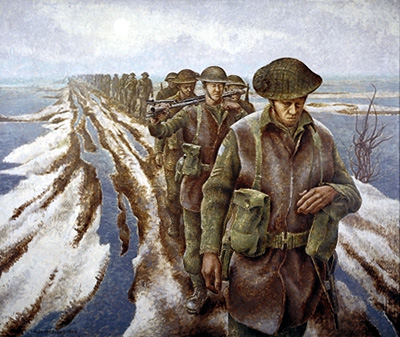
Infantry near Nijmegen, Holland (1946) by Alex Colville

Nancy Sharp's interpretation of Colville's painting
I was in this relatively small exhibition for a long time. Mayumi also tells me that at an forthcoming Sogetsu exhibition in Tokyo, there are going to be 700 creations on display. Imagine how much time I'd feel like spending there!

Saturday, October 18, 2014

What Ms. May had to say

Earlier this month Carol and I attended a CFUW meeting at which we heard Elizabeth May speak. She was introduced to her audience as "the smartest woman in Canada." She is an MP, the leader of the Green Party. I was expecting to learn something about the Green Party that evening, but she hardly mentioned it except by implication. The theme of her talk was Canadian democracy. At one point, with an allusion to Monty Python, she called it "a dead parrot."

"My vision comes from paying attention through six decades of living," she told us. We should all do likewise––pay attention, get engaged, get busy. We have a diminished democracy in Canada now, with political parties and their leaders exerting unhealthy amounts of power, so an informed and active citizenry is essential.

Ms. May comes from a family of left wing activists and she grew up on Cape Breton. She describes herself as a single mum who has no undergraduate degree, although she does have a degree in law. She's a grandmother and a vegetarian who has just published her eighth book, Who We Are, the book being part autobiography and part economic theory. It was the content of the book she wanted to talk about.

She told us who we were. The Canadians' good press was undeserved, she said, and in any case, we no longer have that good reputation. Our state now resembles an "elected dictatorship," with most MPs voting as they're told to vote and the PMO (Prime Minister's Office) being "a cancerous growth that needs to be excised." In her opinion, the PMO's budget, now at $10 million, should be slashed to $2 million at most. Her concern is that the electorate has allowed our democratic system to become "presidentialised." She fears that the only check on the abuse of power is self-restraint and reminded us that Mr. Harper the Prime Minister was not actually elected into that role.

20 years ago, she claims, we used to get better quality news. Now what we are allowed to know is far less useful and objective information is harder to obtain. Legislative committees have become politicised and political parties have charitable status, which makes it easy for them to spend, for example (in the case of the conservatives), $10 million in TV adverts. Nor does she like the way parliamentarians behave in the Houses of Parliament. She spoke of "contempt of Parliament on a daily basis" and called Question Period "bad high school theatre"––she says it's actually against the rules to heckle but no one takes any notice of the rules. The politicians also rehearse their answers to the questions, so the whole process is very artificial. She's obviously disgusted by it and pointed out that Flora MacDonald, whom she greatly admires, believes that "they haven't had a good Speaker [in the House of Commons] since 1972."

It's regrettable, thinks Ms. May, that the opposition parties were unwilling to work together in 2006, when the Conservatives began to lead their minority government. As a rule, minority governments have been healthier for democracy, in her opinion.

Anyway, the apathetic or despairing among us must get over the idea that by not voting we are somehow punishing the powers that be. More of the electorate didn't vote, last time round, than voted Conservative. If only they had bothered. But our first-past-the-post voting system in Canada is unfair and antiquated. It needs to be changed.

This was all preaching to the converted, it seemed, because when she finished speaking she got a standing ovation.