blending an assortment of thoughts and experiences for my friends, relations and kindred spirit

blending an assortment of thoughts and experiences for my friends, relations and kindred spirit
By Alison Hobbs, blending a mixture of thoughts and experiences for friends, relations and kindred spirits.
Showing posts with label NAC. Show all posts

Saturday, November 8, 2014

Humour that doesn't age

Chris and I went to see the NAC's English Theatre production of The Importance of Being Earnest last week. Oscar Wilde wrote it in 1895, calling it "a trivial comedy for serious people *."

The Ottawa audience, seeing it 119 years after its first performance, loved it and laughed at all the jokes. You can read the play in its entirety here. It's not very long, but the NAC performance, including two intervals between the changes of scene, took nearly three hours. The scenery was so excellently done that when the curtain went up for the second Act the audience applauded.

The only modification from the original script was in these lines––
Cecily: I think you had better wait till Uncle Jack arrives.  I know he wants to speak to you about your emigrating.
Algernon:  About my what?
Cecily:  Your emigrating.  He has gone up to buy your outfit.
Algernon:  I certainly wouldn’t let Jack buy my outfit.  He has no taste in neckties at all.
Cecily:  I don’t think you will require neckties.  Uncle Jack is sending you to Australia.
Algernon:  Australia!  I’d sooner die.
Cecily:  Well, he said at dinner on Wednesday night, that you would have to choose between this world, the next world, and Australia.
Algernon:  Oh, well!  The accounts I have received of Australia and the next world are not particularly encouraging...
––in which, of course, the word "Canada" was substituted for "Australia."

Six years before the first appearance of this play a book called Three Men in a Boat was published, by Jerome K. Jerome. His humour is similarly dateless.


* Quakers are serious people and the word "earnest" is often applied to them, but note what they advise one another about marriage:
Remember that happiness depends on an understanding and steadfast love on both sides. In times of difficulty remind yourself of the value of prayer, of perseverance and of a sense of humour.
(my underlining). I dare say the person who wrote that clause was British, too.

Friday, October 18, 2013

Tartuffe in Newfoundland

We had tickets for the preview of Tartuffe at the National Arts Centre last night. It wasn't in French, because this was an English Theatre production, set, in fact, in St. John's, Newfoundland, in 1939, and the English version was Molière's French translated into subtly rhyming couplets using the Newfoundland slang of the 30s––very clever indeed. The man who did the translation was also the actor who played Tartuffe on stage (Andy Jones) who says:
I used a lot of expressions from Newfoundland. I consulted three dictionaries, and used many familiar turns of phrase. I also made up a few expressions of my own.
Molière would have recognised the plot, although Orgon in this version becomes a wealthy fish merchant who is also a veteran of the first World War; he has lost an arm in the war:
It's important to the ending of the play that the main character be a hero in a recent war. World War I was a significant event in Newfoundland. We lost a greater per capita proportion of men than any of the other dominions in the British Commonwealth. Almost every family was touched by the war. Orgon becomes a believable character as a World War I hero.
The French names of the characters were preserved, and Molière would have recognised some of the dialogue too. One scene was a fairly literal translation of
DORINE. Madame eut avant-hier la fièvre jusqu'au soir, Avec un mal de tête étrange à concevoir.
ORGON. Et Tartuffe?
DORINE. Tartuffe? Il se porte à merveille, Gros et gras, le teint frais, et la bouche vermeille.
ORGON. Le pauvre homme! [etc., etc.]
The "poor man" gets his comeuppance in the final scene which was brilliantly staged in this production with all the other protagonists turning to worship Orgon instead, wearing the famous tablecloth, in which he's become entangled, like a toga.

Before we went into the theatre we listened to a discussion between the artistic director, Jillian Keilly, and the enthusiastic wardrobe manager, Marie Sharpe, both of whom are from Newfoundland themselves. It was quite a revelation to hear how important the costumes, lighting and set-design are to a show such as this and how much care is taken over their creation. The set was big and on four levels; it looked like a house split in half, a life-sized, thoroughly furnished doll's house with a board walk winding through rocks in front of it and a deck with washing line to the side. Lively use was made of the doors and stairwell. In the distance (backdrop) was a hint of other houses under a northern sky. The music sounded authentic too, the actors turning into a band of evangelists between scenes, singing Jesus-loves-you songs in a NFL style, in harmony. They have remarkably good voices.

The audience laughed throughout and enjoyed it immensely.

Friday, November 19, 2010

In rehearsal

Julian Kuerti and Johannes Moser were at the NAC yesterday morning, rehearsing for a Bach-Stravinsky-Dvorak concert.

Before the rehearsal began, Eric Friesen of the CBC gave Donors' Circle members an introduction. The concert was to start with Bach's Orchestral Suite Number 1 in C, he said, written in the French style, the opening movement conveying the grandeur and magnificence of a courtly celebration at Versailles. The rest of the suite had a lighter touch; Mr Friesen told us it was Bach's heart dancing. We were to listen out for the woodwind and indeed, when they played it, I noticed a lovely passage for the bassoon and four oboes.

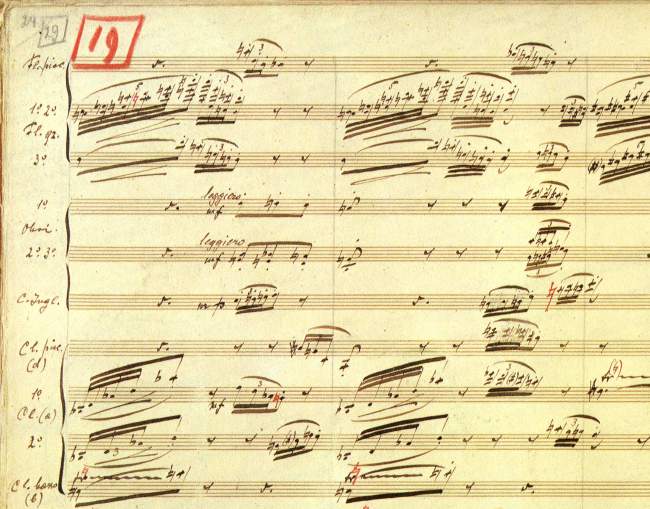
A page from Stravinsky's manuscript
Stravinsky's Firebird Suite is an arrangement of his first major ballet, composed in 1910. (Here's a video clip of Stravinsky in 1961, conducting the triumphant Finale himself!) The Firebird legend is a rather scary, pre-Christian, Slavic one, in which good defeats evil after a lot of trouble. Mr Friesen said that this sort of thing was still popular; look at the recent success of Avatar. Stravinsky got drunk on sound, rhythm and musical architecture, he added, but "you can't look for melodies in Stravinsky!" I nearly accosted Mr. Friesen in the foyer after the rehearsal to tell him I didn't agree. There were some remarkable melodies in it, I thought, like snippets of Russian folksong, especially on the clarinet and horn.

At the end of his introduction to the devotees of the NACO, Mr. Friesen made a comment about their mission to introduce the younger generations to classical music. He said, "We have to take the music to where the kids are, without assuming that they've got to be like us." There were some three-hundred school kids in the auditorium who weren't at all grabbed by the Bach, as I could tell by leaning over the balcony and watching them in the stalls below me punching one another and whispering to the people in the row behind or playing surreptitiously with their forbidden smart-phones, but most of them sat up and took notice when it came to the Stravinsky. Before he started to conduct, Julian Kuerti turned to the kids and asked, "Be honest, how many of you have never seen a symphony orchestra live on stage before?" Most hands went up, and he told them that this piece was a good example of orchestral music; indeed it was, for them, with a full brass and percussion section participating (4 Horns, 2 Trumpets, 3 Trombones, Tuba, Timpani, Bass Drum, Snare Drum, Tambourine, Cymbals, Triangle, Xylophone, Harp, Piano). The sudden change from the soft opening to fff for the "infernal dance" made all the kids jump and squeal, "Oh!" Most of them couldn't refrain from clapping spontaneously at the end of the Firebird rehearsal, though a few deliberately did refrain; it wouldn't have seemed cool.

It was a pity that all the kids had to leave during the rehearsal break; otherwise they'd have heard Dvorak's Cello Concerto afterwards.

"Now Dvorak," said Eric Friesen, "was a consummate melody writer! ... The slow movement is to die for!"

I learned a couple of things, that the composer had already tried his hand at a 'cello concerto at the age of 24 which he had never published. When he came to Brooklyn and happened to hear a 'cello concerto by his colleague at New York's National ConservatoryVictor Herbert, he changed his mind about the potential of the instrument and tried again. Apparently Dvorak's sister in law, the girl he'd loved before he married his wife (echoes of the Mozart story, here!) died while he was working on the Concerto and so he paid a tribute to her by incorporating the tune of a song she used to sing, "Laß' mich allein."

I like the march rhythm on the other 'cellos that starts the last movement. They don't draw their bows across the strings, they beat them like drums.

Both the soloist (Canadian on his mother's side) and the conductor are in their early thirties. Apparently there's "a wave of new conductors" coming out of Canada now, one of the reasons being that we donors to the NAC sponsor a "Conductors Program" in Ottawa, every summer. Julian Kuerti also has the distinct advantage of his mother having been a professional 'cellist and his father being the world-famous pianist, Anton Kuerti. Julian now conducts the Boston Symphony Orchestra, as the second-in-command under James Levine.  Someone asked, why aren't there more women conductors? The answer according to Mr. Friesen seems to be that women aren't usually assertive enough. If a young conductor didn't come across to an established orchestra as supremely knowledgeable and confident, the orchestra, in rehearsal, would "tear her to pieces."

Monday, November 1, 2010

"Les Justes"

Camus, quoted:
N'attendez pas le Jugement dernier. Il a lieu tous les jours.
Il y a dans les hommes plus de choses à admirer que de choses à mépriser.
Je ne connais qu'un seul devoir, et c'est celui d'aimer.
Il faut créer le bonheur pour protester contre l'univers du malheur.
Au milieu de l'hiver, j'ai découvert en moi un invincible été.
I'm still thinking about the NAC production of Camus' Les Justes that I watched about a month ago, its message less optimistic than in some of those famous—wonderful!—lines selected above, from other works by that writer.

Émmanuelle Béart as Dora in Les Justes
It's exhausting to have to concentrate on a foreign language for two-and-a-half hours non-stop, but the actors' French, being Parisian, meticulously enunciated, with an artificial slowness, allowed no one to miss a point. The current French Theatre director at the NAC, Wajdi Mouawad, whom I admire very much for his stand against conventional thinking at the NAC and for his courage in confronting the nastiest politics of the modern world without flinching in his own plays, acted the part of one of the terrorists portrayed in Les Justes, the most intransigent one, in fact. The other actors were from France, the most interesting to watch being Émmanuelle Béart. She had a severe character to play here and a severe haircut to match, but still looked as vulnerably beautiful as in the films she starred in, Manon des Sources and Un Coeur en Hiver. Once again, as in the latter film, I heard her say with furious, growling intensity,
Il faut aller jusqu'au bout!
but in the Camus play that line was spoken in a political, not a sexual context. I was once again bowled over.

The Camus play is a sort of Socratic discussion of whether and why ends might sometimes justify means, in the struggle against hopelessly unjust régimes. It is set at the start of the twentieth century, in Russia. Is it right to assassinate a Grand Duke as a gesture against despotism? Camus' four just men and one just woman believe so, some more assuredly than others. The "poet" among them is all in favour and about to throw the fatal hand-grenade when he sees (in Act II) that the Grand Duke is accompanied by his wife and children. That is when the questions start:
I could not predict this...Children, those children especially. Have you ever looked at little kids? That serious look they have sometimes...I couldn't stand that look...A minute before, however, in the corner of the little square, I was happy. When the lamps of the carriage started to shine in the distance, my heart was thumping with joy, I swear it. It beat harder and harder as the carriage rolling got louder. It made so much noise inside me. I think I was laughing. And I was saying, "yes, yes." Do you understand? I ran toward the carriage. Then I saw them. They weren't laughing. They held themselves all straight and looked out at nothing. They looked so sad! Lost in their parade poses, hands folded, the doors on either side. I didn't see the Grand Duchess; I only saw them. If they had looked at me, I think I would have thrown the bomb. To at least put out that sad look. But they looked straight ahead.I don't know what happened. My arms got weak. My legs shook. One second after that, it was too late. (Silence. He looks at the floor.)
Camus himself was torn over these questions. He was too intimately involved with the France-Algeria conflict to set his play in either of those countries, and the deliberate, Brechtian Verfremdungseffekt of using distant Russia as his setting is reinforced in this production by a symbolically stark, abstract set and very little physical movement on stage.

The consequence of seeing this play is that it makes you realise that terrorists are human. All of a sudden your attitude to the world is not as straightforwardly black and white any more. You are forced to reconsider.

Sunday, December 14, 2008

Le rôle de l'art dans la vie

I was at the NAC again last week (Centre National des Arts) to see the French Theatre production of Cyrano de Bergerac, for which I was lucky enough to get a free ticket. Before the show, I also had the privilege of hearing Wajdi Mouawad, current director of French Theatre at the NAC (who incidentally keeps a blog), give a talk about the importance of the arts and our support of the arts. Having grown up as a French speaking Lebanese immigrant in Montreal, he spoke in beautiful French, quietly but passionately.

For Wajdi Mouawad there are countless possible answers to "What is art for?" or "What is an artist?" but he was not going to try to answer those questions except by giving us a couple of pictures ("images"). The first picture he wanted us to imagine was that of driving a car along a road in stormy weather, the rain lashing at the windscreen, the night very dark, so that the oncoming headlights dazzle and tire us. To keep us going along in the right direction, we put our trust in the occasional roadsigns and the centre lines. We concentrate on them for all we're worth. Of course those lines painted on the road are important in fine weather too, but all the more so at moments of crisis, when we have to face something terrible, like death. Art is like the road signs and white lines, "une chose visible et précieuse" which will prevent us from coming to grief "quand il ne fait plus beau."

It is at such moments that we are at our most receptive to art. For example, a Mozart concerto.

Dans les périodes de crise, ça vous boulverse soudain...

His other image was that of the little scarab, or dung beetle of the Middle East, that feeds itself from what other animals' bodies have rejected. From their excreta—crotte—the scarab makes a perfect ball that it rolls into a secret place to consume at leisure. This is like Artists (the "naifs", the "pure" ones) who nourish themselves from what others have rejected or found useless.

Un artiste est un scarabée qui trouve, dans les excréments mêmes de la société, les aliments nécessaires pour produire les œuvres qui fascinent et bouleversent ses semblables. L’artiste, tel un scarabée, se nourrit de la merde du monde pour lequel il œuvre, et de cette nourriture abjecte il parvient, parfois, à faire jaillir la beauté.

An Artist such as Wajdi Mouawad will put these things into words to let us see what we may have missed:

...des choses profondes, belles, incroyables, des choses fragiles...

(Exactly the message of Baudelaire's Fleurs du Mal !)

One of the audience asked whether Wajdi Mouawad's present place of work, the national capital, had affected his choice of plays for the theatre. Oh, definitely, was the reply; that was a good question. The slogan of this year's French theatre programme is Nous Sommes En Guerre. Apparently, Wajdi Mouawad discussed what it means with his team. We can be at war for the sake of something, against something or with someone. It all depends on our point of view.

En guerre en Afghanistan, en guerre pour conserver le sens des choses ... le théâtre, c'est un geste actif ... pas passif ... On se combat pour rester éveillé...

We fight in order to stay awake.

I like this man, and I really approve of what he says.

Saturday, November 22, 2008

An Indian Dream

As in musicals from Bollywood, the conclusion of A Midsummer Night's Dream is a lavish wedding party, and when Shakespeare's comedy is produced in an Indian setting, with an all-Indian / Sri Lankan cast in Indian costumes, with Indian props and musicians permanently on stage to accompany the action on Indian instruments, well, it's not how you might remember that play from your school days.

The Dash Arts company, directed by Tim Supple, were in Ottawa earlier this month and my friend Tanya, who had seen their production in its first week here, insisted I get a ticket for myself, "even if you have to steal it!" By the way, by turning up at the NAC box office after 4p.m. on the day of a performance, I was allowed to book any remaining seat at half-price, a point worth noting in these financially difficult times.

You can get an inkling of the vivacity by visiting the website where you'll find clips showing the actors (some of them professional acrobats) swinging like monkeys upside down on ropes and drapes hung across the stage. Once the play moves into fairyland (i.e. the Indian jungle), the trappings and inhibitions of civilized society are left far behind and the bamboo frame at the back of the stage becomes a maze of trees or tree-houses for fairies and mortals to climb upon. The silken mats have been removed from the floor, revealing a sand-pit where the various lovers become trapped in a literal web of Puck's mischievous designing (rubber bands!) In other parts of the play, Puck becomes a lethargic fakir, observing high and low caste society with detachment from his reclining position behind the ornamental pond at the front of the stage.

The two who made the biggest impression on our audience were the dancer / actress Archana Ramaswamy who plays both Queen Hippolyta of the Court of Athens and Tatania, Queen of the Fairies (with a strong implication that underneath their clothes they are one and the same!) and the comedian who plays the part of Nick Bottom, Aporup Acharya, in such a hilarious way that he has the audience in stitches even when he's saying his lines in one of the seven languages other than English (Hindi, Bengali, Kannada, Malayam, Sanskrit, Tamil, Marathi) that are used in this production, apparently in a faithful translation of the original script. The actresses all say their lines in English; the men switch from one tongue to another constantly.

The musicians are prestigious instrumentalists and composers in their own right; here they were responsible for setting the atmosphere of the play and keeping its momentum going. The opening scene began with the soft hum of a singing bowl; the last scene had the whole audience on its feet including me, clapping, arms raised, to the wild beat of their drums as the company on stage danced barefoot with fiery torches in celebration of married love.