On my way to pick up my bike that has been in for a tune-up at the bike shop this week, I walked through Beechwood Cemetery, Canada's national cemetery today. I was on the look out for a certain grave, the resting place of Sir Cecil Spring Rice ('Springy' Rice, as he was affectionately known). He died in Ottawa in 1918, having written the words of a hymn that nearly everyone knows: "I vow to thee, my country ..." (the music by Holst and its repeated use on Armistice / Remembrance Day are what makes it memorable). The motive for my quest was that I need to illustrate an article that one of the Ottawa-CFUW members has written about this, for publication in an upcoming issue of our newsletter, for which I'm currently the editor. We'd already found a picture of the grave online, but I wasn't sure we had permission to use it, so thought I'd take my own photo.
Knowing that there are a great many graves in this cemetery I thought I had best go into the office to ask where this one was located. The lady at the reception desk was very helpful, even giving me a map, having looked up the information in a thick reference book. The areas of the graveyard are numbered, in no very logical order it seems to me, but I'm sure there's a system behind it. I commented on how full the cemetery was, and the lady replied that "at the last count" they reckoned they had 83,000 people buried here. That is a lot. Some of their families have had memorial trees planted as well.
During my walk I started on Beechwood Avenue and walked all the way to the St. Laurent Blvd. at the far end, which is quite a distance, meandering to follow the roads and to search within Section 22. I did find his grave in the end but failed to find the grave of my friend Melita, whose funeral I'd attended here last year, the remembrance ceremony taking place in the "Sacred Space" indoors and at her graveside (but we were led there and I couldn't remember the exact plot). The place looks different in the summer.
The Chinese Pagoda at the cemetery
I'd been on a guided tour here once and remembered that at the eastern end there's a Chinese area with names on the gravestones written in Chinese characters. I found that again and admired the oriental pavilion with a cast iron incense burner beside it and a gateway that adorns the garden alongside. This no doubt gives comfort to the relatives of the people buried here: a touch of home.
Music and Beyond's afternoon concert on Sunday, July 9th, was a special event that took place in the Sacred Space, the 9-sided assembly hall of the National Military Cemetery of Canada, at Beechwood Cemetery. The cemetery covers 160 acres of woodland, and, an hour before the music was due to start, the event began with a tour of the graves, but I have already been on such a tour, so waited in the gardens until we concert-goers were invited to take our seats.
During the introduction, with sunshine pouring through the dome at the centre of the hall, we were reminded that the Sacred Space offers "a welcome to Canadians of every religious background", which is good, because Canadians for every religious background have been honoured here. There's a large boulder, a Sacred Stone, so to speak, in the centre of the hall, around which a dozen people walked at its inauguration, each one representing a different faith; this must have been an extraordinary moment.
The exact same concert as the one we heard (A WWI Memorial in Song, also available as a CD or on iTunes) has done the rounds of North America, also performed at Carnegie Hall, at various national military memorials of the United States, etc. Interestingly, the programme chosen by the two young men (John Brancy and Peter Dugan) who have created it can hardly be interpreted as an apology for war, or a nostalgic look back at wartime, since much of it is angry music or the setting of angry words. Performed without a preface, the first song, Channel Firing by Gerald Finzi, was the 1949 setting of a prophetic poem written in 1914. "Good poem!" I had scribbled on my programme, before discovering that Thomas Hardy was the poet.
The singer and pianist thereafter took turns to come to the lectern and talk about the music they were about to perform. Each section of the programme was headed by the name of a different part of the world (England, Germany, France, North America) from which 1st World War soldiers had come.
George Butterworth, a British Lieutenant killed in the Battle of the Somme, had been a promising composer, and is particularly well remembered for the Six Songs from A Shropshire Lad (Housman's poems) that he wrote before going off to war. Since I know these songs note-for-note, I was interested in their interpretation and impressed by the lovely soft start to Loveliest of Trees and Is My Team Ploughing? --- the first and last songs in the cycle. Mr. Brancy took the famous one about The Lads In Their Hundreds at a slow tempo that my husband would find challenging, because of the amount of breath required for each phrase. Brancy was very good at articulation, making the most of the consonants ("the horses trrrrample ...") and putting expressive crescendos / decrescendos on the long vowels (as in "easy" or "sweetheart").
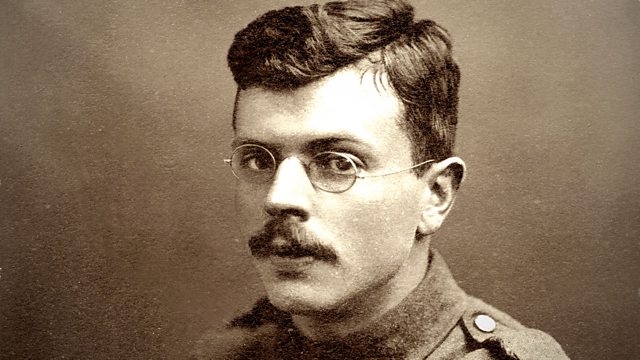
Ivor Gurney
The next song, by Ivor Gurney, incapacitated by a gas attack, was actually written in the trenches: In Flanders expresses the poet's longing for the Cotswolds and Malvern Hills: "my hills." The other song by Gurney, By a Bierside turned out to be another emotional song, one line being: "It is most grand to die, most grand!" which is one of those terrible delusions of the 1st World War. A very British vocabulary and musical style.
To balance all this, the next four songs we heard, composed between 1919 and 1922, were by Carl Orff (1895-1982) who also served in World War I when young, on the other side; he was wounded when a trench collapsed on him. Der Gute Mensch was a bitterly ironic hymn describing a cruel officer in the German army; the following three songs were love songs, One was the setting of a poem by Nietzsche, another, "the confession of a tortured soul" as the singer described it to us. Orff was clearly influenced by the late-romantic early compositions of Schönberg.
France. Since reading Michel Bernard's novel, Les Forêts de Ravel, I knew that Maurice Ravel, in his 40s, had served as an ambulance driver on the battlefields of the 1st World War, and had composed Le Tombeau de Couperin at this time. We heard the Prélude and Toccata from this suite, each movement of which was composed in memory of a fallen friend, as well as Ravel's song Trois Beaux Oiseaux du Paradis, about imaginary birds carrying a last message to the loved ones of three men who have died in the trenches.
The performers tried to relieve our sombre state of mind by making a little joke about Ravel's Toccata: "That was a lot of notes for a small piano."
I had not known that the composer Francis Poulenc had also served in that war, in fact in both world wars. One of the songs we heard by him was the setting of a poem by Apollinaire, entitled Bleuet, meaning cornflower, which was a nickname for the French soldiers in their blue hats. The other song was aptly entitled Priez pour Paix. Here is John Brancy singing it in November 2014, with Peter Dugan accompanying:
Debussy did not directly take part in the war, being too old, but wrote a fast and angry song which was a setting of his own words, called Noel des enfants qui n'ont plus de maisons: Christmas for the children who no longer have homes.
The music of Charles Ives from the USA didn't lighten the audience's mood either with their rendition of three war songs by Charles Ives (1874-1954), written during the month America entered the 1st World War. One of them was a setting of McCrae's In Flanders Fields, the war poem best known to Canadians, that's recited here every November 11th.
The final section of the concert was a performance of four of the popular songs of those days, which the ordinary English-speaking soldiers would have known and sung along to: Keep the Home Fires Burning, My Buddy, God Be With Our Boys Tonight and Danny Boy. What was novel about this was that the pianist, Peter Dugan, had composed his own accompaniment for these songs, so that we heard echoes of pianistic gunfire in the background, evocative indeed. Like the rest of the songs on the programme, they were very well sung by John Brancy.
This was a concert that gave rise to many thoughts, so that I wanted to be by myself for a while at the end of it, and slipped away rather than stay for the refreshments. A day or so later, I read the Hardy poem to my mother, who appreciated it. She'll be 98 this month, conceived at the end of the 1st World War.