blending an assortment of thoughts and experiences for my friends, relations and kindred spirit

blending an assortment of thoughts and experiences for my friends, relations and kindred spirit
By Alison Hobbs, blending a mixture of thoughts and experiences for friends, relations and kindred spirits.
Showing posts with label NACO. Show all posts

Wednesday, June 12, 2019

Free concerts

If you choose carefully and take advantage of good luck, Ottawa can provide cultural experiences that cost very little. I went to two free concerts last week.

The first one (June 5th) was a Wednesday noon concert, an hour and a half long, in the eclectic Doors Open for Music noon hour series at Southminster United Church near Lansdowne Park. This was maybe the best DOMS concert I have ever attended there, and I've been in their audiences for several years. They say it's free but you are encouraged to make a "free will offering" to help the musicians and organisers, so it's best not to bring a completely empty purse. This time the musicians were a cellist and pianist, the latter (Michel-Alexandre Broekaert of Montreal) a former university pal of Roland Graham, the artistic director. The girl, playing the cello, was Noémie Raymond-Friset, also of Montreal. The name of the team is Duo Cavatine. The pianist came in carrying a spare instrument for Noémie, saying, "Don't worry, you won't hear me on the cello today."

She began by playing her Baroque cello, with authentic gut strings, but she told us they were wrapped with metal for more resonance, which was cheating, really. The cello had no spike so she had to hold it between her knees with a masterful grip. She used a Baroque bow, too, wider than the modern bow and held further up the stick than at the frog. The bow appeared slightly convex. I must say the instrument played thus made a beautiful sound. She performed the 5th Cello Suite in C minor by J S Bach which is less frequently heard than some of his other suites (in April I'd heard Suite No. 3 performed on the viola, not yet described in this blog). The movements are the same in all the Suites: Prelude, Allemande, Courante, Sarabande, Gavottes 1 and 2, and a Gigue, in that order. I always look forward to the Sarabande and this one didn't disappoint, a very slow and simple piece, sad but serene. Here is a recording of Yo-Yo Ma playing it:


The last two movements were executed with nice variations in the dynamics as well as the melody lines.

This girl was particularly good at the attack when she began to play each section or each variation on a theme and this was noticeable in the rest of the concert too. The middle item on the programme was Beethoven's Sonata No. 2 in G minor, composed when he was young, and according to the performers, "full of humour and light," before his life became tragic. The Adagio opening was melodic, like something by Schubert, and then it changed to "allegro molto piu tosto presto" (= soon speeding up a lot more?) in the first movement, with a rondo to follow in the second. No more movements. Apparently this was one of the first sonatas where the two instruments were given equal prominence.

Alfred Schnittke
The last piece was one of the cellist's favourite works: the Sonata for Cello and Piano No. 1 by Alfred Schnittke, a German Jew who lived in Russia in the 20th century, so had a tough life. It had been dedicated to a woman. Schnittke's wife was a pianist. There was no pause between the movements, but the difference between Largo, Presto and Largo was fairly obvious. The middle section was "angry" music.

For Thursday evening, I had a ticket to a symphony orchestra concert at the NAC, with a seat on the 3rd row, which I had acquired for free by participating in the annual Musical Lunch arranged by the CFUW. (This is where I heard the viola performance mentioned above.) Mary Partington, who sees to the musical component of that lunch, liaises with the NAC who contribute by helping her to find a young performer and giving vouchers for free NAC concert tickets to everyone who comes along. We don't get a choice of concert, mind, and this year's offering was not to everyone's taste (although I personally appreciate this sort of challenge): from the Vanguard Series of the NAC Orchestra's season: Leila Josefowicz playing her violin in a very modern violin concerto, with another highly energetic young woman conducting, Joana Carneiro of Portugal. The featured violin concerto was the last of four items on the programme and was composed by Thomas Adès, British, written in 2005. It was an exciting piece.

The other three items were also British and also exciting. "Rewind" by Anna Clyne, that started the concert, only lasted 6 minutes; it began with glissandi and a lot of bangs.


"Secret Psalm" (1990) by Oliver Knussen that began the second half of the concert, also lasted 6 minutes, a seemingly very accomplished "meditation" based on something romantic that I failed to identify.


The other item was a fascinating but puzzling longer piece of music (half an hour long) by the Scottish composer James MacMillan, that was meant to represent the "Woman Of The Apocalypse" from Revelation in the Bible, but I couldn't follow the references so easily. I appreciated the title of the section called "The Great Battle", very noisy, especially the brass. I may have been sitting rather too close to the front for this. There was an ethereal moment in the music where the leading string players became an "ecstatic"--- as it says in the programme notes --- string quartet, before the "violent surging" by the rest of the orchestra resumed. Its "relentless, pounding conclusion" generated enthusiastic applause.

Tomorrow I'll be attending a free concert of a different sort, when I attend the end of year performance by the Orkidstra's youngsters. Am greatly looking forward to that one. Again, donations are expected from the audience!

Wednesday, January 28, 2015

A masterclass in conducting

"The National Arts Centre Orchestra have graciously put themselves at our disposal," David Zinman, "renowned international conductor and pedagogue," announced to the audience attending his "workshop for young conductors" in Southam Hall at the NAC this Monday. The audience, including a row of music students at the back, didn't have to buy a ticket for this open rehearsal. As we took our seats, the orchestra was practising like mad, in mufti, most of them wearing jeans, and when the rehearsal got going they played for four hours.

The first turn was taken by the young man from Japan, So Awatsuji of Japan, who brought in the orchestra in dramatic style, using big arm movements. He was good! The maestro was sitting in the orchestra at the back of the 2nd violins, wearing a microphone, advised him on his tempi and told him to relax.

The second participant, Georgios Balatsinos from Greece, conducted the same music but more sedately, using a baton. More criticism from Mr. Zinman here: "Why don't you help the basses a bit? Look at the basses to keep them moving, because they're pulling it back." He complained that Mr. Balatsinos was giving three different tempi, when there was no need for that. "If the modifications are too big, you can get into trouble," he warned him.

The next item, Haydn's Symphony No. 88, has running passages for the double basses that would be easy to lose control of. Vinay Parameswarvan (assistant conductor of the Nashville Symphony Orchestra, although he said that he came from San Francisco) whose name Mr. Zinman couldn't quite pronounce, was the conductor on the podium this time. He too used a baton.

"You're still holding the stick up!" his tutor protested. "Give more energy to the upbeat."

Again there were difficulties with tempo. "The problem for me is that you're not quite sure what tempo you want. You're kind of hedging your bets. Make your upbeat crisper. That's what's slowing them down."

He stopped the music again. "What would you tell the strings here?" he asked. "How should they articulate? It's a technical question."

The young man was flummoxed and didn't know what to say.

"Come off the slur sooner!" was the answer.

To me, watching the masterclass, the key component in good conducting seems to be self-confidence, but how can you acquire that until you've become utterly familiar with the music and have mastered the technical skills required? The trouble is, music being a non-verbal art, it's extremely hard to describe what's required for a great performance in words. Therefore Mr. Zinman could only convey an approximation of his ideas. At one point he took the baton from the young man's hand and demonstrated what he wanted.

"There has to be more contrast in what you're doing, otherwise the orchestra just doesn't watch any more."

The last participant in the workshop, Francesco Lecce-Chong, an associate conductor of the Milwaukee Symphony Orchestra, had an elegant style of conducting, making circular rather than straight up and down movements with his hands. But this conductor, too, was encouraged to relax more: "If you have the right tempo, just let it happen, let them play!"

He required "a little more 2nd oboe––just look at her, to say this is important." But later the woodwind section needed to be "less espressivo, so that all the focus goes to the 'cellos."

Difficult parts of the music had to be repeated over and over, but the maestro made encouraging remarks: "They're playing it better every time."

They took a much-needed break half way through the rehearsal and I bought a coffee in the foyer with one of my NAC coupons. Then we watched the promising Japanese conductor again, dancing with his arms through the 3rd movement of the Haydn. Mr. Zinman said that in the trio section the bassoons ought to sound more "like bagpipes. Bring out the raw sound." He was asked to "make it crisper ... do you know what that means? Like rice crispies!" The young man laughed and nodded. "Add spice to the sound!"

Sometimes he wanted the trainees to more explicit to the orchestra about their performance. "They're using too much bow here; they can't stay together." Or, "They're not playing the rests."

"When you start this movement [now the last movement of Haydn's 88th] you must look at the bassoons. They're not quite sure what you're doing, so they do their best, but ..."

"Are you happy with this tempo? The bassoon's not with you ..." The bassoonist was coming in for a lot of attention so Mr. Zinman mollified him by saying, "He's a wonderful player, actually." He explained what he meant about the problem. "The strings are pushing, the bassoon's pulling––split the difference!"

The expert was clearly fond of Haydn's music and wanted perfection. "This has to be furioso, so keep them furious!" ... "Haydn would shoot you for that! It doesn't make sense to slow down!"... "The strings could play twice as loud––get them to play their guts out! Bring the house down!" And finally, at an easier passage, the music was allowed to happen by itself: "When you get there, don't beat at all, just let them play, like kids let out of school."

Friday, November 19, 2010

In rehearsal

Julian Kuerti and Johannes Moser were at the NAC yesterday morning, rehearsing for a Bach-Stravinsky-Dvorak concert.

Before the rehearsal began, Eric Friesen of the CBC gave Donors' Circle members an introduction. The concert was to start with Bach's Orchestral Suite Number 1 in C, he said, written in the French style, the opening movement conveying the grandeur and magnificence of a courtly celebration at Versailles. The rest of the suite had a lighter touch; Mr Friesen told us it was Bach's heart dancing. We were to listen out for the woodwind and indeed, when they played it, I noticed a lovely passage for the bassoon and four oboes.

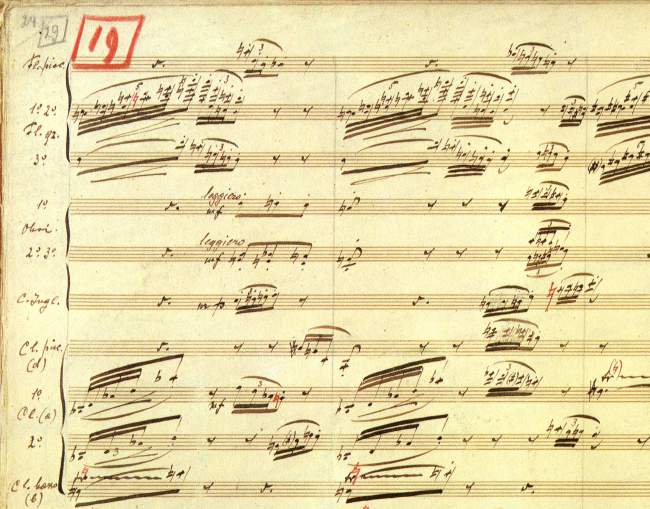
A page from Stravinsky's manuscript
Stravinsky's Firebird Suite is an arrangement of his first major ballet, composed in 1910. (Here's a video clip of Stravinsky in 1961, conducting the triumphant Finale himself!) The Firebird legend is a rather scary, pre-Christian, Slavic one, in which good defeats evil after a lot of trouble. Mr Friesen said that this sort of thing was still popular; look at the recent success of Avatar. Stravinsky got drunk on sound, rhythm and musical architecture, he added, but "you can't look for melodies in Stravinsky!" I nearly accosted Mr. Friesen in the foyer after the rehearsal to tell him I didn't agree. There were some remarkable melodies in it, I thought, like snippets of Russian folksong, especially on the clarinet and horn.

At the end of his introduction to the devotees of the NACO, Mr. Friesen made a comment about their mission to introduce the younger generations to classical music. He said, "We have to take the music to where the kids are, without assuming that they've got to be like us." There were some three-hundred school kids in the auditorium who weren't at all grabbed by the Bach, as I could tell by leaning over the balcony and watching them in the stalls below me punching one another and whispering to the people in the row behind or playing surreptitiously with their forbidden smart-phones, but most of them sat up and took notice when it came to the Stravinsky. Before he started to conduct, Julian Kuerti turned to the kids and asked, "Be honest, how many of you have never seen a symphony orchestra live on stage before?" Most hands went up, and he told them that this piece was a good example of orchestral music; indeed it was, for them, with a full brass and percussion section participating (4 Horns, 2 Trumpets, 3 Trombones, Tuba, Timpani, Bass Drum, Snare Drum, Tambourine, Cymbals, Triangle, Xylophone, Harp, Piano). The sudden change from the soft opening to fff for the "infernal dance" made all the kids jump and squeal, "Oh!" Most of them couldn't refrain from clapping spontaneously at the end of the Firebird rehearsal, though a few deliberately did refrain; it wouldn't have seemed cool.

It was a pity that all the kids had to leave during the rehearsal break; otherwise they'd have heard Dvorak's Cello Concerto afterwards.

"Now Dvorak," said Eric Friesen, "was a consummate melody writer! ... The slow movement is to die for!"

I learned a couple of things, that the composer had already tried his hand at a 'cello concerto at the age of 24 which he had never published. When he came to Brooklyn and happened to hear a 'cello concerto by his colleague at New York's National Conservatory, Victor Herbert, he changed his mind about the potential of the instrument and tried again. Apparently Dvorak's sister in law, the girl he'd loved before he married his wife (echoes of the Mozart story, here!) died while he was working on the Concerto and so he paid a tribute to her by incorporating the tune of a song she used to sing, "Laß' mich allein."

I like the march rhythm on the other 'cellos that starts the last movement. They don't draw their bows across the strings, they beat them like drums.

Both the soloist (Canadian on his mother's side) and the conductor are in their early thirties. Apparently there's "a wave of new conductors" coming out of Canada now, one of the reasons being that we donors to the NAC sponsor a "Conductors Program" in Ottawa, every summer. Julian Kuerti also has the distinct advantage of his mother having been a professional 'cellist and his father being the world-famous pianist, Anton Kuerti. Julian now conducts the Boston Symphony Orchestra, as the second-in-command under James Levine.  Someone asked, why aren't there more women conductors? The answer according to Mr. Friesen seems to be that women aren't usually assertive enough. If a young conductor didn't come across to an established orchestra as supremely knowledgeable and confident, the orchestra, in rehearsal, would "tear her to pieces."

Thursday, October 2, 2008

Zubin, Pinchas and Johannes

Supporters of the NACO's nationwide education initiatives may sometimes attend the rehearsals of concerts taking place at the National Arts Centre, so yesterday morning I managed to get my mother and me into the two-hour rehearsal of Brahms' Violin Concerto and 2nd Symphony conducted by Zubin Mehta, a Parsi from Mumbai, although I expect he also thinks of himself as Viennese, having studied there (under Hans Swarowsky) with Claudio Abbado and Daniel Barenboim. He is obviously a good friend of Pinchas Zukerman, yesterday's soloist in the concerto, who is also the NACO's usual conductor.

The rehearsal was as good as a concert if not better. We had an unobstructed view of the orchestra from where we sat and observing the interactions of the conductor and instrumentalists (Pinchas Zukerman's glamorous wife among them), the orchestra less inhibited and more relaxed than in performance conditions, we also had a good view of their personalities, Yosuke Kawasaki for example, the new concertmaster from Japan, playing in dramatic style, rising from his seat at every surging passage in the music. We heard both works all the way through—none of the listeners could help applauding at the end as each one finished with a mighty flourish, con spirito.

It occurs to me that I'm to lazy to attempt a description of the music we heard and that the modern cult of personality in the music world might simply stem from the fact that journalists, always in a rush, find it so much easier to concentrate on the performers, to the detriment of the music that's performed. The music itself and the way it affects a listener is very difficult to put across in words.