blending an assortment of thoughts and experiences for my friends, relations and kindred spirit

blending an assortment of thoughts and experiences for my friends, relations and kindred spirit
By Alison Hobbs, blending a mixture of thoughts and experiences for friends, relations and kindred spirits.

Tuesday, January 21, 2014

More horses

When clearing my desk, I find all sorts of notes for blogposts I meant to write but never did. Sometime in 2010 I remember visiting an exhibition at the Musée des Civilisations (now known as the Musée Canadien de l'Histoire / Canadian Museum of History) entitled "The Horse"––it was about their evolution, their biology, their characteristics and about how we humans have made use of them through the ages. It included Joe Fafard's sculpture of 11 horses, now installed outside the National Gallery on Sussex Drive. It seems a shame to throw away my notes on that experience unused, so I'll transcribe them here.

Cave painting at Lascaux
55 million years ago there were prehistoric horses with four or five toes; they evolved into three-toed animals (hypohippus) and eventually the middle toe developed into a hoof.

Wild horses appear in the French cave paintings made 33,000 years ago. I have seen the ones at Lascaux. It's thought that the first domesticated horses were the ones in Kazakhstan between 5000 and 3500BC. Villagers raised them for meat.

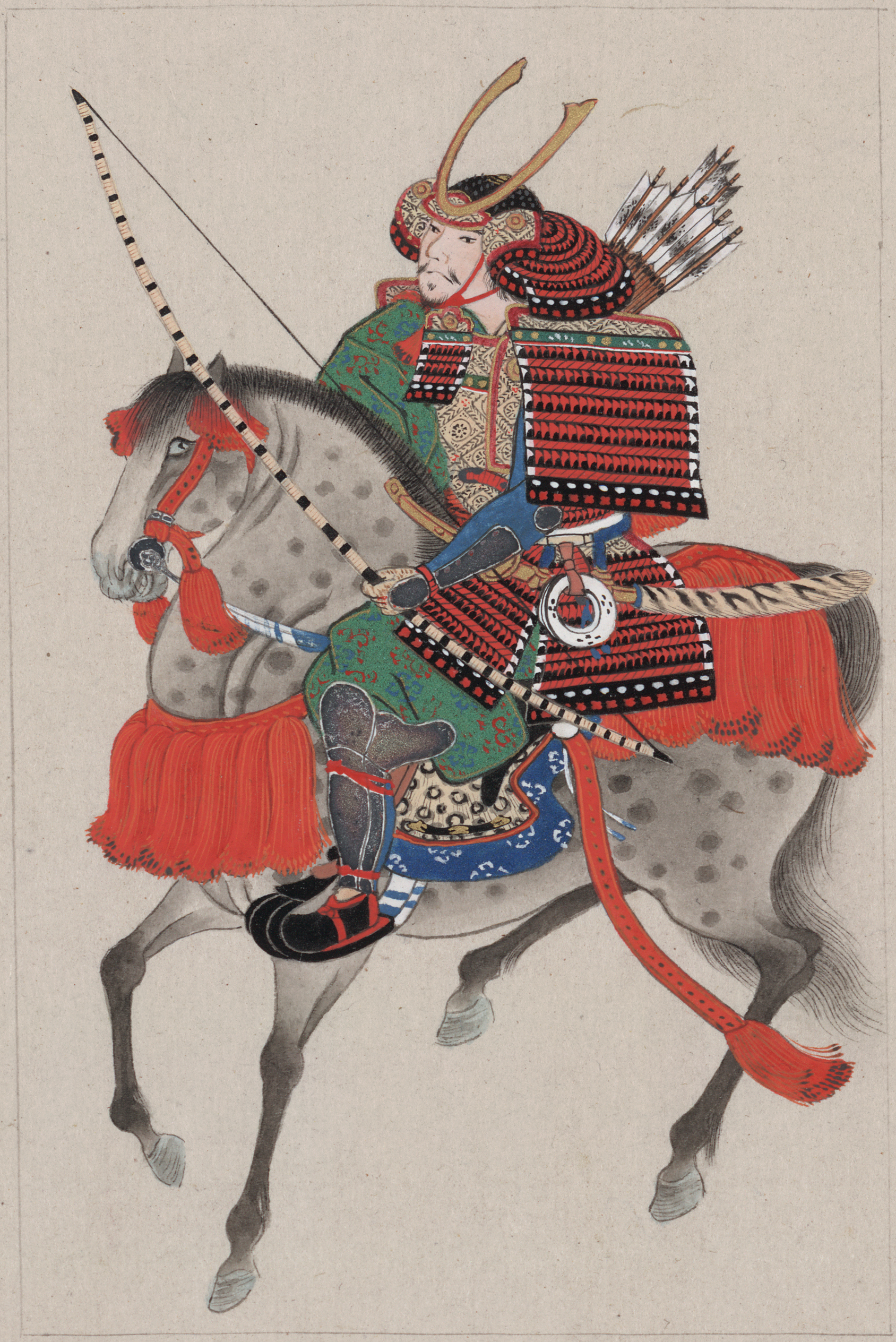
Samurai warrior
History is full of stories of horses ridden into battle, pulling chariots or carrying fighting men on their backs. Chariot races took place in hippodromes. Trousers were invented for the purpose of horse riding by the Scythians. Medieval horses in Europe had to carry a 46kg load, their armour being so heavy. The special breed able to bear it was known as the "Great Horse" or destrier. The Spaniards went on horseback to fight the Incas and in North America, 300 years ago, native tribes began to make use of horses captured from Spanish invaders. The Japanese samurai were cavaliers. In the first World War, the long suffering animals were still being exploited; 800 horses were killed in a single Canadian charge.

Elsewhere they've been used as pit ponies, draft (draught) horses pulling all kinds of merchandise as well as fire trucks and for transporting people or mail. On the Silk Road safe conduct passes were carried on horseback. The Pony Express in the USA went through relay stations changing horses every 16km. Horses were famously used by cowboys or gauchos where a mere five horsemen could control 1000 head of cattle.

The Arab people value mares more than stallions and the Sakhas of northeast Russia ferment mares' milk (koumiss) to drink. In Mongolia, the music made by fiddles with horses' heads transports listeners into a spiritual world.

Monday, January 20, 2014

"And I haven't stopped talking since!"

Cockpit of a Boeing 767 in the 1980s (Wikipedia image)
On Saturday December 7th last year, at an event hosted by the Project North Star volunteer group, Captain Robert ("Bob") Pearson visited the Canada Aviation and Space Museum to talk to a mostly male audience about an "unscheduled landing" he once made in Manitoba, more than 30 years ago. The retired Captain was introduced as a man who had highly polished interpersonal skills and a sense of humour, as well as his famous flying skills. He was the Gimli Glider pilot.

It was a beautiful Saturday afternoon on July 23rd 1983, Captain Pearson said. At Dorval airport he met his crew whom he knew well, having played hockey with them. He would be sharing the cockpit on Flight 143 to Edmonton with Maurice Quintal as First Officer. Recently there'd been some controversy over the compliment of crew and since the 2nd Officer's work in larger Air Canada planes was now automated, the pilot contingent had been reduced from three to two people, although they were still having 3 person workouts in the simulators. Flight computers in the cockpit were a new concept, the only "computer" they really knew and trusted being a Jepperson E6B. Furthermore, the metric system was just coming into use.

That day, there was an electronic fault on the Boeing 767-233. Captain Pearson had met with the mechanics and though the wing (fuel) gauges on his aircraft were deemed inoperable, or unreliable, he determined that the drip sticks were probably OK. Crews in those days used a "drip manual" to calculate the mass of fuel being carried. The flight management computer indicated that there was still sufficient fuel for this flight, so the decision was made: "Aircraft serviceable!" They took off.

However, the fuel load had mistakenly been measured in pounds instead of kilograms. Not realising this, after requesting an en route altitude of 41,000ft and having done fuel checks over Timmins and Red Lake, the crew concluded that they were "ahead on fuel" and put this down to lighter than expected headwinds. They crossed a cold front and thought all was well for the remainder of the flight. Then the low pressure fuel warning lights came on.

They couldn't understand it. It had to be a pump failure on the right wing. Neither Pearson nor Quintal had much background knowledge of the new electronic systems with their more than 100 microprocessors. They diagnosed a computer malfunction and, disconnecting the autopilot, announced a diversion to Winnipeg. Then the left engine failed, and "... that changed the dynamics of the problem."

As they descended through 25,000ft, "the starboard engine went black" as did most of the instruments on their electronic panel. "The darkest place on earth!" thought Captain Pearson, now in a situation for which he and his co-pilot had had no training. The drill for retraction of the undercarriage took more than 5 minutes to read. Don't worry, they told themselves, we'll bring her in high and won't land short. "Maurice really kept his cool," Captain Pearson told us. "I had something to do, which was better."

They never saw Lake Winnipeg. They had no VSI, but the horizon and compass were working and they could use their backup altimeter. Maurice then said, "We shan't make Winnipeg!" As they reached 10,000ft, time was of the essence. Gimli airport, 12 miles ahead at 4 o'clock, was one option. Maurice had done his training there with the RCAF and knew it had a 6800ft runway, 150ft wide. The gear would not come down; they heard no reassuring clunk and couldn't find the reference to the correct procedure in the emergency handbook. Now at 210 knots indicated airspeed there were only 4 or 5 miles to go, and the nose gear was never going to come down. The Captain decided to do a steep sideslip. It was "a bit of a hindrance," he said, "not having a VSI for this," and he was afraid it must have been "quiet uncomfortable for the passengers in the back." He slowed the plane to 180 knots indicated and touched the ground 800ft down the runway.

He jumped on the main gear brakes; the nose collapsed and the cabin depressurised. It was all a "cold, unemotional experience" until he spotted boys on bikes riding on the runway. The pilots had not realised that part of the airport had been converted to a race track. A sports car race was being run by the Winnipeg Sports Car Club that day and the area around the decommissioned runway was crowded with spectators. The aircraft scraped to a halt just in time to avoid the three cyclists, and then the cockpit began to fill with smoke. The pilots did their shutdown drill.

"Get the passengers off, down the chute ... Let's make good and sure!"

Being at an abnormal angle, the rear chute was "almost vertical" which resulted in "a few scrapes and bruises." The purser sprained his ankle. Bob Pearson "just walked off." He was scared then, with a $60-million 'plane about to burst into flames. At first there was no fire extinguisher to be found, but soon the race course people came rushing up to help.

The passengers were bussed to the Viking Inn in Gimli and later flown on to Winnipeg.

In the aftermath, Captain Pearson came home to find his front yard full of journalists. For a moment he hesitated to speak to them, but then ..."All right, I'll answer the questions ... and I haven't stopped talking since!" He has written a book about his experience that has been translated into seven languages. It's called "Freefall."

The restored "Gimli Glider" aircraft gave 25 more years of service and was finally flown to retirement in the Mojave desert, with Captain Pearson and Maurice Quintal themselves on board, as well as three of the six original flight attendants.

Captain Pearson remained in service with Air Canada until 1993, flying aircraft to and from Korea and Japan. He said that the public enquiry into the incident "had exonerated and praised us, which I guessed would happen."

Saturday, January 18, 2014

Music, snow, horses, marshmallows

Oh, we'll drink a drink, a drink,
To Lily the Pink, the Pink, the Pink,
The saviour of the human ra-a-ace,
For she invented medicinal compounds,

Most efficacious in every case.
Marie, of the Celtic Band, with her instruments
I hadn't heard that song for years, but I heard it yesterday, performed by four members of the Lyon Street Celtic Band in the Smithvale Stables barn or Banquet Hall, as it's called on the website. We were there with some diplomats and their families, in order to "celebrate" wintertime. Outside in the cold, the horses helped to make this fun, pulling their wagon loads of excited non-Canadians across the frozen fields. The horses were wearing special shoes to stop them from slipping on the ice.

We had organised a similar event both this time last year and the year before.

At the departure point for the sleigh rides there's a bonfire with hay bales to sit on, where marshmallows were being roasted. Some people sit there to put on their snowshoes.

A Canadian explains to foreigners the art of marshmallow roasting


These three ladies were snowshoeing for the first time:


They liked it. 

Back in the barn Lois was choosing some clappers from the Spoons box the musicians had brought along, as a percussion accompaniment. As the music was being played, the diplomat families and we, their Canadian friends, helped ourselves to bowls of hot chilli and soup, served with plates of sandwiches (I'd made some of those) and cups of hot chocolate. We ate this lunch sitting on the long benches, the children milling around and talking to one another in English, the only language they had in common.

Saturday, January 11, 2014

Still remembering the beaches

Back to November 26th, 2013, which was the day we drove with George to Dee Why. Our time in Australia was running out; three days later we flew reluctantly back to winter in the northern hemisphere, but while we could, we revelled in that sunny day.

Dee Why beach is in the next bay up the coast from Curl Curl (which reputedly has less seaweed). The Australians chose unforgettable place names. We parked in the only available parking space on Oaks Avenue off the Pittwater Road, up a small cliff, where there was a tempting view:


Next to the oceanside pool were stone walled changing rooms; we wasted no time in getting our togs (as Chris calls them) off and our swimsuits on, and walked along to the sandy part of the shore, where parties of school kids were having surfing lessons:


That morning, the waves were perfect for this activity, though you had to watch out for the currents and know what you were doing. The back flow of the breaking waves had a powerful tug.


Chris and George stayed in the water for some time. I was more wary, hesitant to go out of my depth in case the currents and waves proved too strong for me. It was fun, but there was easier swimming to be had back at the rock pool, not at all crowded. I shared it with an elderly lady swimming freestyle and a family with a few months' old baby ... The photo below is now the backdrop on my computer screen! The dark shadows under the surface were patches of seaweed, rather than sharks.


Beyond the enclosing wall of the pool, the creamy surf tumbled and roared.


Before we left the beach to drive back to Marsfield we had time to sit under the parasols at a seafront café and enjoy a lunch of fish and chips.


Get a grip!

The city is slippery, more slippery than ever today when freezing rain fell on ice that's been there for a week already. And this afternoon it rained, so what we now have is water covered ice to walk on. Any salt and grit poured on earlier has simply sunk below the surface, making it useless.

The only thing that keeps me upright is an ingenious device I bought at Lee Valley Tools a couple of years ago––what the locals call cleats: "anti-skid safety soles," with replaceable studs, that fit over my boots and can easily be fastened with velcro straps. The Lee Valley Tools people call them Icer's. Never mind the erroneous apostrophe and the fact that they make indoor surfaces feel like ice as well. Out of doors in these conditions, they work!

Enough about the winter. I think it's time I wrote another blogpost about the Sydney beaches.

Afghan carpet making

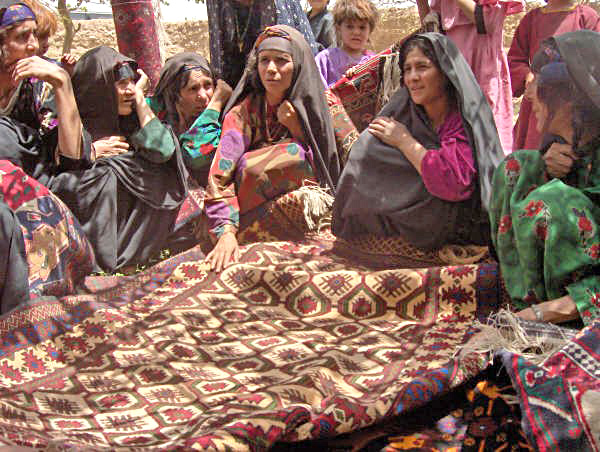
(Wikipedia image)
I'm at the end of another busy week: busy but interesting! Thursday afternoon I was listening to a talk given by Hanneke, an enthusiastic member of CFUW-Ottawa's UWHAW group, who in the 1970s had made multiple trips to Afghanistan to buy carpets and other woven goods (she ran a wholesale warehouse in the Netherlands). She told us about the importance of the wool and weaving traditions in central Asia, in particular in the area around Herat, the place she most frequently visited in those days. As part of the talk she brought several items from her collection to show to us.

Some of the weavings displayed by Hanneke
Hanneke spoke about the different sheep rearing tribes of Afghanistan, of their originally nomadic culture and the importance of woollen artifacts in their yurts and tents. She showed us one weaving that wasn't a carpet but a door to a yurt––you'd just push it aside to go in. Apparently there are five types of sheep bred for their wool, in Afghanistan, and the best wool comes from the karakul sheep of Turkestan who have a long, lustrous outer coat and a fine, soft inner coat. They are sheared twice a year, and from their easily spun wool, low in lanolin content, the art of felting evolved.

Natural dyes are used for the carpet fibres, some made from remarkable ingredients, walnut shells, camel hair, crushed insects. Two women work at the construction of a carpet; they start at the ends, making the flat woven border (kilim), then begin the knotting work, folding the carpet as they go. It can take a year to make a large rug by hand, and any young girl involved in its making might not have time to go to school. Afghan Turkmen weavers use the "Persian knot"––up to 400 knots per square metre. This is a very old skill and the carpet weaving patterns are passed on from one generation to the next, so that the secrets of their art are kept within the family. When the carpet is complete a tiny piece is burned, for luck, and then it's either carried by donkey or bike to the local market for selling or kept aside for the family's own use, or for a dowry––the most carefully worked carpets are the ones used for dowries.
Afghan shepherd's coat

After she had shown us rugs, saddle cloths, woven salt bags and donkeys' neck ornaments, Hanneke also modelled a coat that would be worn "by the most important person in central Asia, the shepherd!" The coat had extremely long sleeves, the purpose of these being to conceal the hand movements of the merchant as he haggles over a price for his merchandise, while holding the hand of the buyer.


Saturday, January 4, 2014

Layer upon layer

Gérard's photo of snow layers
Gérard says (on Facebook) about the layered pile of snow outside his house: "It's just like in the Arctic... Looking at the side gives you a history of the time that has passed. The only difference is that this is for this winter only ..."

The last few days have been extremely cold with wind chills in the minus-30s, even minus 40 at one point, but I'm proud to say we've been out of doors every day, well wrapped. I've been wearing two layers on my legs and arms, two layers of underclothes, not to mention the overclothes, double pairs of socks, two pairs of gloves, a furry hat under my hood and a scarf that comes up to the top of my cheeks and gets all wet from the moisture in my breath. It takes a while to get dressed, but it's worth it. Even if my eyelashes freeze, I keep warm. When we were down town yesterday a TV crew, randomly interviewing passers by, asked Chris what he thought of the weather and got a lengthy reply! I've no idea whether it was broadcast. I added that I didn't mind the cold so much. Yesterday was a blue sky day.

There's layer upon layer of thoughts in my head too, mostly thoughts of responsibilities, the dreaded To Do list combined with concerns for my mum (who's >3000 miles away aged 94 and worrying about living on her own) and for other people I fear I may be neglecting. Sometimes the thought layers overlap as I'm lying in bed at the end of the day:

buy more shampoo ... should I order a box of groceries for Mum? ... she needs to talk without being offered advice all the time ... water the pot plants ... why haven't my new pillows been delivered yet? ... I must edit that article for the University Women's newsletter (who was it that wrote the first draft? Judith, no?) and get that Facebook page updated... have also got to download the material for the Rockcliffe Flying Club's next newsletter and talk to Nathalie about a poster for the recruitment evening at the club in February in case I'm still away ... need to publish Crosswinds this month ... where on earth did I put that bag with my indoor shoes in it? ... I haven't chosen enough reading material for the German group ... get our accounts up to date ... would my grandsons manage OK at school if the family moved to another part of the UK or would they get teased for their London accents? ... will Lolan and / or Greta be able to give me a lift to the two meetings on Thursday? ... I ought to keep practising that piano part for Erstarrung in case Chris' new singing teacher asks me to play it (can't do that at the moment without making an awful mess of it) ... make appointment with the piano tuner! ... I promised my aunt I'd send her a book of family photos soon, have to compile that ... must remind Chris to book that hotel room in Brighton for February ... we still haven't done anything about the lights on the ceiling of our living room ... I need to make some more photo cards for sale at the Diplomatic Hospitality even on the 17th ... still have a few people to send Christmas letters to ... what are we going to have for supper tomorrow? ... put the washing on first thing tomorrow, don't forget, and we need to collect Elva's vegetable order from the Chelsea Smokehouse ... am glad I didn't have any side effects from the Prolia jab ... I wonder why Chris doesn't like Shakespeare's Falstaff ... hope it won't snow too much while we're driving home from Kanata tomorrow night ... didn't George's garden look wonderful on Skype today? So warm and sunny ...

I received two books of poetry during the holidays and have been reading the poems. In the modern Canadian anthology there were at least two about insomnia, a common symptom of our restless times.