blending an assortment of thoughts and experiences for my friends, relations and kindred spirit

blending an assortment of thoughts and experiences for my friends, relations and kindred spirit
By Alison Hobbs, blending a mixture of thoughts and experiences for friends, relations and kindred spirits.

Tuesday, March 30, 2010

Plenty of juxtapositions on the old Silk Road

Today, Barbara and I went to the Musée des Civilisations to find some of the hidden treasures that had been brought there from Afghanistan. We did not expect to find such a variety.

The richest part of Afghanistan from a cultural point of view seems to have been the Hindu Kush in the mountainous north east of the country, through which the Silk Road ran. Along it came itinerant merchants from China and Mongolia in the east, also from Persia, Mesopotamia and India, and from what is now Turkey and Greece in the west; they brought their artifacts with them and deposited them in various places along the way. From the west they carried glass and bronzes; from the central countries precious stones (rubies, garnets, lapis lazuli) and Persian carpets. Horses from Siberia, ivory from India, silk from China.

At one time northeastern Afghanistan was known as Bactria, colonised by followers of Alexander the Great; they founded the city of Ai-Khanum (meaning "Lady Moon") around 300 BC, building imposing Grecian columns topped with stone capitals which were later toppled by the Mongolian hordes under Genghis Khan. The central edifice was a temple, perhaps to Zeus, with images of the (Phrygian) Goddess of Nature, Cybele, besides. Among the exhibits in the hall showing Ai-Khanum was an animated model of the temple shown on a screen, computer generated ghosts wandering about in it. They had stone sundials, some of them almost identical to ancient sundials from Italy or Grecian Egypt; others were apparently Indian in design. Beautifully coloured ointment bowls were on display as well.

Two thousand years before Ai-Khanum, in the Bronze or "Oxus" Age the area was Mesopotamian and golden bulls with beards have been unearthed to prove it.
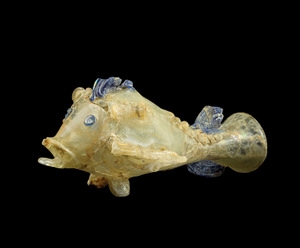
Bagram was another such city, where an astonishing cache of treasures was discovered, Chinese, Indian, Egyptian and Roman, presumably either made by itinerant craftsmen or transported from those parts of the world. The cache had been bricked up and sealed in an underground storage room in the foothills of spectacular, pointed mountains. A few items—Chinese laquer ware and ostrich eggs—were too fragile to be displayed in this exhibition, but we did get to see the alabaster dishes and amphorae, and the wonderful glass-blown fish. The fish are presumed to have been vessels for cosmetics; glass blowing had begun in Egypt around 1500 BC. There were goblets from Roman Egypt too, painted with animals and people and plaster medallions, moulds from Roman silverware, perhaps intended as samples to be shown to buyers.

We were intrigued by the ivory models of mythical beasts, such as the leogryph (ridden by a voluptuous woman) with its lion's body, eagle's wings and the beak of a parrot. Likewise there was the makara, the beast traditionally ridden by the goddess Ganga, part crocodile, part elephant, part fish. Most fascinating were the three ivory table legs in the form of three women, two of them (partly) dressed in Indian garb, but the third in a Grecian robe.

The most spectacular of the exhibition rooms was the one showing the finds at Tillya Tepe, from the tombs of a tall nomadic chieftain (1.8 m) and his five wives, perhaps sacrificed at the time of his burial along with his horse. The horse's skeleton was alongside, anyhow. These tombs were full of golden jewellery mostly set with turquoise or lapis lazuli, although there was also a stunning collection of hair pendants (sic) and a headdress ornament shaped like a tree, hung with tiny pearls. Headdresses seem to have been the women's crowning glory and there was indeed a proper crown, but collapsible—hinged in sections for ease of packing in a saddle bag. Its golden leaves would have rustled in the breeze, interspersed with flowers with silver centres. A miniature ram was found, made of pure gold, another headdress adornment.

All these treasures are the property of the National Museum in Kabul which was bombed and looted by the Soviets. Fortunately in 1978 someone had had the foresight to remove the most portable artefacts to a hiding place in the Presidential Palace, so these were saved from destruction. The vault was re-opened in 2003. Afghanistan is still not exactly a safe country, but the people have access to their treasures. On more than one wall of the exhibition halls was written:

A nation stays alive when its culture stays alive.

Sunday, March 28, 2010

Arnie and the mothers

Although I often have to label myself on forms as a "home maker", I soon get tired of home improvements and, for example, can only bear to think about our on-going kitchen renovation in short bursts. This weekend we shopped for backsplash tiles, not finding such a wide choice as advertised at Home Depot, so the next day we went to Lowe's.

I have no desire to describe this in my blog.

Otherwise I have been trying to work on the creation of two very different books, one being an illustrated story for my grandson about the ice breaking machine that was recently set to work on the Rideau River. I've named the character Arnie Amphibex and although "he" is officially known as an amphibious excavator I've called "him" a Water Digger. With our small camera we took some video footage of the ice breaking operations and mailed this to Alexander ahead of the story which will now follow (I've just finished printing it), illustrated by stills from the movie.

The other book in production is not mine but the brain child of a Caribbean diplomat living in Rockcliffe, homesick for her island in the sun, I believe, who is compiling a collection of narratives, or eulogies, about people's mothers, all of these ladies from her part of the world. I volunteered to help her with the layout and editing of her book, a fiddly task, quite time consuming. I'm using the Pages application on my Apple Mac for this (although Chris thinks I should be using LaTeX) while my diplomat friend tries to locate the illustrations—photos—of the individuals described. Each story has been submitted during the last few years by a worthy islander, and it's interesting for me, an outsider, to discover how similar they are. Nearly every contributor mentions his or her mother's piety and strictly disciplined, principled approach to child rearing. Several of these people born at the start of the 20th century were the children of slaves who had worked "on the plantation" before they were freed, but the details and general atmosphere of the stories remind me of my great aunts and grandparents in Britain.

In my friends house hangs an oil painting of a typical island shack, with little boys and chickens roaming outside. The shack sits in the sun on a pile of rocks. Apparently this was a typical former slave hut that had been moved bodily to the place where the occupant wished to live.

My friend wants her book to be tribute to all the mothers of the Caribbean, of all origins, in particular her own mother, the end of whose life inspired the start of this project.

Monday, March 1, 2010

Outside / Outsiders

Suffering from cabin fever, we went flying again on Sunday, intending to make it to Lachute for lunch, but low clouds hung over the hills north of the Ottawa River and thickened mistily over the flat country to the east of Papineauville, so that made it too risky. We can't penetrate too much cloud in winter for fear of icing. It is springlike at ground level with ice and snow thawing rapidly, but above 2000 ft. the air temperature falls below zero. We circled back and landed at Gatineau for lunch, where a hulking great Hercules dwarfed all the other aircraft on the apron.

Saturday night we had stayed out late at Gareth's and Greta's house, meeting a number theorist (cryptographer) at the dinner party, who with his wife had once entertained the world famous Paul Erdös at their home in California, and later in Calgary. Chris was in awe of this and keeps talking about it. Erdös was a man without possessions, an outsider who "turned caffeine into theorems", living from day to day off other people's charity. When his welcome grew thin he would simply pack his suitcase and move on to the next colleague's house.

That is the single-minded way a genius gets things done.

Yesterday afternoon we met another one-tracked man, an artist who wants to be nothing else and who lives in a laundrette, or buanderie, which he has converted into a studio and filled with his paintings. Marc Brzustowski (we know his parents) has been painting prolifically and the walls of the laundrette are hung with his recent winter landscapes, plus a few that I recognised from last summer at The Cube gallery, of his nightscapes. Marc has also painted more personal, anti war pictures on large canvasses, some of which hung in the foyer of the Great Canadian Theatre Company's premises during a recent performance.

It was most interesting talking to Marc and his parents. We'd spent an hour walking to the rue Frontenac through the showers so appreciated the wine and cheese provided. We bought a sketch in oils of MacGregor Lake, painted in situ north-east of here, the paint on it still not quite dry. Marc paints with gloves on, out of doors, and says the paint becomes more viscous in the extreme cold; he has to be careful not to add too much thinner. I also liked his sketches of the stretch of the Ottawa River under Parliament Hill at night time, featuring the floodlit Supreme Court or Chateau Laurier, the moon in the wintery sky and the reflections of lamplight in the pools of rainwater that sit upon the melting ice. He'd enjoyed painting the tumbling water under the Chaudiere Falls as well.

I can identify with people who live on the outside, looking in.

As non-native Canadians, Chris and I were both amused by how quiet the city became towards the end of the afternoon while everyone else had their eyes glued to various TV screens, watching the Olympic final hockey match between arch-rivals, the Canadians v. the Americans. As we walked home through the empty streets, we could hear from the pubs we passed the cries of GO CANADA! and when the winning goal was scored in extra time at the end of the game the city rang with a great cheer from the fans in the pubs, all on their feet. Then the cars began to roll, honking their horns, and the parties repaired to Parliament Hill to carry on celebrating. I'm not sure they were as patriotic on the Quebec side of the river where we had seen some graffiti saying F... the Olympics!

Friday, February 26, 2010

An Olympian torch bearer

In the 1956 an athlete called Jackie MacDonald (b. 1932) took part in the Melbourne Olympic Games, competing in the discus throwing and shot put events. She had won a silver and a bronze medal for Canada in the Commonwealth Games. She is still regarded with respect for these achievements and for this year's lead up to the winter Olympic Games in Vancouver she was one of the famous Canadian sportspeople allowed to carry the Olympic Torch. Apparently there were about 12000 of these people across the provinces and as many torches too! The bearers had the option of buying their own torch (I hadn't realised that) which they could then keep. Each of these elegant objects was made by Bombardier and did not come cheap. There were words engraved on the side, quoting from the National Anthem:

with glowing hearts/ les plus brillants exploits

At the Nigerian Ambassador's house this morning a group of us met Jackie MacDonald; she told us about her experiences bearing the torch and passed it around so that we each got to hold it. It felt heavier than expected, weighing 1.6kg.

Saturday, February 20, 2010

Arson

As if I hadn't enough to do with cardboard boxes (with all the full ones cluttering our living room), this afternoon Elva and I, afterwards joined by Chris, volunteered to construct and fill a great many more. This was at the company premises of our friends Don and Carol and not for fun: on Wednesday night their headquarters was broken into and set on fire. Not all was lost: a snowplough driver happened to notice the smoke and called the fire brigade in time to prevent the company archives and computers going up in flames, but unidentifiable small objects that had melted are lying around in profusion, the offices are unusable and everything salvageable is covered in soot. As are we, after this afternoon.

It couldn't have happened to nicer people. Apart from the hundreds of hours of extra work Don and Carol have put in at the Flying Club since November masterminding the construction of the hangar, apart from spending further hours lately helping (helpless) me to replace my kitchen and their (far less helpless) son to replace his bathroom, a close friend of their family died this week and they have been keeping his bereaved wife company and helping her for several days too. Because Carol's parents came up from Toronto to attend the funeral, she also had to make arrangements for their stay.

It occurs to me that whereas our friends have magnificent coping skills, the arsonists presumably don't. Goodness knows what thoughts are passing through their mean minds at the moment.

Anyway, talking of boxes, I'm due to see dozens more over the next couple of days when IKEA delivers the component parts of our new cupboards, in two installments—don't ask!

Sunday, February 14, 2010

E-books

With the house all dusty and disrupted I spent more time than usual "on the road" (or simply out around the corner) last week and one of the essentials I carried with me was something to read during lunch in the coffee shops. Chris had encouraged me to try out his Kindle (his Christmas present from me which had proven such a boon on his recent journeys to England and back) and every time I sat down to use it in a public place, it attracted a good deal of attention.

"Excuse me, what's that you've got there? I couldn't help noticing ..."

"Oh, is that a Kindle? If you don't mind my asking, how much did you pay for it?"

"Do you like it? Is it easy to use? How many books can you put on it? Can you buy anything you want? How much do the books cost? Do you think you'll stop reading ordinary books now that you've got one of these? Sorry to ask so many questions but my sister keeps a small bookshop!"

To bookshop owners, the Kindle is a major threat. Perhaps they're right to worry. The technology is still in its early stages and the number of available books is still limited to what Amazon thinks will sell well, plus the free-of-charge classics (out of copyright) that can be downloaded from the Project Gutenberg website. Even so, perhaps traditional books will soon go the same way as the papyrus scrolls and waxed tablets of ancient times so that electronic literature become the norm, with the result that our bookshelves will become obsolete. Well, the consequence will be less lifting and carrying, and less dusting.

Which brings me back to the beginning of this post.

Friday, February 12, 2010