blending an assortment of thoughts and experiences for my friends, relations and kindred spirit

blending an assortment of thoughts and experiences for my friends, relations and kindred spirit
By Alison Hobbs, blending a mixture of thoughts and experiences for friends, relations and kindred spirits.

Saturday, December 1, 2012

Spending a day in Bremen

On the last day of November we made the acquaintance of Bremen, one of the Hanseatic League ports of the middle ages. Lübeck was another such place, as was Bremen's Partnerstadt of Riga (Latvia), so I learned in the cathedral where they were collecting donations for a new organ in their sister church there.

Chris set off straight after our hotel breakfast for a three hour meeting with a Bremen company I'm not allowed to name, accompanied by Karsten, QNX's sales manager for North Germany and Malte the FAE for the area. Karsten too was suffering from a cold, so Chris and he manfully croaked at their potential customers together, hoping they'd be able to make a quick getaway afterwards. Not before lunch in the staff canteen where on Fridays it's always Currywurst.

Meanwhile I had a leisurely stroll down to the River Weser in the morning sunshine to see the tethered boats, several restored old ones among them, such as the Admiral Nelson, Pannekoekschip (that's Dutch for pancake ship ... we're close to the Dutch border here). A harbour boat tour wasn't on offer, regrettably. On the upper promenade by the river (the Schlachte), stall owners were getting their stalls (Buden) ready for the Schlachte-Zauber: a famous annual winter market with a maritim flavour, that had just opened the previous evening. Hundreds of thousands of shoppers are expected here and the merchants will make the most of it, dressed up in olde worlde garb, pirate costumes a favourite, especially if you have long hair and a beard to start with, selling not only Christmas decorations and cookies, but also felt hats, woolly socks, candles, ropes, salted herrings, poffertjes (another Dutch concept), wooden swords and scimitars, nose flutes, tubular bells and bronze bells. I bought a little bell for bringing my Konversationsgruppe in Ottawa to order, next time we meet. There were improvised outdoor bars with wood chips underfoot to soak up the spills and small wooden fires in braziers, to encourage long term standing in one spot. There was a rope ladder to climb for a dare, bound to throw you off onto a padded mat at the third rung, though if you made it to the top you were promised a 20 Thaler reward. After sunset, I brought Chris back here; the fiery torches were lit then, crowds were gathering and we heard a choir of elderly gents in captain's caps and navy jackets singing old time songs in Plattdeutsch to the accompaniment of harmonicas, their listeners swaying to the music, some singing along. When we returned this way after a warm up in an indoor restaurant, four lively throat singers from Uzbekistan (I guess), accompanying themselves on erhus and drums, had taken the stage in place of the ancient mariners.

My lunch had been a beautifully grilled fish with lemon juice, sauce, rice and steamed vegetables in a cosy corner house on the market square, a Unesco heritage area also full of Christmas stalls at present. I'd got there up the narrow Böttcherstrasse, which I'd remembered from a BBC German lesson I used to make use of when teaching the language, and where I bought a children's book about the Musicians of Bremen, the Stadtmusikanten of Grimms' fairy tale fame. Their likenesses are absolutely everywhere in Bremen, the bronze sculpture of them the best. I ate early, because I wanted to visit the St. Petri Dom for the free lunchtime organ recital there, J.S. Bach's Fantasien in C-mol and C-dur and his Choral-Vorspiele (Preludes) played on the Hochchororgel.

By the time that was over, Chris was free to come and meet me by the Kaiser-Wilhelm-Brücke, and then we explored the Schnoorviertel together, i.e. the oldest part of town, the streets there very narrow, winding and picturesque. The Schoor-Konditorei, in an old vault apparently, served me a delicious slice of Stachelbeertorte.

We carried on by walking through the parks am Wall, by the curved city moat, and so back via a couple of bookshops to the coloured lights and noisy merriment by the river. The Schlachte-Zauber smelled of woodsmoke and Glühwein.

Friday, November 30, 2012

Unterwegs

Hamburg Hauptbahnhof, yesterday afternoon
We're crossing northern Europe from one place to another, again.

On November 23rd we flew overnight to London, with hardly any queuing at the airports and an extraordinary view of flooded England on the descent to Heathrow. What are those wide rivers I don't recognise? I asked myself. They weren't rivers, they were watermeadows, doing their job, as Martin pointed out when we met him in Reading later.

It was still raining when we got off the X26 bus at Teddington with our luggage (lucky enough to be able to leave it in our Park Hotel room at 10 o'clock in the morning) and raining more heavily when we walked across Bushy Park to Emma's and Peter's house with the boys, via a fish 'n' chip shop. Why did they put that 'n' in the sign, Alexander's granddad asked? Because there wouldn't have been enough space between fish and and and and and chips. Alexander thought that was a very funny sentence.

On the Sunday (Nov. 25th) we all caught the Number 33 bus to the London Wetland Centre, although that was less of a wet day, quite fine, fortunately. It's a good place for families. We found all manner of ducks and geese there, and a black necked swan. When the birds dived underwater Thomas said "Duck gone ... 'peared ..." (short for disappeared. He is just beginning to talk.) There were bird watching hides with adult watchers who had taken a vow of silence within. Thomas threw pebbles into the puddles for the sake of the splash, and Alexander used his binoculars. We found a great playground with tunnels and a rope slide. Back at the house, Alexander demonstrated his reading skills to me, and Thomas admired the moon, as well as a street lamp that he also referred to as the moon. ("Bye-bye, moon!" he said, as we went in again.)

By Monday I was developing Thomas' cold. Chris went down with it the following day, and my mother, sad to say, the day after that, because we were visiting her in Cardiff. I have far less to report about Cardiff than I'd have liked, because we were so indisposed. It can't be helped. We enjoyed one another's company and an Indian supper in Whitchurch, and would have very, very much enjoyed a trip to the empty beach with Faith and Mel on the Wednesday morning, had we felt up to it. As it was, we had to muster our inner resources for the drive back to Reading, where we had to stay that evening, at the Ibis hotel on Friar street, stuck in heavy traffic in the Reading rush hour on the way. The Budget car rental staff are to be commended for waiting for us to arrive late at the end of a stressful day for them, and for treating us courteously when we finally brought their car back.

We slept on the 13th floor of the Ibis, which is the best floor according to a regular customer I met in the lift. It certainly offered a good view from the windows, looking down on the curly high street gables, without which that city would be far less attractive. Next morning we made a leisurely start on the RailAir bus to Heathrow's Terminal 5, whence we flew to Hamburg with British Airways, taking off in sunshine, landing in grey cloud. Neither of us felt poorly any more; it was easy enough to roll our luggage to the S-Bahn station: "This train [S1] proceeds in the direction of Hamburg Central Station," the loudspeakers helpfully announced in English. Hamburg Hauptbahnhof was rapidly filling up with rush hour commuters and long distance travellers as we waited for our connection to Bremen, and when the train came, it was so packed that we couldn't find a seat. Chris stood up all the way to Bremen and I sat on the floor between people's feet, reading the "Spiegel" and eating leftover Heathrow sandwiches. At Bremen Hbf. we had some difficulty hiring a taxi and when we did manage it, the driver was somewhat rude and curt, but no problem, we came directly to the Mercure Hanseatic Hotel in the Alte Neustadt and neue Neustadt along the Friedrich-Ebert-Strasse, across the river. Another Ibis-like hotel with perfectly adequate accommodations but no bath for Chris to soak in. Nonetheless we slept like logs, apart from the strange dreams we both had.

Today Chris worked hard until lunchtime, then spent the afternoon with me in old Bremen, but that will be the subject of a separate blogpost.

Tuesday, November 20, 2012

Under the ruins and over the dunes

Flashback to Wednesday, 29th August

Carreg Cennan Castle in Carmarthenshire, at the western end of the Brecon Beacons, is an extraordinary place. Faith and Mel took Mum and me to visit it while I was staying in Wales. It's just beyond a pretty little village called Trapp, where Mary, Mum's friend and neighbour (who died this year) was born.

Built in the 12th century and already a ruin by the mid 15th century, after the Yorkists had attacked it during the Wars of the Roses, the castle had been of interest both to Edward I and Owain Glyndŵr and had changed hands many times during that turbulent period.

It was a stiff climb up to the castle from the farmhouse at the foot of the hill. The farm breeds sheep and longhorn cattle and uses the meat from them in the meals you can buy in the "tea room," a former barn. We saw the animals on the hillside as we walked up, Mum clinging on to Faith's arm and managing well.

The castle ruins were impressive enough; it must have been a stately home in its day. But in the bedrock below the castle was something astonishing:
In the south-east corner of the inner ward steps lead to a vaulted passage and a natural cave beneath the castle, which leads deep into the hillside. A fresh water spring rises in the cave, which would have been a useful supplement during dry weather (Wikipedia)
While Mum stayed in the courtyard on the surface, Mel persuaded me to go down those steep steps. I slipped and sat down once, in spite of the railing; no harm done. We had to watch our heads too, wearing head torches because the passage led beyond the light of day. The spring, surrounded by stalagmites, was rather beautiful down there, and the water very clean and cold. I had a taste of it, of course.

Another thing I had a taste of was the pie served at the "tea room" where we were kept amused by a party of elderly gentleman-cyclists at the next table, dressed in brightly coloured modern biking gear and boasting about their knowledge of computer apps. All this time, the weather was clearing up.


Looking down from the castle hill to the farm and beyond
In the afternoon, Mel drove us to the Gower peninsula

Whiteford Burrows is a dune and pine plantation, just North of Llanmadoc. Owned by the National Trust, it is classified as [a] National Nature Reserve [...], a haven for ornithologists and botanists alike.

We went for a walk recommended by the National Trust, that led to a tidal saltmarsh on the shore of the Loughor Estuary where ...
the vegetation is grazed by graziers with commons rights. Some of the lamb reared here is sold as 'salt marsh lamb'. The unique taste of this highly flavoured meat is thanks to the area's marsh vegetation.
Wild horses were grazing there too. It was soggy underfoot on the path to the shore; before we struck across the dunes I enjoyed wading barefoot into the water with the seabirds. The wind was blowing the sea spray on the horizon and the views across the estuary were crystal clear. Then we found the track through the pine grove back to the village where we'd left the car.


Friday, November 16, 2012

What is wealth?

From an article on the BBC website:
"I'm called 'the poorest president', but I don't feel poor. Poor people are those who only work to try to keep an expensive lifestyle, and always want more and more," he says."This is a matter of freedom. If you don't have many possessions then you don't need to work all your life like a slave to sustain them, and therefore you have more time for yourself," he says."I may appear to be an eccentric old man... But this is a free choice."
That was the President of Uruguay, "who lives on a ramshackle farm and gives away most of his pay."

I took an international group of visitors to the Bank of Canada's Currency Museum this morning, and we had guided, hour-long tours. The tour guide for my group paused at the exhibition of early Canadian currency to explain that the native people of Canada didn't consider the accumulation of wealth (i.e. capitalism) a very good idea. What was better, in their view, was to give their possessions away to the representatives of neighbouring tribes, typically at potlatch ceremonies. In that way they may have lacked a few necessities for a while, but they became immensely rich in friends.

Interesting concept?

Wednesday, November 14, 2012

Two chairs on a stage

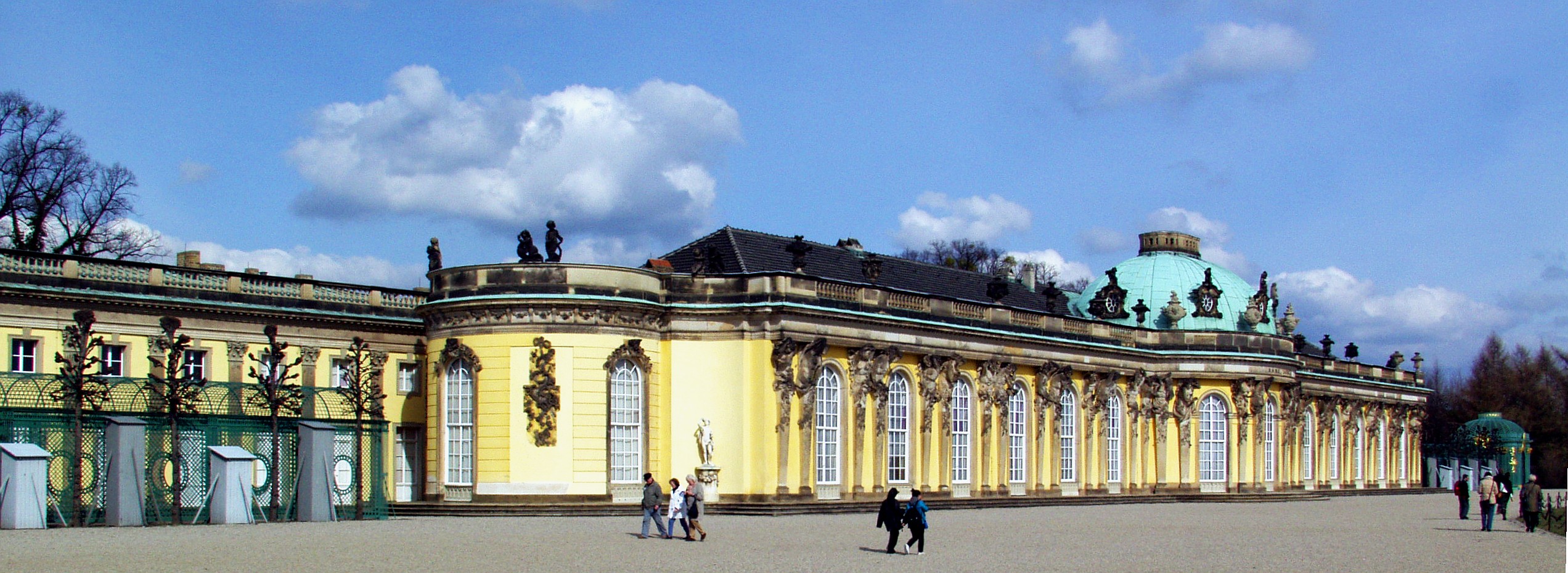
At the weekend Chris and I went to the Arts Court for a one-off show. Publicised by the German Embassy and the Goethe Institute, it was entitled Voltaire and Frederick, a life in letters and was a dramatised reading of an exchange of letters by Voltaire and Frederick II (aka "the Great") of Prussia. Frederick knew J.S. Bach as well, and C.P.E. Bach was a musician at his court, but they didn't come into the story. Many of the letters were sent from the palace at Potsdam (Sanssousi), which we visited once.

The two men corresponded for almost 50 years, in sickness and in health, sometimes quarrelling bitterly, till death did them part. We didn't get to hear every single word of their letters, just a selection. The letters were originally written in French and in modern English the translation was bound to include anachronisms, but it made their ideas and emotions immediately recognisable. They sounded equally intelligent. Voltaire in particular had a great sense of humour.

The only props consisted of two spotlit, modern office chairs centre stage which the actors came and sat on. They wore modern clothes and read the letters from ring binders. In fact I think it would have worked better as a radio play, although admittedly the actors' faces were interesting to watch as they read out the angry or the excited letters. Both men led troubled lives, but clung to their correspondence as a sort of consolation, it seems. The performance ended with "Frederick" reading out his eulogy to the philosopher who had died at the age of 83.


Tuesday, November 13, 2012

At the Asian supermarket

In 1993, a rather homesick Taiwanese lady in Vancouver called Cindy Lee started a business in that city, opening a grocery store called T&T. There are 22 T&T supermarkets in Canada now, most of them in Vancouver and Toronto. Today, with some other people from the Canada-China Friendship Society, I joined a guided tour of the much talked about the new Ottawa T&T on Hunt Club Road. We had some very enthusiastic young people as guides, employees of the store, who allowed us to sample quite a few items of edible produce, baozi stuffed with tasty roast pork, for example, xiao mai, and tender slices of Nanjing salty duck, but fortunately we weren't encouraged to nibble at the barbecued cuttlefish or the chickens' feet.

Jimmy, the manager, met us at the front door and showed us a map of China, explaining that the Chinese visualise their country as being north and south or between the great rivers, the Yellow River and the Yangtze. North is the wheat country (noodles and baked baozi) and in the south it's rice (and steamed dumplings). Then we went straight to the "Kitchen" or dim sum corner for some sampling. Dim sum are southern snacks, typically eaten "with chicken tea" for breakfast by groups of old people after they've done their morning exercises. We witnessed these physical exertions in Hangzhou!

The groceries at the T&T supermarket are impressive in their variety. At the barbecue counter is a display of roast chicken and whole roast ducks, hanging from hooks in their necks, the heads still on, of course and coloured red by virtue of the sugar used in their coating. A pig's carcass hung there too, with the roast pig's head on a tray underneath, and the cuttlefish with its dangling tentacles. If you don't fancy slicing up these meats yourself you can choose from 23 ready meals neatly packaged ("BBQ Meal Combo"), or from a selection of ready-to-fry meals with labels to tell you what they are: "spicy pork stomach" or "salty mustard greens" (very popular).

To the bakery corner, next, where we met bakery manager Raymond who let us try a piece of pork filled bun and then announced, "I have some dessert for you ladies!" handing out pieces of egg custard tart with  miniature cups of a mauve coloured drink called "taro tapioca"––the taro had a sweet flavour, rather like sweet potato, but I'm afraid the tapioca reminds me of frog spawn. They had a purple-frosted taro cake there too and some cakes for children's birthday parties that looked like cats' or pandas' faces.

In the main part of the supermarket we were told that the sauce aisle is the "most busier aisle;" it had a large variety of soy sauces and marinating sauces, among which was an enormous jar of pat chum "for pork's feet"––good for new mothers, apparently. We paused at the noodle section too. I hadn't realised that some noodles are made from calcium rich, low calorie tofu. When buying the ready-shaped dumpling dough, don't forget that "round is for dumpling, square is for wonton."

I think that the fishmonger, wearing a yellow apron, was the most enthusiastic of the T&T department managers; he told us he had the biggest seafood sales in Ottawa. Lolan commented that fish is a must for the Chinese New Year because the character for fish, yú, (鱼) also means "abundance." Many live creatures were swimming, wriggling or otherwise still alive in the fish tanks. At the opening of the store, they had 10,000 lobsters available. Yesterday a few of us were struck by a large, live clam that according to one of our group "looked vaguely obscene": the geoduck. "Vaguely" may be an understatement.

Asian shoppers prefer their meat and fish as fresh as possible, and I suppose that is why the meat still looks like what it really is in their displays (such as the large tongue of beef and the tripe). We heard the word "nutritious" used a great deal. The free range, black chickens, for instance, were more nutritious than the conventional sort: the butcher waxed quite lyrical when describing them. He also told us about the communal meal that consists of dropping thin uncooked slices of beef into a consommé soup for a short moment before picking them out again to eat (i.e. the Chinese fondue or "hot pot" custom). "Every people like this one!" he exclaimed.

Tuesday, November 6, 2012

An old-fashioned day at the seaside

Monday, September 1st


The forecast promising fine weather, it was time for a day on the beach. We chose Barry Island because of its short walking distance from the railway station to the sands, and met my sister on the train at Cardiff. It was a 25 minute ride, quite long enough for an excited toddler like Thomas, who wants to climb the chair backs and explore the aisles all the time. As soon as we were off the train though, he fell asleep in the sunshine.

Barry Island is a very traditional British seaside resort on the Welsh side of the Severn estuary, complete with merry-go-rounds, bucket and spade shops and a first class fish and chip shop; tea can be bought there, although Mel's Aunty Kathy used to bring her own teapot with cups and saucers for the brew, when his family used to come here on Bank Holidays, down from the Rhymney Valley in the 1960s. There's plenty of sand for crowds of families, especially when the tide is out, rocks to sit on at the end of the beach, rockpools with hermit crabs and a ramp up to the "showers"––cold water water taps in the wall––for the times when you're covered in sticky sand. The damp sand does stick to your skin, but is of a perfect consistency for sandcastle building and the digging of holes. Emma, thoroughly enjoying her little break from work, built an Olympic Stadium and the boys played with their spades, buckets and a ball. We went in the water too, no waves, but it moved about alarmingly, as far as Thomas was concerned. My mother tripped over a rock she hadn't spotted and gashed her leg. No permanent harm done, but she had to have 1st aid. I built a small inuksuk; my sister wandered around in the rockpools.

From the grassy headland:
Whitmore Bay, with Steepholme Island in the distance
(Chris was in Fremont, California at the time, at meetings with designers of robots that do knee surgery, advising them on the safety critical aspects of their software.)

For lunch wie had fish 'n' chips with the apostrophes in the right place. Barry Island is an alcohol free zone, a good idea! At the end of the day we took a short walk on the grassy headland––lovely to have one's bare feet on the turf––and Alexander, looking west, shouted, "Oh look, there's another beach!" without a human soul on its wide sands. Wonderful. We came back past the bouncy slide (5 minutes allowed) and he played on that though almost too tired from the hours of running about. Thomas, drifting off to sleep then waking up again, was overawed by the great quantity of rubber ducks in the hook-a-duck game.

And so back to Cardiff.