At last, we have a functioning light rail network in Ottawa. The Confederation Line, with 2.5 km of tunnel, has been opened and connects with the existing Trillium Line at Bayview. Only consisting of 17 stations so far, it is nothing like as complex as the networks of other capital cities in the world of a similar size, such as Copenhagen, but at least it's a start in the right direction. The airport will be connected to downtown Ottawa three years from now (allegedly) as part of the Stage 2 enhancements that will eventually give us 24 more stations. There are vaguer plans for a Stage 3 in the distant future, probably well beyond the time when Chris stops going to work in the mornings and coming home in the evenings from Kanata. Let's hope someone else will benefit, though. If only a rail bridge could take these trains across the Ottawa River into Gatineau too, wouldn't that be wonderful?
Waiting for my first ride
It remains to be seen how well the new transportation system will function during the winter. We're hopeful that it'll be an improvement on what we've had till now.
Ottawa citizens seem excited by the new trains (although commuters are frustrated about the time it takes to connect to a bus ride home, once they have disembarked from the train, at the Tunney's Pasture terminal in particular). There ought to be larger parking lots at the end stations, in my opinion, to encourage people to park and ride. When the lines get extended, that is more likely to be the case.
On the train
On impulse, Chris and I decided to go for a ride on the new line on its opening day. We didn't go until the evening, when the crowds had diminished a little, but it was still standing room only on the eastbound train we took from Rideau to Tremblay, the stop we'd need if we were hoping to catch a ViaRail train bound for Montreal or Toronto or places in between. We used our local Presto cards which work at the gates just like London's Oyster cards* or Tokyo's PASMO cards. The mood on board was positively jubilant, everyone talking at once, joking and celebrating. Most passengers were just riding the new train for fun, some of them buying drinks at each end of the line! In a few months' time it will doubtless be a more routine and less exhilarating experience.
Tremblay station
The station at Rideau is deep underground, requiring a series of escalators to reach its platforms. A little further west the tunnel is as much as 40m from the surface. I thought the escalators at Rideau juddered and wobbled a bit, which shouldn't happen; the managers need to make this part of the journey smoother or people will feel too anxious to repeat the experience. Teething troubles only, I hope. At Tremblay where we got off, there were no escalators at all, just stair cases and elevators, which surprised me, since people with luggage are going to be using this station.
It was already dark when we rode the train so we couldn't really see the views from its windows and most people, Chris for instance, hadn't a clue where we were. I knew though. I have studied the map!
* The Oyster card is fairly redundant these days since London Transport's card readers were modified to allow passengers to tap a credit card, instead.
Je ne montre que ce que je veux bien montrer, said Paul Gauguin, speaking of his art in 1903. So his images keep us guessing.
His mother was of Inca descent. Born in 1848, he spent his childhood in Peru. When he grew up he went into the French navy and also worked as a stockbroker. He was a full time artist from the 1880s onwards, living in Brittany, Martinique, Polynesia (in self imposed exile), and finally Tahiti.
This restless soul, according to the notes on the wall of the National Gallery of Canada's exhibition this summer, was "cut off and shrouded in gloom". Although they had five children together, his marriage to a Danish woman fell apart and the (very young) Tahitian girls with whom he lived abandoned him as well. A self portrait of 1891 is entitled Jésus abandonné, ses disciples le quittant. Presumably he was implying that he knew how Jesus felt.
The Auto portrait au Christ jaune is another meaningful painting, first exhibited in 1892, with a Polynesian idol in the background as well as the crucified figure; the Christ jaune was a canvas he had worked on three years previously.
Meijer de Haan is the "thinker" in the background of several paintings: Gauguin's ginger-haired Dutch friend and fellow artist. A better known associate of Gauguin was Vincent van Gogh with whom he lived for a while in Arles, where colours were their obsession:
Dans ma chambre jaune, des fleurs de soleil aux yeux pourpres se détachent sur un fond jaune; elles se baignent les pieds dans un pot jaune, sur une table jaune. Dans un coin du tableau, le signature: Vincent. Et le soleil jaune qui passe a travers les rideaux jaunes de ma chambre, inonde d'or toute cette floraison, et le matin, de mon lit, quand je me réveille, je m'imagine que tout cela sent tres bon. [...] Quand nous étions tous deux a Arles, fous tous deux, en guerre continuelle pour les belles couleurs, moi j'adorais le rouge.
This all sounds very poetic, if more than a little manic. The co-habitation famously came to a sad end when Vincent got his razor out and lashed out at Paul and at his own ear, after which episode he (Vincent) was put out of harm's way by the doctors.
Jean Moréas was another friend who looked weird, a poet, one of the symbolistes. Mallarmé, poet of symbolism and synaesthesia, was the most famous of the symbolists' circle in France. Gauguin's cylindrical carving in native Polynesian style, L'Apres-midi d'un Faune, 1893, is a mysterious fantasy inspired by Mallarmé's poem of that title (published in 1876). Does it depict encounters with beautiful nymphs, or what? It is unclear what's happening in Gauguin's image, something sexual, certainly. In a variety of art forms, the poem inspired music by Debussy, was danced by Nijinsky and was translated into English by Aldous Huxley (among others).
Clovis
Annette Belfils (1890)
Having been to the exhibition twice, I felt that what I'd remember of this were the faces. The portrait of Annette Belfils (1890), in simple lines of crayon and chalk, was remarkably well done, as was the sympathetic and sincere painting of a two year old who had just died in Tahiti, lying as if asleep, done in 1892 for the child's parents who apparently hung onto this painting all their lives. Gauguin painted portraits of his own children, for example of his son Clovis in 1886, the boy's expression old beyond his years (his parents separated when he was six; he died at the age of 21). Gauguin's immortalisation of An Old Man with a Stick (1888) was beautifully observed, still touching those who look at it. Then there were portraits of an Arlésienne and of a young Breton woman, thin and depressed. It seemed to me that Gauguin became less crazy whenever he was focusing on someone other than himself.
La Boudeuse, a likewise depressed Tahitian girl in a long, red, western (missionary) dress, is perhaps one of the ones he made pregnant; I'd guess she was sickened by the loss of her innocence or the loss of her cultural heritage, and that the artist knew it. By contrast, La Femme au Mango, in purple, looks more cheerful and self-assured.
Les Ancetres de Tehamama portrays another mysterious Tahitian girl, Teha'amana, who was only 13 when handed to Gauguin as a "bride". He paints this naked girl lying face down on a bed with "the spirits of the dead watching", 1894. Perhaps those dead ones disapproved of how he was using her. Perhaps he created this picture in order to confront his own shame. We shall never know. "Je ne montre que ce que je veux bien montrer."
A new season of DOMS concerts has begun. Today I went to listen to an organ and saxophone duet, an unusual combination. The saxophone sounds quite like an extension to the organ, an extra, on-stage pipe. Ludovik Lesage-Hinse from Trois-Rivieres played both a soprano and an alto saxophone during his performance, with Jocelyn Lafond, also from the Trois-Rivieres Conservatoire de musique, at the organ.
The composer featured in this concert was another French-Canadian, Denis Bédard, of my generation, born 1950. Half way through the concert I realised what it reminded me of, the easy-to-listen-to harmonies, rhythms and melodies of John Rutter.
At the beginning we heard a piece by Bédard for organ alone, variations on the tune of a hymn we used to sing long ago, known as The Old Hundredth:
All people that on earth do dwell, Sing to the Lord with cheerful voice. Him serve with mirth, His praise forth tell, Come ye before Him and rejoice.
At least, that is what I learned then. In modern hymn books (such as the ones kept in the pews at Southminster Church), it reads like this ...
All people that on earth do dwell Sing out your faith with cheerful voice. Delight in God whose praise you tell, Whose presence calls you to rejoice.
What a comedown! For one thing, to that tune, it puts the stresses on the wrong syllables (DE-light in in God ... WHOSE presence calls you TO rejoice.) What was wrong with the older version? To serve "with mirth" admittedly sounds odd nowadays (in the 16th century it meant "joyfully") but I don't recall that this used to bother me; I liked the funny-sounding old words and could follow their meaning perfectly well. Then I bet the language committee censored "the Lord ... His praise" and "... before Him ..." because it's now considered sexist to give God a masculine identity. And they probably thought that the retention of words like "ye" would deter modern youth from entering a church. That sort of nonsense irritates me immensely.
Such thoughts interfered with my concentration on the music today, a series of variations on the chorale-like melody of this hymn. When I was listening, I was feeling critical of the music too: interesting ideas but unoriginal chords, tempo too fast. The variations didn't altogether fit with the hymn's solemnity, but fair enough, they are supposed to be variations. At one point the organist added vibrato effects, as with the old fairground or cinema organs. (Where I grew up there used to be a swimming pool organ, even. Wandering thoughts, again!) I liked the variation that presented the tune on the foot pedals, with swooping downward arpeggios above it. That one had some substance.
There followed an arrangement of another Protestant chorale (Befiehl du deine Wege) by a composer I'd never heard of, Gotthilf Friedrich Ebhardt of the 18th / 19th century, played here on the trumpet-like soprano saxophone, with organ accompaniment. This composer didn't write music in the style of his day either, sounding more late-Baroque than early-Romantic.
Back to Bédard for the rest of the programme. The saxophonist played seven Vocalises originally intended to be performed by a mezzo soprano. "They're really beautiful!" he told us. The first was wistful, as was the fourth. Other movements had a more folksy quality. The 2nd vocalise I found rather Swiss, where the organ kept echoing the saxophone (voice) part. I almost expected yodellers to chime in. The last movement was clearly inspired by French-Canadian folksongs.
The soprano instrument was then put away. The last item on the programme was Bédard's Sonata No.1 for alto saxophone and organ. Apparently there are two more such sonatas, to be set aside for a later concert in the series! Again, the music sounded sweetly derivative, pleasant enough to listen to, but lacking depth, I felt. Most of the audience was enchanted by it. The faster movement at the end, the Humoresque, seemed to have more character, a bouncy piece that would also have come across well on a clarinet.
They gave us"one more", perhaps a movement from one of the other sonatas, I didn't catch. The composer's signature style seems to be a long drawn out, emotional melody line with a steady beat in a low register on the accompanying instrument.
So why am I so snobbishly critical of light, crowd-pleasing music? It goes back to my upbringing and further back yet. In his impoverished youth, my father was given free, private music lessons by a retired Oxford don, a long story. One of the things this "Great Man" impressed upon him was that there are standards to be met in music, as in life. He taught him, for example, that a dominant seventh in compositions was a cliché to be used only sparingly, and that sentimentality made musical compositions mediocre. When I in turn became my father's music student, such attitudes rubbed off onto me, and (more than ninety years later) still stick.
Where was I? Back in Tokyo, where we ate a few Japanese meals, not as many as we should have, perhaps, given the opportunity, because we were staying in the middle of the city where food of every origin is available, slightly modified to suit local tastes; we ate at north Indian restaurants, Thai and Vietnamese restaurants, at a very good Italian trattoria near the Nihonbashi bridge (twice) and at French bakeries for breakfast in the mornings where you could pick up croissants and quiches with the metal tongs provided and put them on clean trays to take to your table. To collect your cup of coffee you have to bring a paper receipt to the drinks station and wait.
Before and after eating, moist hand wipes wrapped in plastic are liberally supplied. In the posher places you're given a hot flannel roll for this purpose, also wrapped in plastic, more often than not.
The Japanese seem to enjoy eating beef; a popular thing to do is to eat at the places where they serve "steak and hamburg" (i.e. hambagu, a hamburger steak without the bun, smothered in Teryaki sauce).
Shabu shabu beef portion
A couple of the people with whom Chris was working in the city invited him and me out for a meal at a Shabu Shabu restaurant. The meal — of the sort sometimes called a Chinese Fondue — was cooked at our table, effectively by the four of us, although a waitress came by from time to time to supply the ingredients and scoop unsightly foam from the broth that was cooking in two shiny copper, lidded bowls. The amount of raw beef on each of our plates looked daunting (see photo) but the slices were so thin that they disappeared fairly quickly, once quickly dipped into the broth with our chopsticks, then consumed. "Shabu shabu" indicates the gesture and perhaps the sound you hear as you do this. You mustn't keep the meat cooking for long. You're encouraged to grind your own seeds and spices in which to coat and flavour it; each diner has an individual bowl of soy sauce too. We also had a bowl of fresh, raw vegetables, tofu and rice noodles to coat with sauce and add to the broth, one ingredient at a time. The finale to this meal entailed drinking the broth from soup cups, having cooked ramen noodles in it and eaten them also.
Shabu shabu sauce, seeds and spices
Shabu shabu vegetables with tofu and noodles
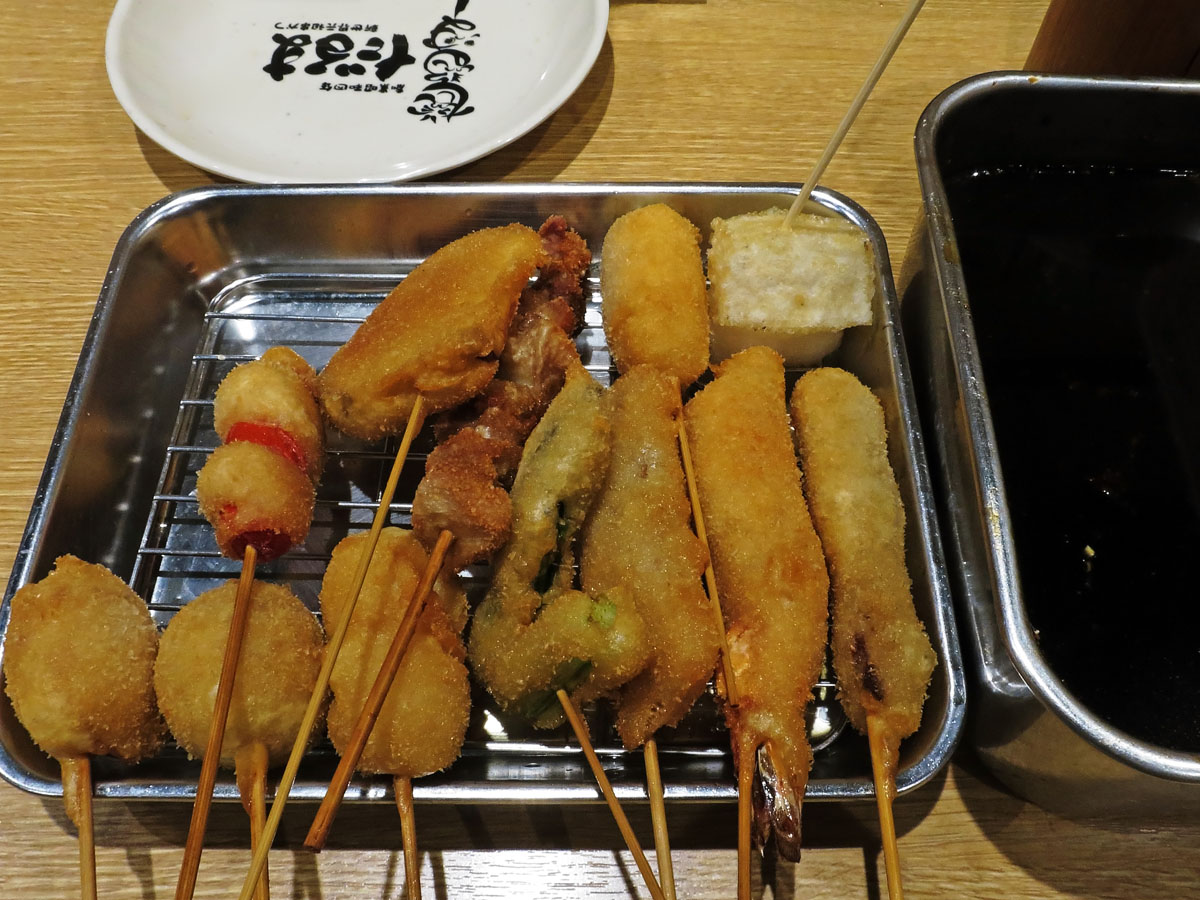
Left to our own devices, we found a small place one evening in the Kanda district where kushikatsu, a speciality of Osaka, was served. This meal was fun, eaten close to a table of noisy young men squatting on small stools. The kushi are the bamboo skewers, whereas katsu are the breadcrumb coated, deep fried pieces of meat, fish, prawns or vegetables (onion, Lotus root, pickled turnip, aubergines, green peppers, asparagus spears, mushrooms) or hard-boiled quails' eggs. You're meant to dip these delicacies into a black sauce to flavour them, presented in a stainless steel dish, but double-dipping is not allowed. In case you'd like extra sauce on your katsu, raw cabbage leaves are provided; again, don't dip them twice because it is unhygienic, but you can use them as spoons to scoop some sauce from the dish.
At one restaurant I ventured into, on an upper floor (many eating places are not at ground level), I was shepherded into a private annex; I'm not sure why. There wasn't much English vocabulary on the menu here so I chose from the photos, although what I was served didn't match the picture very well.
On a hot afternoon towards the end of our stay we cooled down in the piano bar below our hotel, where we were treated to a sort of clarinet and piano recital as we sipped our drinks, an elegant place hung with splendid lanterns.
On my way to pick up my bike that has been in for a tune-up at the bike shop this week, I walked through Beechwood Cemetery, Canada's national cemetery today. I was on the look out for a certain grave, the resting place of Sir Cecil Spring Rice ('Springy' Rice, as he was affectionately known). He died in Ottawa in 1918, having written the words of a hymn that nearly everyone knows: "I vow to thee, my country ..." (the music by Holst and its repeated use on Armistice / Remembrance Day are what makes it memorable). The motive for my quest was that I need to illustrate an article that one of the Ottawa-CFUW members has written about this, for publication in an upcoming issue of our newsletter, for which I'm currently the editor. We'd already found a picture of the grave online, but I wasn't sure we had permission to use it, so thought I'd take my own photo.
Knowing that there are a great many graves in this cemetery I thought I had best go into the office to ask where this one was located. The lady at the reception desk was very helpful, even giving me a map, having looked up the information in a thick reference book. The areas of the graveyard are numbered, in no very logical order it seems to me, but I'm sure there's a system behind it. I commented on how full the cemetery was, and the lady replied that "at the last count" they reckoned they had 83,000 people buried here. That is a lot. Some of their families have had memorial trees planted as well.
During my walk I started on Beechwood Avenue and walked all the way to the St. Laurent Blvd. at the far end, which is quite a distance, meandering to follow the roads and to search within Section 22. I did find his grave in the end but failed to find the grave of my friend Melita, whose funeral I'd attended here last year, the remembrance ceremony taking place in the "Sacred Space" indoors and at her graveside (but we were led there and I couldn't remember the exact plot). The place looks different in the summer.
The Chinese Pagoda at the cemetery
I'd been on a guided tour here once and remembered that at the eastern end there's a Chinese area with names on the gravestones written in Chinese characters. I found that again and admired the oriental pavilion with a cast iron incense burner beside it and a gateway that adorns the garden alongside. This no doubt gives comfort to the relatives of the people buried here: a touch of home.
Former fish dock on the river (seen from Kachidoki Bridge)
I caught a whiff of the Tsukiji Outer Market area before I reached it. First I had taken a look inside the Buddhist Tsukiji Hongwanji Temple, as large as a cathedral, that had immediately caught my eye as I emerged from the closest metro station, H10 on the Hibiya Line. Walking towards the Kachidoki bridge over the Sumida River, the market area was on my right; I could smell the fish from the other side of that 6 lane road. The fishermen's dock where they sold their fish from the boat used to be here too, but has recently moved elsewhere (to Toyusu).
As usual, this was a very, very hot day and it was a relief to find that some of the stores and shopping areas in that crowded district had cool interiors, the market hall in particular, where I quenched my thirst with a bottle of freshly squeezed mandarin orange juice, a glass bottle for once (plastic is the norm, unfortunately, and most shopping in Tokyo, apart from the very high-end stores, involves plastic bags too). The fishes, large and small, the eels, octopus, turtles and so on for sale in that long, old fashioned market hall, recently caught, were displayed in crates and packed in ice. I found the squishy-looking dead turtles particularly revolting, but I suppose the locals get used to them. Shellfish is sold complete with shells. By the time I was looking round, late morning, a lot of the day's produce has been sold already. In the warren of narrow streets around this place, many other things apart from seafood were on sale, but it was mostly seafood. Tourists can pick up bargain souvenirs here, tawashi brushes, teapots, kitchen utensils, speciality teas, and many places sell viciously sharp looking kitchen knives that wouldn't be allowed through airport security checks. It was a great place for browsing, very atmospheric and noisy, the marketeers shouting out their wares, and two men on one corner literally singing the praises of a local restaurant, in counterpoint. Overhead was a tangle of electrical cables, as in the more chaotic parts of Chinese or Indian cities. I felt thoroughly abroad here. On one alleyway fish was being grilled on a barbecue, charred by means of a flame-thrower. Some shopkeepers and restaurant owners were coming outside to sluice down the pavement outside their premises. I caught one on camera.
My chef at the Sushi restaurant
Beginning to want some lunch, I paused outside one of the numerous fish restaurants, this one called Sushi Say Honten, and was persuaded inside with expressive gestures and welcoming words in Japanese from the man at the door. I was offered a high stool at the counter where I could watch my choice of sushi roll being prepared. The young chef had a sort of conversation with me in which he ascertained that I was from Canada, at which he beamed all over his face, saying "Ah, MAPRE SYLUP!" --- at which I smiled broadly, too. The young man also conveyed to me that he was going to prepare me a very good lunch: using hygienic gloves started slapping some sticky rice together and preparing thin slices of raw tuna, salmon and yellowtail, with serious concentration. It did taste good, with a small cup of miso soup on the side. Whenever any individual or party finished their meal, paid their bill and left the restaurant, all the staff shouted something incomprehensible and cheered: a lively farewell. I got the same treatment.
*****
Exhausted by the stimulating time I'd spent in Tsukiji, I didn't feel like discovering much more in the afternoon, but on my way back to the hotel, after a little searching, I found the entrance to the quirky Kite Museum in Nihonbashi. It appeared to be a popular restaurant, with lines of people waiting for a table; indeed the owner of this restaurant is also the kite collector who owns the small museum upstairs, the entrance to which is at the door of a narrow lift on the 5th floor. When I went, I was the only visitor at this museum. It was quite claustrophobic, packed with kites of every age, size, shape and origin. Most were made of paper, but some were quilted or made of cloth affixed with feathers, etc. Curious children must love it here. The exhibition includes paintings or drawings of kites and kite flying. I liked the demon faces and the extraordinary paper kite that looked like a sailing ship.
There's a choice of transportation to reach the centre of Tokyo from Narita airport. On our first visit seven years ago we'd been met by a Japanese gentleman who helped us buy tickets for a direct "Limousine bus" ride to the Tokyo City Air Terminal near our hotel. This time, the TCAT was not so convenient because we'd have needed to buy a separate subway ticket from to this year's hotel. We'd had some advice from a citizen of Tokyo who told us that our best option was to take the fast, Skyliner train to Ueno, then change to the Ginza line. Taking the Narita Express train to Tokyo's central station and going the rest of the way on foot would have worked too, but the walking route at the end wouldn't have been straightforward.
The Skyliner is comfortable and fast, although you can't see much out of the window beyond the barrier fence that lines its tracks. Before we were allowed to board the train at the airport we had to wait while it was rapidly and efficiently cleaned. Seat reservations are compulsory. My only complaint is that foreign travellers ought to be warned the ticket office deals with cash only, not credit cards. We were encouraged to buy "Special Discount" return tickets that included full use of the city's underground train system, valid for 24 hours after our arrival. It was a shame we were too tired to take full advantage of this deal.
The subway trains in Tokyo are worth using, for the cultural experience. I was surprised at how full they were at 9:30 - 10 a.m. and around 7 p.m.; Tokyo office workers start and finish work later than in the countries I'm used to, so these are the rush hours. Most trains are air conditioned, which is just as well, but I often noticed people fanning themselves, either with electrical or traditional fans. Not so many people wear face masks in August as in February. The predominately solitary passengers use their smartphones to avoid too much eye contact. Children are brought up to keep quiet and still in the trains. At each stop, electronic signs indicate where you are, Japanese and English displays alternating, showing a list of possible connections and which side of the train to step from. The more up-to-date platforms have barriers with automatic gates that line up with the train doors, preventing suicide attempts. The trains are long and frequent. Stations are long, too, some requiring a good half kilometre's walk underground, and generously supplied with shops, eateries (numerous French bakeries / coffee shops associated with the commercial towers above street level), information centres and washrooms. Their passages are spotlessly clean. At the stairwells of our local station, Mitsukoshimae, lights in changing colours enhance the brick walls. I have read that the blue lights are another suicide preventative, that has proven effective in this nervy city.
Travel by road is another story. Chris rode a short distance in a posh limousine to one of his meetings. We saw regular taxis slipping down side streets, but didn't make use of one. An eye-catching vehicle was the little one-person EV we passed on our first morning in Tokyo, ready for hire on a street near the Imperial Palace; we also found one of these at Toyota's MegaWeb showplace on Odaiba island, where I sat in it. The driver's seat is the only seat; someone my size just fits, but it would be too small for Chris.
The Concept Car
The MegaWeb theme park, fun for the whole family, is really a glorified car showroom, a clever idea of Toyota's. It features one of their Concept Cars, a futuristic, "smart" vehicle that could be fuelled by hydrogen. The site also has a race track would-be race drivers can try out, and an area where able-bodied kids can sit in wheelchairs to play basketball, an allusion to the fact that Toyota is sponsoring the 2020 Paralympics.
I'm not sure where these cars come from, being enjoyed by young tourists
Speaking of the MegaWeb reminds me that this was located beside Tokyo's 115 m high Giant Sky Wheel, another vehicle we rode on, in a very small cabin that wobbled. It wasn't air-conditioned on that very hot day (Sunday, August 11th) and it did not feel at all safe up there, but no harm done. The choice was between that cabin and a larger one with a glass floor (no thanks!) --- more expensive, cooler inside. We were snapped by an opportunistic photographer at the entrance.
Skywheel seen from below
The hatless girl noticing a Fisheries Inspection ship
We couldn't leave Tokyo without taking a boat tour. We rode on a smallish river boat based at the Nihonbashi (Edo Bridge in the old days) the spot where Tokyo's zero milestone was set in the 17th century, now below concrete pillars supporting the overhead motorway. The authorities have done their best to beautify the underside of the motorway by having a section of it painted glossy white and by affixing lights that reflect in the paint after dark. We took the boat tour after lunch on a sunny, windy day. Straw sunhats were provided for passengers, but before we'd gone very far, one of the girls on the front deck lost hers overboard in a gust; it sank in the Nihonbashi River. We'd walked beside the wider Sumida River that morning and seen a pair of fire-brigade boats doing manoeuvres on it. Now we emerged from the canal further downstream on that river in choppy conditions that made for an exhilarating ride. We bounced along under several big bridges and past several important looking boats.
Firemen working on the Sumida River
Tokyo docklands , as seen from the Big Wheel
Bridge at a river confluence in Tokyo
On the river boat the Captain gave the commentary (in Japanese)
Out in Tokyo Bay
For me, the most fun in Tokyo can be had by riding on the Yurikamome Line train across the high Rainbow [suspension] Bridge crossing the mouth of the Sumida River into the docklands on the Odaiba island, the reclaimed, very modern part of town where my daughter stayed for a conference once, at the Grand Nikko Hotel. I went by myself on a weekday then brought Chris back for a more crowded experience the following Sunday. The quieter time was better because I could sit at the front of the driverless train on that day. It isn't only children who enjoy this. A train ticket allowing unlimited rides is the best bet for this line; then you can get off and on again as often as you wish. As a matter of fact I have written a blogpost about the experience before. On this trip I walked through the stations at Odaiba-kaihinkoen from which you can walk downhill to a beach, Daiba where a copy of the Statue of Liberty stands, the Tokyo International Cruise Terminal from which you can visit the Maritime Museum or what remains of it (after seven years they still say this ship-like building is being renovated), Aomi to visit the Mega Web, big wheel or "Venus Fort" (this being a fancy shopping mall in an architectural style akin to the Galleria Vittorio in Milan, not a sex shop as Chris assumed from its name), Kokusai-tenjijo-seimon where the Convention Centre is (the Tokyo Big Sight), Toyosu (the terminus, a residential area), and at Shimbashi of course, the first and last stop on the line.