I went to a wonderful lecture last night, given to Canada-China Friendship Society members in Ottawa by a former diplomat, banker, financial expert and business consultant, Lars Ellström. He told us that on retirement in 2009, he decided to take one last good look at China, a country he'd loved since the age of 10 and where he'd lived in for most of his life, by going for a walk. He said, "I decided to get off at the last station at the western end of Line 1 on the Beijing subway––Pinguoyuan zhan––and start walking west. I had no definite plans as to where I was going." He finished his walk a couple of years later on the borders of Kyrgyzstan, in Kashgar.
I just love that kind of story, and Mr. Ellström told it very well, showing slides for illustration. The first few slides included two famous Chinese proverbs, 百闻不如一见 bǎiwén bùrú yījiàn: Seeing it once is better than hearing about it a hundred times! and 实事求是 shí shì qiú shì: Seek truth from facts.
Beyond the edge of Beijing, with no particular lodgings in mind, Mr. Ellström wandered into the Xishan (西山, western hills), often following traces of the Great Wall, sleeping where he could, either in ¥10-¥15 guesthouses or under the stars, and so continued into Hebei, Shanxi and inner Mongolia, which was a "centre of contention". Here he came to Ordos where he met migrant workers building a new city that seemed as yet deserted. Since then Ordos has become inhabited. Three Mandarin-speaking sisters that he met told him they were direct descendants of Genghis Khan, of the 30th generation. Aristocratic ladies, he called them.
Most of his encounters, though, were with poor and often illiterate people. He showed us a photo of a kind, welcoming man, head of his household, who had been born in 1960 and who'd had no proper schooling because of the Cultural Revolution. Mr. Ellström's conversations with local people (speaking Mandarin with strong regional accents) were over and over again the same: Where do you come from? Ni na'r lai? Where are you going? Ni qu na'r? The people he met often had no concept of Sweden or even of Europe, only vaguely aware that it was somewhere far away to the west. They asked him about his rulers in Sweden. Were they corrupt? Here, they told him with bitterness, in a sort of refrain, all officials are corrupt. "Do Swedish farmers own their own land?" Mr. Ellström did his best to explain and was met with incomprehension. The frustration of the Uyghur peasants, nomads forced to be farmers under bureaucratic control, was expressed by a tearing down of public notices and a strewing of litter, including dead animals, all over the roadsides. Mr. Ellström saw this as a form of civil disobedience, subversion.
Thence into Gansu and along the He Xi Corridor (aka Silk Road ... although that is a western concept) that stretches between the Tibet Autonomous Region on one side and the Gobi desert on the other, to his destination, the province of Xinjiang––the Uyghur Autonomous Region, where the wooden gates in the towns are decorated with beautiful patterns. They had no cemeteries in these faraway places; their dead simply lay under mounds by the roadside, in "auspicious" spots.
He was fascinated by the place names on the way, often having something to do with the Wall or a defeat of The Others. He showed us how the village names were written in large Chinese characters (hanzi) with their original names above, in smaller, Arabic font. He saw many women wearing burqas, as a sign of defiance, he thought, clinging to their Muslim culture. There's a growing sense of defiance among these people, although the minority languages are diminishing in use. The Han Chinese have traditionally seen outsiders such as the Uyghurs as barbarians. Now, their homes have touristic value. He mentioned a place not so far west, where (migrant) construction workers were tearing down ancient, Ming dynasty houses and building replicas of them in their place, so as to create a tourist resort. "Like it or not" (quoting another Chinese phrase) their owners had had to leave. In another location, an unhappy family was being evicted into the desert so that their home and land could be flooded and a new reservoir built.
His conclusions? Modern China is agro-industrial, despotic, expansive, militant. It is a "Realm of Walls" and at the same time, when he thinks of the individuals who welcomed and fed him along the road, "a Realm of Human Warmth." His final conclusion is that it is a Realm of Contradictions!
blending an assortment of thoughts and experiences for my friends, relations and kindred spirit

By Alison Hobbs, blending a mixture of thoughts and experiences for friends, relations and kindred spirits.
Showing posts with label China. Show all posts
Showing posts with label China. Show all posts
Friday, September 18, 2015

Wednesday, May 27, 2015
From the Temple of Heaven to the sky
May 17th, 2015 (written 10 days later)

Just as we'd finished checking out, Howard turned up at the hotel to collect us and put our luggage in his car. For our sakes, he was sacrificing a whole Sunday, instead of spending that day with his wife, in-laws and baby son. We were grateful to him. This was a sultry morning with heavy rain threatening and smog in the air, so it's just as well he was able to drive us to a spot quite close to the attraction we were going to visit: the famous Temple of Heaven, a UNESCO heritage site, southeast of the city centre.
 Having squeezed his car into a parking spot on the Xiangchun Hutong, Howard led us with confidence across the busy road to the North Gate of the Temple of Heaven park, generously paying for our entrance tickets himself. He has brought foreign visitors here before. Immediately within the park we noticed groups of people in fours, playing games of Chinese shuttlecock (jiànzi) on the tree lined pathway.
 The replica––I've just read on Wikipedia that the original was struck by lightning and burned down in 1889––15th century Hall of Prayer for Good Harvests is a huge, triple roofed, circular building with marble terraces around it in concentric circles, steps leading up them on all sides. It's hard to get a photo showing the scale of the site, especially with all those people in the way. The best ploy might be to arrive at 8am, just as the gates open. I was curious to peer inside this building, as Howard said, the equivalent of a cathedral, but it was difficult to catch more than a glimpse of what was beyond the barrier with people pushing in from behind with their cameras. In the interior stood richly patterned pillars, and the domed ceiling was covered with coloured images of dragons (long, 龙) and phoenixes (fenghuang, 凤凰), representing the Yin and Yang. In China, the dragon is a symbol of good fortune, strength and wisdom, not of evil. I think there were stone buffalos in the shadows too; I couldn't be sure.
South of the Hall of Prayer (the largest structure) is a smaller one, with an echoing wall, The Imperial Vault of Heaven, and lined up with that, further south, is the open air Circular Mound Altar, built in 1530, where they used to worship at the winter solstice, again built in concentric circles with balustrades and flights of marble steps, nine at a time, the nines (as it says on the nearby plaque) "symbolizing the nine layers of Heaven and Emphasizing its extreme importance" (sic). At the centre was the Heavenly Centre Stone, surrounded by nine rings of lesser stones, 18 in the second ring, 81 in the ninth, etc. ... As Howard told us, and as the Wikipedia article explains:
 While we were there, people were irreverently posing for photos on it.
The temple complex is too huge to discover everything in one morning. It includes, for example, the Hall of Divine Music Administration on the western side of the park. What was that? I wondered. We could have explored the paths through this park for hours more. What we did find on the way back to the car was the loveliest méi gùi yuan, rose garden, that I ever saw in China. Such magnificence!
I had to be torn away from there and from the strange birds with their black heads, long tails and blue feathers––which I now think was an azure-winged magpie––and the tiny, tame Chinese marmot in the grass, to be driven to the airport for our flight back to Canada. It only took us about an hour to reach the airport area from the city this time, as the traffic on the main roads was flowing well, that Sunday lunchtime. Howard lives near the airport, he told us, so he knew the way to a restaurant in a modern residential area where he chose a variety of dishes for our substantial lunch at a quiet table. We didn't recognise much of what we were eating, Chris reminds me (though I seem to remember spring rolls, mushrooms, bok choy, flavoured carrots and meats?) but we left well satisfied.
We said goodbye and thanks to Howard at the International Departures drop-off. Then came the long check-in procedures, exit card handover, passport and boarding pass controls, security checks, the wait for our flight to board and the long, long flight itself. We had a good 40 minutes' wait in our seats on the plane, in row 50 again, before ground control gave our pilot push back permission, so our take-off was delayed, and we presumed we wouldn't catch our connecting flight in Toronto. We had intermittent turbulence all the way. I must put it on record that Chris behaved himself remarkably well on this journey, not losing patience once. We each nodded off for about an hour en route; I even had a dream that, near the Arctic waters, the pilot brought the plane down almost to water level so that we were flying among the fishing boats in a harbour, under a bridge and through a hangar, a manoeuvre that knocked off some of the landing gear and fuselage and left cables dangling. We'll never be able to land safely in this state, I thought, as we headed (in my dream, not in reality) towards the mountains of British Columbia ... then something woke me up again, and I went back to watching Gone With The Wind.
It was over 13 hours again before we touched down at Lester Pearson airport, for a long queue in the Immigration Hall (though luckily we were put in a priority line for passengers with connections), then a frantic dash through the baggage collection hall, up and down the steps and the corridors to re-drop our suitcase and be issued twice with new boarding cards: after being told we'd be on a later than planned flight to Ottawa, the original flight turned out to be delayed so we could make the connection after all, but only just. "Paging passengers Christopher Hobbs and Alison Hobbs ...!" During the security checks at Domestic Departures I was of course chosen for the random body search; once released from there we all but ran to our gate. This sort of thing is very stressful for people with erratic pulses. Our last flight of the day in the Canadian sunset was smooth and quick and easy though, and the taxi ride home through peaceful little Ottawa a real pleasure. As we could see in the lamplight, my green garden plants had sprung up beyond recognition during our week away.
Finally we lay down in our own bed. It had been a 28 hour day.

Just as we'd finished checking out, Howard turned up at the hotel to collect us and put our luggage in his car. For our sakes, he was sacrificing a whole Sunday, instead of spending that day with his wife, in-laws and baby son. We were grateful to him. This was a sultry morning with heavy rain threatening and smog in the air, so it's just as well he was able to drive us to a spot quite close to the attraction we were going to visit: the famous Temple of Heaven, a UNESCO heritage site, southeast of the city centre.

 The replica––I've just read on Wikipedia that the original was struck by lightning and burned down in 1889––15th century Hall of Prayer for Good Harvests is a huge, triple roofed, circular building with marble terraces around it in concentric circles, steps leading up them on all sides. It's hard to get a photo showing the scale of the site, especially with all those people in the way. The best ploy might be to arrive at 8am, just as the gates open. I was curious to peer inside this building, as Howard said, the equivalent of a cathedral, but it was difficult to catch more than a glimpse of what was beyond the barrier with people pushing in from behind with their cameras. In the interior stood richly patterned pillars, and the domed ceiling was covered with coloured images of dragons (long, 龙) and phoenixes (fenghuang, 凤凰), representing the Yin and Yang. In China, the dragon is a symbol of good fortune, strength and wisdom, not of evil. I think there were stone buffalos in the shadows too; I couldn't be sure.
 |
| Wikipedia photo of the Hall of Prayer and outlying halls |
 |
| A tourist making fun of the Heavenly Stone |
South of the Hall of Prayer (the largest structure) is a smaller one, with an echoing wall, The Imperial Vault of Heaven, and lined up with that, further south, is the open air Circular Mound Altar, built in 1530, where they used to worship at the winter solstice, again built in concentric circles with balustrades and flights of marble steps, nine at a time, the nines (as it says on the nearby plaque) "symbolizing the nine layers of Heaven and Emphasizing its extreme importance" (sic). At the centre was the Heavenly Centre Stone, surrounded by nine rings of lesser stones, 18 in the second ring, 81 in the ninth, etc. ... As Howard told us, and as the Wikipedia article explains:
The centre of the altar is a round slate called the Heart of Heaven(天心石) or the Supreme Yang(太阳石), where the Emperor prayed for favourable weather. Thanks to the design of the altar, the sound of the prayer will be reflected by the guardrail, creating significant resonance, which was supposed to help the prayer communicate with the Heaven.

The temple complex is too huge to discover everything in one morning. It includes, for example, the Hall of Divine Music Administration on the western side of the park. What was that? I wondered. We could have explored the paths through this park for hours more. What we did find on the way back to the car was the loveliest méi gùi yuan, rose garden, that I ever saw in China. Such magnificence!
I had to be torn away from there and from the strange birds with their black heads, long tails and blue feathers––which I now think was an azure-winged magpie––and the tiny, tame Chinese marmot in the grass, to be driven to the airport for our flight back to Canada. It only took us about an hour to reach the airport area from the city this time, as the traffic on the main roads was flowing well, that Sunday lunchtime. Howard lives near the airport, he told us, so he knew the way to a restaurant in a modern residential area where he chose a variety of dishes for our substantial lunch at a quiet table. We didn't recognise much of what we were eating, Chris reminds me (though I seem to remember spring rolls, mushrooms, bok choy, flavoured carrots and meats?) but we left well satisfied.
 |
| Chris puts his Tilley hat away at the airport |
 |
| Flight AC32 being prepared for departure |
It was over 13 hours again before we touched down at Lester Pearson airport, for a long queue in the Immigration Hall (though luckily we were put in a priority line for passengers with connections), then a frantic dash through the baggage collection hall, up and down the steps and the corridors to re-drop our suitcase and be issued twice with new boarding cards: after being told we'd be on a later than planned flight to Ottawa, the original flight turned out to be delayed so we could make the connection after all, but only just. "Paging passengers Christopher Hobbs and Alison Hobbs ...!" During the security checks at Domestic Departures I was of course chosen for the random body search; once released from there we all but ran to our gate. This sort of thing is very stressful for people with erratic pulses. Our last flight of the day in the Canadian sunset was smooth and quick and easy though, and the taxi ride home through peaceful little Ottawa a real pleasure. As we could see in the lamplight, my green garden plants had sprung up beyond recognition during our week away.
Finally we lay down in our own bed. It had been a 28 hour day.
Monday, May 25, 2015
Day 6 in Beijing: on the Jiao Tong campus and up the Jingshan
Written May 15th, 2015
Today, Chris was
finally able to relax after the completion of his assignment here.
The people he's been working with left a box of expensive and
beautifully packaged guan yin tea at our hotel--we found it on the bed just
now when we came in.
 |
| Entrance to Jiao Tong University |
 |
| Graduates of Jiao Tong Da Xue |
 |
| Reading outdoor newspapers on the campus |
 |
| The graduates were celebrating, in their robes |
 |
| Old lady walking through the campus |
 |
| Chris' place of work, with soldiers running |
 |
| Chris orders a coca cola |
No worries about supper because Howard
and Henry had offered to treat us. We were to meet them at the
junction of Lines 6 and 8 at Nanluoguxiang station (a bit of a
mouthful to pronounce), which is so new that it does not appear on my
map, but we worked it out from first principles, and realised that,
once there, we'd be within walking distance of Jingshan park. Chris
wanted to relax on park benches again this afternoon, so that's where
we headed after coming up to ground level at Exit B. This area,
remarkably popular with non-Chinese tourists, is also not far from
the Qianhai and Houhai Lakes and Beihai Park, so I didn't think we'd
get too lost.
 |
| Western couple on the slopes of Jingshan |

This is a very famous view. It strikes me that the similarly extensive, strictly guarded Zhongnanhai compound behind the long red wall on Fuyou street today is not so very different from what this Imperial compound of old China used to be. The earth and rocks from the moat excavation around the Forbidden City, by the way, were used to create Jingshan, this "mountain" on which we stood looking down.
 There's a gigantic golden Buddha in a temple
at the summit of the Jingshan, to whom people were being encouraged to pray after the
purchase of incense sticks and rosary beads. One lady I watched
refused to pay for the extras but having stood and muttered with her
fingertips together and having dipped her forehead to the cushion at
the Buddha's feet, did slip him a 10-yuan note under one of the boxes
of offerings. People of many different nationalities were sitting on
the wall and benches or chatting in groups, including a large group
of people who were Asian, but definitely not Chinese. I'm guessing
Burmese, all the ladies in identical long golden, lacy dresses, some
of them also wearing Mandarin hats bought from the gift shop. They
and their menfolk were in a cheerful mood.
There's a gigantic golden Buddha in a temple
at the summit of the Jingshan, to whom people were being encouraged to pray after the
purchase of incense sticks and rosary beads. One lady I watched
refused to pay for the extras but having stood and muttered with her
fingertips together and having dipped her forehead to the cushion at
the Buddha's feet, did slip him a 10-yuan note under one of the boxes
of offerings. People of many different nationalities were sitting on
the wall and benches or chatting in groups, including a large group
of people who were Asian, but definitely not Chinese. I'm guessing
Burmese, all the ladies in identical long golden, lacy dresses, some
of them also wearing Mandarin hats bought from the gift shop. They
and their menfolk were in a cheerful mood.
As we climbed back down the mountain we
stopped to listen to a musician on a saxophone accompanied by an
accordion player, entertaining a group of American and European
students with a medley of music of their countries. He had an
impressive repertoire, from the Marseilleise to Funiculi-Funicula.
We
took our time wandering through the bottom of the park then walked
back to Nanluoguxiang station to wait for Howard and Henry at Exit B.
They showed up dead on time at 5pm and we set off walking again:
supper was at a Korean restaurant on Qianhai Lake. We ate at an
outdoor table under the willow trees, the Beijing men doing the
ordering, fortunately. We shared all the dishes. My drink was a
surprisingly good, frothy tomato juice and Chris got two bottles of
the beer he likes. While we dined, lines of tourists went by in
groups following their leader who held up a flag. Howard said he
could “feel” that some of them were southern Chinese. After the
meal we did a slow circuit of the lake, past the street vendors
selling massages, kites and so on, constantly offered rickshaw rides
and seeing the sunset over a distant mountain. Before it was quite
dark a taxi ride with Howard and Henry took us back to the hotel,
past Ping'anli and under the intertwining Xizhimen road bridges.
 |
| Typically chaotic afternoon traffic near Nanluoguxiang zhan |
 |
| Supper with Howard and Henry |
 |
| Sunset and tourists at Houhai Lake |
Day 5 in Beijing: Olympic Park and hutongs
Written May 14th, 2015
 |
| Pond and tower at the Olympic Green |
This morning I decided to see something modern, the Olympic (Ao Lin Pi Ke) park, which is accessed by three well spread out tube stations; I chose the middle one, Olympic Green. To reach it, I had to take Line 13, the railway on stilts, giving me a view of hutong demolition below, the slums everywhere giving way to tower blocks, to Zhichunlu, two stops to the north, then transferred to Line 10 along a long passageway, then at the fourth station along that line to Line 8, two stops. Line 10 used to be our nearest tube line when we stayed at the "Hornki Great" Hotel four years ago, so as I went through Mudanyuan station I thought of Sha, George, Rob and Sally who had been with us then.
 |
| At the Olympic Park, with IBM building |
 |
| Bird's Nest Stadium with future athlete |
 |
| Imitation Bird's Nest lamp |
Surfacing at Olympic Green is quite a thrill, because you're immediately surrounded by wide, clean spaces and futuristic architecture and art installations. There's also a big pond that I remembered seeing on the way to George's 2011 astronomy conference dinner. It had waterlilies and boats in it. I walked by the side of the pond as far as the entrance to the Olympic plaza which seems to be inspired by Tian'anmen Square, being so vast and rectangular. Ai Weiwei's Bird's Nest Stadium is on one side and the Water Cube and wiggle-topped IBM building on the other. I could have ridden in a little train-bus like the sensible people, but I chose to zigzag the whole length of the plaza on foot, which I estimate to be at least 3 kilometres, so by the time I'd reached the Olympic Sports Centre station at the far end I'd really had enough walking for the day. The heat was already intense and it was not yet noon.
 |
| A long walk through the Olympic Sports Centre |
 |
| Rickshaws waiting for passengers at Shichahai |
 |
| In the Yandai alleyway |
 |
| Qianhai Lake |
Sunday, May 24, 2015
Day 4 in Beijing: Wangfujing and Zhongshan Park
Written May 13th, 2015
Chris had a productive day today, meeting the “Director State Key Laboratory of Rail Traffic Controland Safety,” Mr. Tang, for lunch at the campus hotel (Hongguoyuan) with all four of the local QNX men. They had roast duck plus dozens of other dishes, apparently. Chris' training course is going well; they'll probably finish the training half way through tomorrow, but then Chris will spend some extra time with the university people.
Chris had a productive day today, meeting the “Director State Key Laboratory of Rail Traffic Controland Safety,” Mr. Tang, for lunch at the campus hotel (Hongguoyuan) with all four of the local QNX men. They had roast duck plus dozens of other dishes, apparently. Chris' training course is going well; they'll probably finish the training half way through tomorrow, but then Chris will spend some extra time with the university people.
Today, my day was going to be shopping, but
it's never my favourite pursuit, so I lingered in a park again.


 I
set off straight after breakfast with good intentions, buying a tube
ticket that would allow me to reach Wangfujing station (a ¥4 ticket) on Line 1, change at Xidan. The trains were crowded today,
but twice I was politely offered a seat by a young man and accepted
gratefully both times. When you arrive at one of these stations you
need to pay attention to the map of the exits and choose the right
one for your purposes, or you could find yourself the wrong side of
an 8-lane highway. The exit I chose this time brought me up to ground
level in the middle of a huge department store, so finding my way out
took a while. Wangfujing Dajie is the Oxford Street of Beijing, wide
and largely pedestrianised with booths selling soft drinks in the
middle. It sells clothes ranging from Prada outfits to kitschy straw
hats and plastic flip flops. There are two enormous bookshops, both
of which have English novels for sale, precious art books, computer
manuals and maps of Beijing, and a huge children's books and toys
section, but of course most of the shelves are copiously stocked with
Chinese literature. In the corners of each floor they sell souvenirs––tea sets,
bangles, placemats and such. I browsed through these big stores,
wasting time rather, because I didn't find anything that appealed to
me. A friend in Ottawa had asked me to try to find a plate-display
stand for her, a sort of wooden easel. I found some, but they weren't
for sale without the object to be displayed, so the shop assistants
wouldn't let me buy one. I am too embarrassed to describe my attempts
at making myself understood in Chinese; in the end I gave up. I went
into an Emporium too, tried and gave up again, but bought a fan
and a silken tissue box cover there. I should perhaps have bought
more things made of silk, but being a poor and uninspired shopper, I
didn't.
I
set off straight after breakfast with good intentions, buying a tube
ticket that would allow me to reach Wangfujing station (a ¥4 ticket) on Line 1, change at Xidan. The trains were crowded today,
but twice I was politely offered a seat by a young man and accepted
gratefully both times. When you arrive at one of these stations you
need to pay attention to the map of the exits and choose the right
one for your purposes, or you could find yourself the wrong side of
an 8-lane highway. The exit I chose this time brought me up to ground
level in the middle of a huge department store, so finding my way out
took a while. Wangfujing Dajie is the Oxford Street of Beijing, wide
and largely pedestrianised with booths selling soft drinks in the
middle. It sells clothes ranging from Prada outfits to kitschy straw
hats and plastic flip flops. There are two enormous bookshops, both
of which have English novels for sale, precious art books, computer
manuals and maps of Beijing, and a huge children's books and toys
section, but of course most of the shelves are copiously stocked with
Chinese literature. In the corners of each floor they sell souvenirs––tea sets,
bangles, placemats and such. I browsed through these big stores,
wasting time rather, because I didn't find anything that appealed to
me. A friend in Ottawa had asked me to try to find a plate-display
stand for her, a sort of wooden easel. I found some, but they weren't
for sale without the object to be displayed, so the shop assistants
wouldn't let me buy one. I am too embarrassed to describe my attempts
at making myself understood in Chinese; in the end I gave up. I went
into an Emporium too, tried and gave up again, but bought a fan
and a silken tissue box cover there. I should perhaps have bought
more things made of silk, but being a poor and uninspired shopper, I
didn't.


 I
set off straight after breakfast with good intentions, buying a tube
ticket that would allow me to reach Wangfujing station (a ¥4 ticket) on Line 1, change at Xidan. The trains were crowded today,
but twice I was politely offered a seat by a young man and accepted
gratefully both times. When you arrive at one of these stations you
need to pay attention to the map of the exits and choose the right
one for your purposes, or you could find yourself the wrong side of
an 8-lane highway. The exit I chose this time brought me up to ground
level in the middle of a huge department store, so finding my way out
took a while. Wangfujing Dajie is the Oxford Street of Beijing, wide
and largely pedestrianised with booths selling soft drinks in the
middle. It sells clothes ranging from Prada outfits to kitschy straw
hats and plastic flip flops. There are two enormous bookshops, both
of which have English novels for sale, precious art books, computer
manuals and maps of Beijing, and a huge children's books and toys
section, but of course most of the shelves are copiously stocked with
Chinese literature. In the corners of each floor they sell souvenirs––tea sets,
bangles, placemats and such. I browsed through these big stores,
wasting time rather, because I didn't find anything that appealed to
me. A friend in Ottawa had asked me to try to find a plate-display
stand for her, a sort of wooden easel. I found some, but they weren't
for sale without the object to be displayed, so the shop assistants
wouldn't let me buy one. I am too embarrassed to describe my attempts
at making myself understood in Chinese; in the end I gave up. I went
into an Emporium too, tried and gave up again, but bought a fan
and a silken tissue box cover there. I should perhaps have bought
more things made of silk, but being a poor and uninspired shopper, I
didn't.
I
set off straight after breakfast with good intentions, buying a tube
ticket that would allow me to reach Wangfujing station (a ¥4 ticket) on Line 1, change at Xidan. The trains were crowded today,
but twice I was politely offered a seat by a young man and accepted
gratefully both times. When you arrive at one of these stations you
need to pay attention to the map of the exits and choose the right
one for your purposes, or you could find yourself the wrong side of
an 8-lane highway. The exit I chose this time brought me up to ground
level in the middle of a huge department store, so finding my way out
took a while. Wangfujing Dajie is the Oxford Street of Beijing, wide
and largely pedestrianised with booths selling soft drinks in the
middle. It sells clothes ranging from Prada outfits to kitschy straw
hats and plastic flip flops. There are two enormous bookshops, both
of which have English novels for sale, precious art books, computer
manuals and maps of Beijing, and a huge children's books and toys
section, but of course most of the shelves are copiously stocked with
Chinese literature. In the corners of each floor they sell souvenirs––tea sets,
bangles, placemats and such. I browsed through these big stores,
wasting time rather, because I didn't find anything that appealed to
me. A friend in Ottawa had asked me to try to find a plate-display
stand for her, a sort of wooden easel. I found some, but they weren't
for sale without the object to be displayed, so the shop assistants
wouldn't let me buy one. I am too embarrassed to describe my attempts
at making myself understood in Chinese; in the end I gave up. I went
into an Emporium too, tried and gave up again, but bought a fan
and a silken tissue box cover there. I should perhaps have bought
more things made of silk, but being a poor and uninspired shopper, I
didn't. |
| Yi wan kung pao ji |

 |
| Tiananmen Square from the northern side |
 |
| Inside Zhongshan part |
 |
| Moat round the Forbidden City, seen from Zhongshan Park |
 |
| A respite from the city in Zhongshan Park |
Back to Beihai Park, on my own
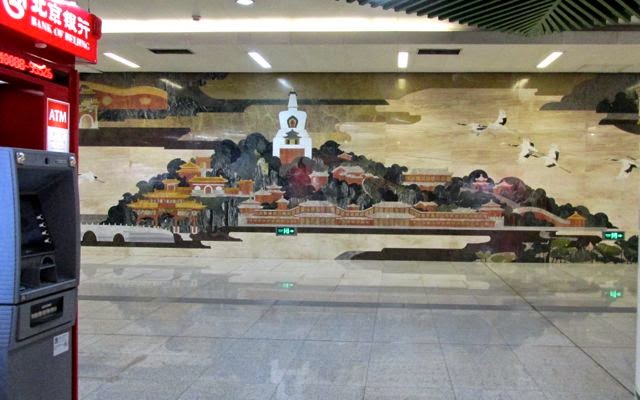 |
| Mural and ATM at Beihai Bei underground station |
Chris went to work today, met by 3 young men in the lobby at 8:30am who accompanied him to the large, white Science building on foot. The day was cool, but rapidly warming up. Half an hour later, I set out myself, solo this time, and headed to Xizhimen zhan, the tube station, over the dangerous pedestrian crossings. I tried getting cash from an ATM but my card was rejected, probably because I tapped in the wrong PIN--some keypads are differently configured here. Then I also made the mistake of going through the security check at the entrance to the trains before buying my ticket (Everyone has their bags scanned, and in other places, the ticket machines are beyond this hurdle.). In my rudimentary Chinese, I had to explain to the security guard I'd have to repeat the procedure, but like most people in Beijing he smiled at me, mei guanxi, no problem. I was returning to Beihai Park, because I hadn't seen it all yet and thought it would merit a second visit. This time though, I took a far easier route to get there: Line 4 to Ping'anli, 2 stops, transfer to Line 6, 1 stop, and out at Beihai Bei zhan, which was almost diagonally opposite from the North Gate of the park. On the northern side of the road is the entrance to the “Hutongs” (old alleyways) near Qianhai lake which we'd visited in 2011 with our daughter-in-law-to-be, Sha.

 |
| Mudan |
 |
| Teaching their grandson to fish, in Beihai Park |
 |
| Communist sculpture in Beihai Park |
 |
| Bridge to the island |

 |
| In the long corridor |
 |
| In the long corridor, detail |
 |
| The corridor is a place to take a rest |
 |
| "Qiong dao chun yin" |
I sat on a stone step--the benches
being fully occupied--to eat an improvised picnic from what I'd found
in a supermarket this morning, including a tub of yoghurt with
integral spoon. Dairy products are generally not so popular, but the
Chinese do seem to like yoghurt. I'd failed to find any cheese; they
prefer tofu. Then I slowly retraced my steps to the North Gate,
leaving the cacophony behind (one man on a saxophone was
teaching his fellows to play Auld Lang Syne ... over and over
again) and the gentleman with his spinning top on a string, and the
park's cats, sparrows, swallows and magpies, for the cacophony of the
traffic on the street beyond the wall.
We'd walked so far yesterday that today my
knees had started to hurt; I decided to take the tubes back “home”
with a long stop at the Costa Coffee shop on the way and this time
did manage to withdraw some more cash from an ATM at Beihai Bei
station. In the mall, I also managed to locate the restaurant called "Tasty" whose advert Chris
had noticed yesterday and where we ate tonight: steak and salmon,
served in a very posh way, with a bread basket, vegetables, fruit
tea, beer for Chris and desserts for us both, this whole meal costing
the equivalent of a light weekend brunch in Ottawa, about $30. And
they don't expect any tips.
Chris, having had a demanding but
apparently satisfying day working with intelligent people at the
university is in bed, fast asleep, as I type this. It's not yet
9:30pm.
Subscribe to:
Posts (Atom)