blending an assortment of thoughts and experiences for my friends, relations and kindred spirit

blending an assortment of thoughts and experiences for my friends, relations and kindred spirit
By Alison Hobbs, blending a mixture of thoughts and experiences for friends, relations and kindred spirits.
Showing posts with label tea. Show all posts

Wednesday, March 5, 2014

The legendary Chá Mǎ Gǔ Dào

Fuchs meets a lady at a waypoint on the Road
Last week I heard the first westerner to walk the length of the 茶马古道 (the Ancient Tea Horse Road)––Jeff Fuchs––give a talk about it. He's part Hungarian, part British, comes from Ottawa, lives in Shangri La, Yunnan, as an eco-tour guide and has also written a book about his explorations. He is addicted to the "forlorn desolation" of high, remote places ... and the taste of tea.

Fuchs' chá mǎ gǔ dào trek took seven months. In order to prepare for the expedition, he learned Mandarin in Taiwan and spent three years acquiring the funds (North Face was one of his main sponsors). The tea trading route, 5000km altogether, was once a migration route for nomadic peoples also, and, although it has been used for an estimated 13 centuries, is not as familiar to the western world as is the Silk Road; its history has not been written down.

"Snogging an ancient tea tree" (on JF's website)
Tea, he said, is "a commodity like no other." The oldest tea forests in the world are in southern Yunnan. The big leafed species of tea that grows there is pu'erh tea (pǔ'ěr chá). It can be kept good for a long while; in time it ferments and turns black. People like to drink it "super strong!" Tea is an ancient fuel for the body and an ancient medicine too, beneficial to the pancreas. A 91 year old lady he met in the Himalayas lives on a diet of raw eggs, whisky, sugar and tea. Traditionally it was transported in bamboo husks, on the backs of mules (200 mules at a time) that have mostly been superseded by transport trucks nowadays, but are still necessary over the high passes––really high, 6000m and more. If a mule is injured up there it "becomes dinner." The mules had to carry their own food, barley, as well as the butter, yak cheese or rancid goat's milk, onions and garlic that kept the traders fed. The nomads even ate tree bark "with butter." Other things taken along the tea road were salt, wool, tobacco, opium, silver and resin. "DNA would travel too," said Fuchs. He needed a team of linguists as well as his guides because 27 different languages are spoken along this ancient route.

At one point he met a handsome, long haired horseman (see the photograph on this page) proud of his ancestors who had been highwaymen and murderers. Every village up there has a distillery, and the people like their whisky: arra. For parts of the trek glaciers had to be crossed, sometimes 4000m thick (although the glaciers are said to be only a third the magnitude they once were). At a 6000m altitude the expedition crossed a pass that the explorers dubbed "Nosebleed Central"––the Tibetans call it "the place where the bandits rest." The mules had to be muzzled on the way there to stop them eating hallucinogenic thistles which would have driven them to leap off the precipices. One place was known as "The Valley Of Bones" because of the casualties.

The men on the tea road had to be tough, joked Fuchs, "because the women were tougher!" It was the women who proved the more reliable sources of information, too, but he showed us a picture of an old man, Mr. Wu, who said, "If you want to speak of trade, you must come and sit down and take tea with me. I speak slowly, so we will need a lot of tea." The conversation lasted three days.
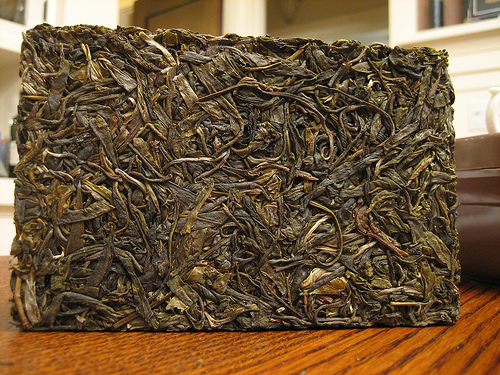
A brick of pu-erh tea (Wikipedia)
"Our teas have been travelling for as long as we had feet," say the travellers. For centuries tea has been a currency and panacea that brings many cultures together despite the barrier formed by the Himalayas. The market capital in the 13th century was Llasa where this most precious commodity was traded for horses. Accounts were kept in the chá shū (lit. tea book) because tea was the common currency. The word "cha" or "chai" for tea was spread across the world via the land route. The word "tea" ("té" etc) implies that its traders travelled by sea.

Fuchs spoke of the salt too, that used to be taken from the "salt wells", the salt lakes of Tibet, now extinct. Vultures, crows and cranes rest here during their migration. The red salts of the region are not valued by the local populace as much as in trendy California. The Tibetans feed their pigs on it.

Yunnan became part of China during the Mongolian invasions; the borders kept changing. This region is renowned for its bio-diversity, with its red clay soil of a high nitrogen content; it is the place from which the world's best shitake mushrooms are shipped, daily, to Tokyo. The country people are attracted to China's big cities, but many return home. The heart of China (a misunderstood, misrepresented country!) is in the rural areas, says Fuchs, but every home has a solar panel, these days, even in the mountains; the electricity is used to charge people's cellphones and boom-boxes. Tourism and modernity is inevitable, he adds. The question is, how it's managed. Tourists come to see the old traditions but as they do so, they destroy those traditions. It's a dilemma.

Friday, August 12, 2011

Tea

Tea plantation, Hangzhou
June 2nd, Thursday

I did something I've often dreamed of-- I walked through a tea plantation. You'd think you were in the open countryside, surrounded by steep wooded hills, but in fact this is only a couple of miles from the city centre and West Lake, up the Longjing Road. Hangzhou's Longjing tea is famous for its quality, because conditions are just right for the production of green tea here: warm days, cool, misty nights, and mountain streams to water the crop. I saw a lady in a straw hat watering some bushes with a tool like a long, wooden, giant-sized spoon. I also spotted a shiny blue tailed lizard slithering along an irrigation channel as white butterflies fluttered around the tea leaves.

I'd come up this road in order to visit the National Tea Museum (chá bó) which offered free admission, like the Silk Museum. Again, the surroundings were so attractive, with statues, little waterfalls, quiet tea houses, flowerbeds and lily ponds as well as the plantation, that I wandered around outside the building for a considerable while before actually going in to see the indoor exhibits. Besides, it was already very hot out of doors mid-morning, and I thought that postponing the cooler part of my visit might be a good idea.

Tea tasting paraphernalia
Inside, I was refreshed in more senses than one. I had just started to take in the information about the different kinds of tea processing, when one of the staff interrupted me with an invitation to join a young chap from France and another young chap from Russia to go across the garden for a tea tasting in the adjacent building. So I followed along very willingly. When we went in there, she put the young men in one room and asked me to wait in another room-- maybe she thought I'd misbehave if I stayed with the young men; who knows! Anyway, it meant that I had a demonstration all to myself and when the tea girl arrived, she spoke to me in Chinese, having asked me if I understood any. I'd said, "yi dian dian," a little bit.

Tea growing near the museum
To my delight she did use quite a lot of Chinese in her explanation of the tea ceremony, interspersing it with some English when I got stuck, but we kept going and I learned some new vocabulary. I sampled the local green tea, hong cha (black tea), Jasmine (hua) tea and oolong. The flower she steeped in the glass tea pot, letting me watch its magical opening in the hot water, was called the tian re hong flower. "Daytime sun, red," I think that means. She did the ritual of pouring hot water all over the cups, the tray, the utensils, raising and lowering the spout as she poured, three times, paying her respects to me, her guest. This has a mesmeric effect, and though we didn't soak a jade green rabbit this time like the one in Beijing, the colour of the dragon design on the porcelain pot did change when scalded. The taste of the individual teas, drunk out of those tiny cups, was wonderful. You're supposed to hold the wooden saucer with your thumbs and the cup on it with your finger tips, then raise the whole thing to your mouth to sip. It's not like having a cup at Tim Hortons. The flower tea tastes perfumed, if that's the right word. The little balls of oolong tea when they unfold and stew in the water, taste slightly sweet. Pure water should be used, either spring water or distilled.

Tea leaf roller
Wu Lizhen of Sichuan,
first planter of tea
Different teas are produced by different processes. White tea is simply withered and dried leaves. Black tea has been heated, rolled, heaped (fermented) and dried. Yellow tea has the leaves "smothered" at some stage in its production. Green tea is "pan fired," rolled and dried. I tried manipulating the large, wooden "tea-twisting" contraption that usually takes four people to use. The "bud leaves" are favoured. I hadn't realised that the tea bushes produce quite large white flowers with orange stamens and have big seeds about the shape and size of hazelnuts. I learned a lot about what tea can do for you, of course, how it agrees with "those who have excessive yang." Black tea helps to tonify the spleen; it "reduces turbid and aids digestion." Oolong tea is a suitable drink after a high fat or high protein meal. White tea can relieve toothache and any dark tea decreases your "blood fat." They claim that there are as many as 500 healthy chemicals in tea.

Photo opportunity in the tea fields
In the rest of the museum, I saw displays of tea buckets, bull horn tea measures, jade tea pots, a lacquered tea tray with a clam shell inlay, and a mdong mo for Tibetan butter tea, with auspicious animals decorating it. I saw copper saucers decorated with paintings of cabbages and huge panchang copper kettles with a space for fuel underneath. The first ever monograph on tea was written on a scroll by a man called Lu Yu in the 8th century, mid-Tang Dynasty.

On my way back to the bus, I spotted a young couple having their pre-wedding photos taken in the tea bushes, and before I caught bus No. 27 I had some lunch at an airy roadside restaurant with bamboo furnishings––chicken (with its head lolling over the edge of the bowl, unfortunately) with rice, and weak tea from a cedar goblet.