blending an assortment of thoughts and experiences for my friends, relations and kindred spirit

blending an assortment of thoughts and experiences for my friends, relations and kindred spirit
By Alison Hobbs, blending a mixture of thoughts and experiences for friends, relations and kindred spirits.

Monday, July 11, 2011

Duck for supper again!

May 11th, continued

Having walked right around Qianhai Lake with a stop at the tea house, it was time for lunch. With Sha to help with the ordering again, we particularly enjoyed the kong pao jiding and spinach pancakes with creamed tofu flavoured like a vegetable pâté, Sha's favourite. There were large bowls of noodles to which we added a glutinous sauce and finely sliced cucumber, radish and celery. To drink, hot water was served; we had bottles of beer as well.

 On our way to supper: "Bird's Nest" stadium in the background
Our evening meal that day was a special occasion: Chris and I attended the international pulsar timing conference dinner with George, Sha, her parents, and all the participating astronomers, several of whom (people who have been good friends to George during the last few years) remained in Beijing until the weekend. The restaurant for the conference banquet, another branch of the Quan Ju De chain, was in the modern part of the city near the university and Olympic Park.

We had to walk a few blocks from where the taxi dropped us, seeing the dramatic architecture the other side of a pond: the blue Water Cube and the world famous Bird's Nest Stadium.

Sweet and sour mandarin fish
Guests of honour at the banquet, as were Sha's parents, we shared a circular table with the conference organisers from China, with Jonathan and Daniel from Australia and with two scientists from Russia. Toasts to George and Sha were frequent and the wine, the beer and the bai jiǔ––of very good quality, 75% alcoholic––flowed liberally. The latter tasted surprisingly innocuous; however, I was cautious and only had a small amount. I read on this website that "Chinese women do not drink baijiu," so I hope I am not considered too forward. The dishes revolving on the lazy susan included ducks' hearts, like walnuts in appearance, to be individually toasted on skewers, over a flame. Slivers of "duck stomach" were served as well as the ubiquitous slices of roasted duck and its crispy skin. Duck liver pâté to accompany that as well as a crispy and colourful "Mandarin" fish (a speciality of Suzhou) and unusual vegetable dishes (black cloud ear fungus, seaweed and the like) as well as the politically incorrect (in North America) though apparently highly desirable (in China) shark fin soup, traditionally served as a mark of respect for one's guests, or perhaps as a status symbol.

After supper Jonathan and Daniel came through the Olympic Park with us and with Sha's parents, everyone now off work and in high spirits.

Sunday, July 10, 2011

At the tea house

May 11th, Wednesday

The bell and drum towers
yandai xie jie
We needed a quieter day than the previous two and it was her mother's idea for Sha to take us to the city's most peaceful area, where the river forms two lakes, Lake Houhai and Lake Qianhai, north of the Bei Hai park in the inner city. We got off the bus at the Drum Tower, with the Bell Tower adjacent, where the arrival of visitors to the Emperor's court used to be announced in the age of Kublai Khan, and walked from there onto a pedestrian thoroughfare that used to be called the Hutong Gulou and is now known as the yandai (meaning tobacco pouch). It's a narrow street, like the ones in the old port of Quebec or the Shambles in York, nowadays aimed at tourists.

Gift shop in the Hutongs
By the water were many boathouses and people offering massages. The restaurants and the rickshaws were for foreigners, but the local people seemed to like this area too, with old men playing card games under the trees and mums with children strolling along.
The giant teapot and teacups

Beside Qianhai Lake we found the Tang Ren tea house. Everything about the place was attractive and it was too early in the day for many other customers. Dark wooden screens and window frames with a giant teapot outside to advertise the service. Inside, walls of orchids and other plants, rocky water features and parrots and minah birds in bamboo cages at the doorway, a bead curtain to the inner room. Guzheng (zither) music was playing and incense sticks burning; a relaxed and friendly cat sprawled on the window seat. We sat on plump, embroidered, silk cushions in a booth opposite the window where a tea service was laid out on a wooden tray with slats for drainage, the tiny porcelain cups without handles reminding me of the dolls' tea parties I used to host as a child. A jade rabbit stood on the tray as well. Small lanterns and stuffed ornaments, red fish, dangled over the window or hung on the walls and an indoor fountain splashed in the corner. On the wall between our seats hung a lacquered painting of a goldfish pond with lily pads. The lamp stand on our table was decorated with a bronze horse and chariot covered by a parasol.

Sha sat on a little stool at the head of the table to act as translator when the girl approached with the tea menu on a bamboo scroll. We chose a delicate variety of green tea, the leaves manipulated by wooden utensils. With slow movements but rapid speech the tea girl showed us how to hold our cups properly, ladies extending the little finger as they drank. Much pouring of hot water to warm and clean the tea ware. The green rabbit had hot water poured over it too at regular intervals, at which its head and ears turned pale, almost white. Our tea was poured out between the lid and lip of the pot, then with our full cups on wooden saucers we sat back sipping the tea and munching on a tray of peanuts with a lacquered bowl for the shells.

The experience had an amazingly relaxing effect on us all.

Sally wants to run a tea house in York!

Card players by Qianhai Lake

View from the window of the Tang Ren tea house

Sally at our tea table


Sha at the entrance to the tea house. The bird said "ni hǎo!"

Rickshaws being pedalled round the lake

Street scenes, Beijing

During our two week stay in Beijing we had plenty of opportunities to observe the everyday life of the city. Here are some pictures that I took:

PT lesson in a school yard near our hotel

Playtime in the school yard

A weekday morning rush hour scene near one of the railway stations. There are 20 million people in Beijing!

A refuse collector's tricycle

Horse and cart belonging to a water melon vendor

Standing to attention for the morning's pep talk outside the local hairdressing salon, before the working day begins. We witnessed several instances of this, the employees chanting in unison in response to their superior.

A tricycle taxi (unofficial)

Overhead wiring, Beijing style

Saturday, July 9, 2011

Seeing Tiananmen Square

May 10th, Tuesday


Bike path (!) on the Zhexin Dong Lu: Sha and Rob walking to the bus stop
After a long walk down the Zhixin Road we caught the No.22 bus into the city, the road "like a big China town" (as Chris said) continuing for miles, with shop after little shop behind the bike path: not only for bikes but also for electric scooters, motorbikes, pedestrians, the occasional horse and cart and parked cars. The many people employed as refuse collectors and street sweepers carry the rubbish away on their bikes. Parents and grandparents carry little children on their bikes too, risking their lives at every moment. Not a helmet in sight for the whole time we were in China! People sell fruit, vegetables and underwear from their bike carts. On the road itself the traffic is continuous and noisy with plenty of honking just to say, "I'm here" (as Sally said). On the bus, most people stand, but Sha, solicitous of our welfare, ensures we get on at a terminus so that we have seats. This ride cost ¥1.50; Sha had a paycard that gave her a ride for 40 mao. As we approached the city centre, the people who got onto the bus were in smarter clothes. We had passed the hutongs, narrow alleyways between one storey houses, and seen a row of music shops where George hopes to buy a cheap 'cello bow. Goodness knows what all the other places were selling: sometimes it's a two-in-one establishment, like the laundry cum travel agent's where our train tickets were bought.

Waiting to be served at the duck place
An ornamental gate, Qianmen

Qianmen was the last stop. The street is quasi-historic, reconstructed and pedestrianised just before the Olympic Games, and neatly paved with a couple of old trams on show. We decided en masse not to patronise Starbuck's although there were long queues outside the other eating places. Sha began to look anxious, but eventually we discovered that the famous Quanjude restaurant, specialising in Peking roast duck, had a fast food section with stools available, low stools according to Chris and Rob. Sally and I found them just the right size. The English translations on the menu were intimidating, duck gizzard, fried foot webs, curried duck intestines, oh dear, but then I spotted "noodles with duck" so that was what we ordered, along with spring rolls and Chinese lemonade. I paid the bill by the kitchen where whole dead ducks, smoked and dried, were hanging by their necks, heads and feet dangling.

Representatives of the Chinese navy, plus tourists!
Outside the museum
Sha was keen to take us to the National Museum of China, just reopened after years of renovation; she had loved going there as a child. Chinese military units were lining up to visit the museum as part of their education, and to our amusement, ordinary passers-by were joining in the parade.Entrance is free ("open daily, closed on Mondays") but you have to arrive before 8 a.m. before the allotted number of tickets available runs out. Obviously we had arrived too late.

However, Sha doesn't like to be thwarted: "I'll talk to the officials," she said. At the fourth attempt, a man came out of the building and took her aside, slipping five tickets into her hand. She had done it! How? She'd told him that we were from overseas, had come a very long way just to see this museum, that this would be our only opportunity and, her trump card, that all four of us were seniors. Our bags were scanned at the entrance and we were in.

Inside the museum
The interior was like a great railway station forecourt, so spacious it looked empty. We started upstairs at the collection of precious vases, then of artefacts dating back to the 14th century B.C. with mysterious anthropomorphic zoömorphic images engraved on them (a battle axe with a fierce face was that old) and many a bronze zhong, a bronze, bell-shaped gong from the Zhou dynasty. Then came a gallery of "thousand armed and thousand eyed" bodhisattvas, porcelain coloured ones seated on lions with expressive eyes, and some "in embracing posture" with a female goddess at which a trio of Chinese boys were giggling as schoolboys do, the world over. Giant Song dynasty Buddhas followed in wood and clay and stone.

In the larger halls downstairs the glorious history of the Chinese Revolution was shown, and what preceded it. The Qing forbad international trade: we saw the "rules of precaution against foreigners" in vertical script. We saw horrid paintings of, for example, the Lüshun / Port Arthur massacre, of which I'd never heard, and sculpture groups, e.g. The Chinese People Mired in Misery, a title that sticks in my head. In the 19th century there were Japanese, American, British, German and Russian intrusions into China. One caricature on the wall had Uncle Sam with claws for hands.

The "Red" Boat
Sun Yat-Sen was the leader of the bourgeois revolutionary faction, a contemporary of Lenin, overthrowing the Qing Dynasty and thus "putting an end to more than two thousand years of feudal monarchy." And so to Chairman Mao, very handsome as a young man, and his leadership. The crucial meetings to plan the upheaval took place on an old wooden boat.

At this stage of the exhibition I began to feel exhausted and had to sit down to recuperate. The end of Chinese history in the final gallery featured space travel and the railway to Lhassa.

Being on the edge of Tiananmen Square, we had to walk across it and in order to do that had to have our bags scanned again. No water bottles allowed. Armed sentries stood rigidly to attention and wide screens in the open showed patriotic video clips.

A sentry in Tiananmen Square


Back "home" on the 290 bus, to meet George and his astro-colleagues Xiao Peng, Bill and Bill's wife Elma (American Canadians) for supper at a nearby restaurant. With Xiao Peng there to do the ordering for us we had a better selection of food for this supper, fish, vegetable dishes, dumplings, Peking duck. Again we were allotted a private room for the feast.

Friday, July 8, 2011

A Palace for the Summer

This describes our first full day in Beijing

May 9th, Monday

Sha met Rob, Sally, Chris and me at the hotel to take us out to breakfast at the kuaile jia yuan (meaning "Merry Home") round the corner––seaweed soup with dumplings, baozi (buns stuffed with meat and dipped in vinegar) and what Sha called "porridge," a watery gruel with bits of rice in it. The following morning she kindly lent us a toaster to use at the hotel, so I confess we didn't persist with the Chinese breakfasts (sliced bread and bananas being available from the local Wumart).

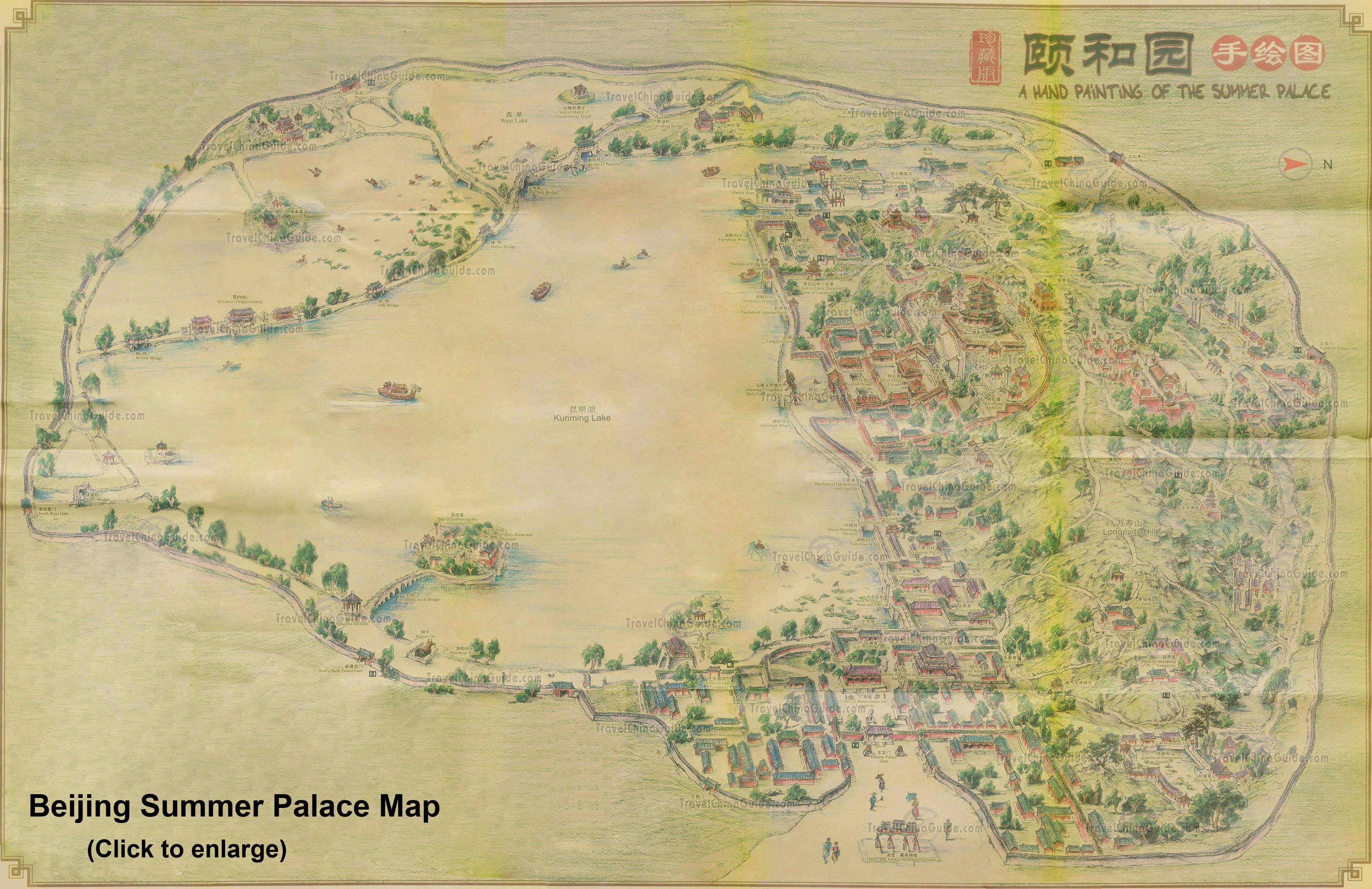
Then, having hailed a pair of taxis, Sha took us along the 4th ring road to the Qing Dynasty Emperors' Summer Palace (yi he yuan). Travelling along Chinese roads in a passenger seat was something we had to grit our teeth and get used to. No seat belts, the vehicles weaving all over the place in close proximity and nothing on the road signs comprehensible, although Chris mastered the characters for EXIT. Bikes and tricycles were loaded beyond belief.

The Summer Palace on Kunming Lake looked as crowded as I'd anticipated although fewer people were walking beyond the areas near its gates. Its temples, bridges and pagodas, first built in 1750 by Emperor Qianlong, were largely destroyed by Anglo-French forces in the Opium war of 1860, restored during Emperor Guangxu's reign three decades later, damaged again during the Boxer Rebellion, restored again in 1902. After the Revolution the Palace grounds were appropriated by the Chinese government and have been a public park since 1924. Sha used to be brought here at weekends and on holidays by her parents to dance along the paths and have picnics by the lake and to admire the legendary animals and people painted on the roofs and walls. The long corridor (over 700 m long!) at the northern end of the lake, for example, is covered with murals and ceiling paintings inside and out, each picture telling a story from the Chinese classics. I was touched to hear that when my daughter-in-law was a little girl, her dad used to carry her on his shoulders to show her these pictures and tell her some of the stories.

Dragon boats and pedal boats were crossing the lake and we chose to walk all the way around it. West Lake in Hangzhou (where we'd be staying later) was the inspiration for its features. The West Causeway was a long dyke incorporating decorative bridges and the beauty spots had poetic names––the Temple of Timely Rains and Excessive Moisture, the Rock of Longevity, the Pavilion of Bright Scenery (jing ming lou) recalling a 13th century painting and poem:
The Spring is peaceful and the scenery is bright. The waves are sleeping ...
We sat in the equally peaceful courtyard of the Dragon God Temple on South Lake Island across the 18th century seventeen arch bridge, one of the park's most prominent features. Money had been thrown at the god's feet and plastic flowers decorated its altar. Flowers were growing on the roof of the gateway.

From the causeway we saw Chinese pond herons and a flock of low flying water birds, as well as a pair of grebes doing a courtship display; he offered her a fish.

We crossed the steep bridges including the Jade Belt Bridge over which Emperors and Empresses used to walk from their Garden of Clear Ripples to the Jade Spring Hills. There used to be a "weaving and dyeing bureau" (sic) here for the production of silks, the silkworms nourished from the "ancient mulberries" beside which we sat to eat a hot dog for lunch, a sausage on a stick with a sweet breadroll (mianbao), not very appetising really. Across the water we noticed the famous stone boat, another novelty for the 18th century courtiers. I thought of Versailles. At the gift shops Chris bought a history book and Rob bought a CD of Chinese guzheng music.

We returned to the Great Hornki by bus, costing us ¥1 each for a 40 minute ride! Because we could get on at the terminus we all got seats and the conductress in a blue uniform kept order on the bus. The cityscape was similar all the way, neon shop signs, street vendors selling fruit, street sweepers wielding twig brooms. The noise and proximity of 20 million other people becomes overwhelming, but thanks to Sha we had thoroughly enjoyed our first outing.

At supper on our own across the road from the hotel I was hopeless at ordering and have no idea what we ate, a lot of stir fried vegetables with red chilli peppers and a bubbling pot of liver and other offal, the chopped intestine of some animal floating in the broth (the liver was OK)! We filled ourselves with rice and beer. Then George came over and walked round the block with us. At the university, he had given an impromptu presentation to a jet-lagged group of astronomers that day, before eating with his in-laws who treat him very kindly indeed.


Thursday, July 7, 2011

From Ottawa to Beijing

Who knows whether I can keep this up? I'll try. Here begins my report on China, frustratingly postponed because of the impossibility of accessing blogger.com from that part of the world. I only once managed to publish a blogpost while we were in Beijing and once again in Suzhou. However, I was able to take handwritten notes on the other occasions, so that the details of our forty days in China would not become blurred and forgotten.

The story begins with our flight across the North Pole.

May 7th, Saturday

Crew and passengers for Flight AC 31 to Beijing
On the short leg to Toronto, the Captain of our Boeing 777 came up through the cabin to shake hands with Chris and me, inviting us to visit the cockpit when we landed. This surprise treat had been arranged by another Air Canada pilot, Louis, who knows us at the Rockcliffe Flying Club and who knew we'd be travelling that day. Coincidentally and fortuitously we met Louis himself having his lunch in uniform in the departure lounge at YYZ. During our chat he asked if we'd like to visit the Air Canada pilots' flight planning room at the terminal. Of course! Some 2200 pilots use this facility that contains rows of airmens' hats on pegs, computer desks and filing cabinets for the charts and other paperwork. What do pilots do in the cockpit during long haul flights? It seems they sit there updating their Jeppeson approach plates. While being shown around the preparation area, we were introduced to two of the four pilots about to fly us to Beijing. I was introduced as the editor of RFC's Crosswinds and it transpired that the Captain himself had once edited such a newsletter, for Air Canada personnel; they called it Waypoints. He and the co-pilot showed us the maps they were using to plan our flight. By flying the Great Circle north then south, one of our "alternate" airports en route would be in Norway! Later, we would have to get permission from Russia to enter Mongolian airspace.

An Arctic glacier from above
We had to go through security again in order to reach our gate and the 'plane was 45 minutes late departing because of its previous late arrival from Paris. Our flight lasted about 13 hours. We're not sure where May 8th began, where the date-line was, because the tracker map didn't work in the vicinity of the North Pole. I snoozed very briefly after the plastic chicken and wine supper and lifted the porthole blind to see icefields, the snowy deserts and mountains of Greenland with their glaciers. Further on, blue cracks in the polar sea, pure beauty!

Much later, we saw the Russian tundra very like the Canadian equivalent and the high steppes of Mongolia, with cloud shadows. Approaching Beijing it became cloudy and grey, pouring with rain below us in the late afternoon, but we saw the mountainous edge of the city.

Chris in line at PEK, waiting to have his VISA checked
The first creature we noticed on landing at PEK was a magpie, considered a lucky omen in China. Beijing Airport, designed by Norman Foster, was huge and clean. An official zoomed around on a Segway and I took this illegal photo of the immigration queue. After a little train ride to the baggage carousels our cases were the last to roll up. George and Sha were anxiously waiting for us; George, afraid that either Chris had been arrested or I had fainted, looked extremely happy to see us. Sha had a bunch of flowers for me, for "Mother's Day!" Big hugs all round. Her cousin was there too, a professional chauffeur and a very nice young gentleman; this solved the problem of how we'd reach the hotel.

The front of our hotel after dark
It took a good hour to get to the Zhixin Road (East)––zhi xin dong lu––in Haidian in the rain. Stepping out of the car onto the steps of the Hornki Great Hotel we got soaked. A white sheet had been laid on the steps to protect them. Rob stood there eager to greet us and Sally made me a wonderful cup of jasmine tea in their room opposite ours, which revived me; I was feeling very tired. Rob and Sally had arrived in Beijing from York a few days beforehand. It was fortunate that Sha had been along to negotiate our down-payments with the hotel receptionist so firmly because nobody at the hotel spoke any English, it seemed. At supper, on the hotel premises, we met Sha's parents in the flesh for the first time (though we had seen them before on Skype). It was a lovely atmosphere, friendly and warm, and quite a feast: food kept coming, served from a lazy Susan in a private room adjoining the main restaurant.

I used my Chinese!

Tuesday, July 5, 2011

Here I am at the airport

Heathrow again, midday, British Summer Time. It is very familiar, but what is special about this occasion is that it's the first time I will ever have completed a round-the-world trip: the last leg will have been today's,
all being well. Ah, the future perfect tense! I could write a poem about that.

Anyhow, last week was a delight, the weather staying fine for the whole of my stay in Wales. I saw parts of the Gower Peninsula and even of the Cardiff area that were new to me and which I hope to share with more of my family and friends before long, Rhossili Bay and Cefn Bryn, the medieval churches, the free ranging ponies and their foals on the hilltops and the wild flowers on the dunes and cliffs. There's also a forest (fforest) walk near Castell Cogh that's full of quirky surprises, as are the bedrooms and bathrooms at the Western House (B & B) in Llangennith and the interior of Cardiff Castle. Yesterday I had a chat to one of my nieces in Cardiff whom I hadn't seen in ten years.

Photos to follow, I promise.

The only trouble is, there are friends to catch up with in Ottawa and a series of concerts to attend; there's our house and garden to see to as well. Never mind. I shall give doubtless be my usual irresponsible self and give priority to the blogging, having been deprived of the opportunity for so long. Eight weeks away from my computer is a long time.

Thanks to George, to Sha and her parents, also to Sally and Rob -- all such good companions in Beijing! - to the staff at the Intercontinental Hotel in Hangzhou, to Andy and the other QNX people we met on our travels, to Emma and Peter and Alexander (baby Thomas being too young to know we're thanking him for his company), thanks to Tini and Phil, David, Debbie, Richard and Sarah, then to Faith, Mel and my mum for giving us such a welcome everywhere we went. So many people to miss. I'm not being sentimental; it is simply a fact.