blending an assortment of thoughts and experiences for my friends, relations and kindred spirit

blending an assortment of thoughts and experiences for my friends, relations and kindred spirit
By Alison Hobbs, blending a mixture of thoughts and experiences for friends, relations and kindred spirits.
Showing posts with label Ottawa Chinese Language Centre. Show all posts

Wednesday, January 16, 2013

Ten words for a wife!

我儿媳妇
Another Chinese lesson this morning, and in the course of it, I asked my teacher to explain the many words for "wife" in his language, because I was getting confused by them. Predictably, he told me that the words were bù yī yang (不一样), not the same (in meaning), but I was amazed when he reeled off at least nine translations for "wife." In fact this page gives a whole lot more, and the first one on the list, nǔrén (女人) wasn't even mentioned by my teacher. He gave me the following:

lǎopo (老婆); he disapproved of that one, too common!
fūrén (夫人), too formal for everyday use.
taitai (太太), polite and rather formal, also means "Mrs."
qīzǐ (妻子); he uses that one for his wife, when talking to friends
xǐfu (媳妇), ... or this one
xǐfu r (媳妇儿), young wife
airén (爱人), lit. "love person"

An Emperor's wife (concubine) would have been his fēizi (妃子).

Then there are the words for people's unofficial wives or mistresses. Nǔpéngyǒu (女朋友) is "girlfriend," but if a man's already married to someone else, he might call the mistress his xiǎo sān r (小三儿) i.e. "little number three" (the phrase used to be used for the third child in a family, in the days when such a thing was allowed), or his èrnǎi (二奶) lit., "number two breast", as opposed to his dànǎi (大奶), lit. "big breast", i.e. the wife, again. The latter are not very polite words; my teacher was obviously embarrassed by them and apologised for his bad language!

Isn't that an extraordinary list, and interesting?

*****

Thursday, January 17th

The young wife in my picture read the above and has sent me an email saying:
Interestingly, those ways of calling wife is happened in different time or different places (south, north, etc.) My dad calls my mum" ài rén" when he introduced my mum to new friends, but nowadays we normally call wife "lǎo po" in our generation. I guess your teacher is a funny man; he even taught you "xiǎo sān" and "èr nǎi." Those all the illegal lovers (not wife) exist in China, common and healthy family won't have those, those words just showed in society recently, say less than 20 years; they were new built words for that twist phenomenon. My grandpa's generation or even early called wife as" nèi rén" 内人 which means the person inside his house. Funny, isn't it? We won't use this anymore now though.
杜莎

Sunday, October 28, 2012

German and Chinese

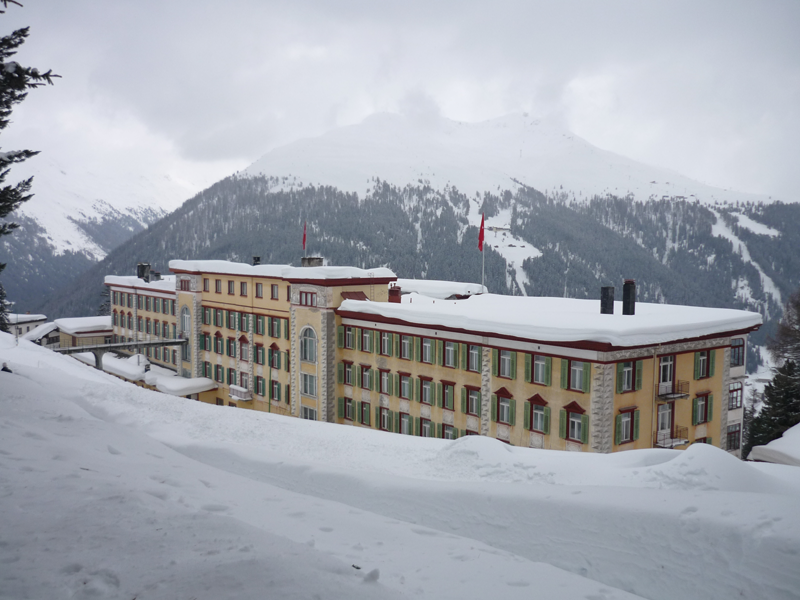
The old sanatorium at Davos, the setting of Mann's novel
I spent a few weeks this summer reading in German. I read both volumes of Thomas Mann's Der Zauberberg again (a "set book" when I was studying German at university and a favourite of mine) and got hold of a film of the novel that wanders rather from the original, but is still in keeping with its spirit, though I was disappointed with its interpretation of the last chapter. I've been watching DVDs of a German TV dramatisation of Buddenbrooks as well. Sabine of the German Embassy left some books behind when she left Ottawa this summer, one of which was the novel Eine Handvoll Glück by Barbara Noack, set in wartime Berlin and the few years before. Apart from the Berliner Dialekt used in the dialogue I found that story a very readable one.

Since September I've been in charge of the weekly meetings of the German-speaking Konversationsgruppe (26 people) that's part of Ottawa-CFUW's Diplomatic Hospitality service. Chris, who is also needing to study the language like mad in preparation for a business trip to Bremen, Stuttgart, etc. discovered something useful on the Deutsche Welle website: Langsam gesprochene Nachrichten: international news read out by German newsreaders at an abnormally slow pace and very clearly articulated, which gives non-Germans a better chance to follow what's being said––brilliant idea. I wish I'd had access to this when I was a teacher in the old days. I've told my Konversationsgruppe about it, anyhow. We've had five meetings so far and at the last one I decided to hand out some copies of extracts from a little book of old Chinese stories ("Anekdoten") entitled "Und Buddha Lacht" and translated by a German sinologist called Franz Kuhn, who died in 1961. As a matter of fact, Dr. Kuhn was the great uncle of Dagmar, one of my German-Canadian friends, and Dagmar was there to tell us a great deal more about him than appears in the Wikipedia article! Also present was Lolan, Chinese by origin, who with her in-depth knowledge of China's history and culture could help us appreciate the background to the stories.

I have also been taking some more Mandarin Chinese lessons on Skype with Mr. Yin of the Ottawa Chinese Language Centre, and practising with my daughter-in-law Sha or my friend Yiwen when the opportunity arises. I hope I'm making progress, have been trying to use modifying words like "yīnggāi" (should) and "kěnéng" (perhaps) as well as the very basic vocabulary, in order to make my sentences in Chinese a bit longer than they were to start with.