blending an assortment of thoughts and experiences for my friends, relations and kindred spirit

blending an assortment of thoughts and experiences for my friends, relations and kindred spirit
By Alison Hobbs, blending a mixture of thoughts and experiences for friends, relations and kindred spirits.
Showing posts with label University Women Helping Afghan Women. Show all posts

Saturday, January 11, 2014

Afghan carpet making

(Wikipedia image)
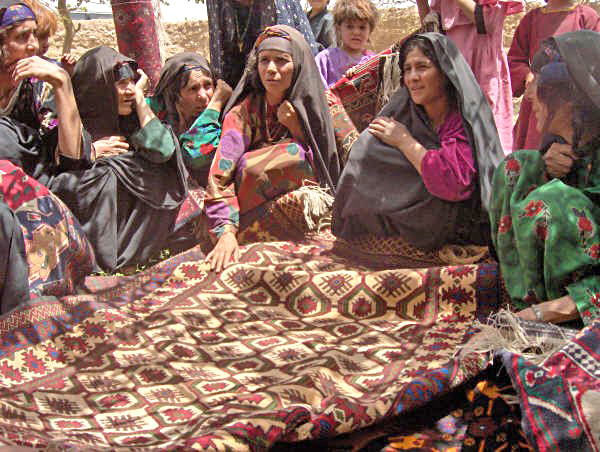
I'm at the end of another busy week: busy but interesting! Thursday afternoon I was listening to a talk given by Hanneke, an enthusiastic member of CFUW-Ottawa's UWHAW group, who in the 1970s had made multiple trips to Afghanistan to buy carpets and other woven goods (she ran a wholesale warehouse in the Netherlands). She told us about the importance of the wool and weaving traditions in central Asia, in particular in the area around Herat, the place she most frequently visited in those days. As part of the talk she brought several items from her collection to show to us.

Some of the weavings displayed by Hanneke
Hanneke spoke about the different sheep rearing tribes of Afghanistan, of their originally nomadic culture and the importance of woollen artifacts in their yurts and tents. She showed us one weaving that wasn't a carpet but a door to a yurt––you'd just push it aside to go in. Apparently there are five types of sheep bred for their wool, in Afghanistan, and the best wool comes from the karakul sheep of Turkestan who have a long, lustrous outer coat and a fine, soft inner coat. They are sheared twice a year, and from their easily spun wool, low in lanolin content, the art of felting evolved.

Natural dyes are used for the carpet fibres, some made from remarkable ingredients, walnut shells, camel hair, crushed insects. Two women work at the construction of a carpet; they start at the ends, making the flat woven border (kilim), then begin the knotting work, folding the carpet as they go. It can take a year to make a large rug by hand, and any young girl involved in its making might not have time to go to school. Afghan Turkmen weavers use the "Persian knot"––up to 400 knots per square metre. This is a very old skill and the carpet weaving patterns are passed on from one generation to the next, so that the secrets of their art are kept within the family. When the carpet is complete a tiny piece is burned, for luck, and then it's either carried by donkey or bike to the local market for selling or kept aside for the family's own use, or for a dowry––the most carefully worked carpets are the ones used for dowries.
Afghan shepherd's coat

After she had shown us rugs, saddle cloths, woven salt bags and donkeys' neck ornaments, Hanneke also modelled a coat that would be worn "by the most important person in central Asia, the shepherd!" The coat had extremely long sleeves, the purpose of these being to conceal the hand movements of the merchant as he haggles over a price for his merchandise, while holding the hand of the buyer.


Saturday, January 21, 2012

Medica and Oruj

I could have entitled this "Diba and Sadiqa"––these are the names of the two young Afghan women I listened to on Thursday afternoon at a meeting of the Ottawa CFUW's "University Women Helping Afghan Women" group. They are currently both students at the University of Ottawa.

Diba told us about Medica Afghanistan, a new organisation (for whom she works in her spare time) that provides counselling, mediation and legal aid for women and girls who are sheltering from "war and other forms of violence" in the city of Kabul. Canadian donors are helping to pay for the literacy classes at these shelters. Sad to say, the children there (in the same room as their mothers for most of the day; each shelter can accommodate up to 50 people) are disturbed by the stories that circulate. Illiteracy deters their mothers from seeking work and in any case these women are often too traumatised to concentrate on formal training or learning to read.* None is healthy enough to leave the shelter for the sake of work, said Diba. They do weaving, leatherwork, knitting, etc. for various enterprises but do not get the satisfaction of seeing what becomes of their handiwork, so have no real pride in their achievements. Diba claims that (in a population of 30 million) 95% of Afghans are in need of psychiatric help. But there is no qualified psychiatrist in Afghanistan.

* I have mentioned this to two people since, both of whom were reminded of the Maslov pyramid.

Sadiqa, who spoke for an hour without notes in English (her mother tongue is Pashto), told us about the NGO she had founded herself which runs "Learning Centres" for female students in Afghanistan. It is called Oruj, meaning Ascent. Sadiqa (who must be about 31 years old now) told us she had been working for girls' education in Afghanistan since she was in Grade 11. She had left her homeland as a five year old to live in Pakistan with her refugee parents and she attended a refugee school there. On a visit to Afghanistan to visit her cousins she found those girls very eager to hear about the education she was having, of which they themselves had been deprived. She swore to herself there and then that she'd do something about this and returned to Afghanistan in 2002 having raised enough money to start up a school on her father's property. When it opened in 2003, 63 girl pupils came along in great excitement, wearing glittery clothes and lipstick, because they had no idea how to dress for school. It was hard, she said, to get them to sit down in rows and face the board at the front (they all laugh about this now).

However, before long, the class shrank to half its size. No woman could be found literate enough to teach Grade 1 lessons so they'd had to employ a man teacher; kind though he was, the girls "covered up" and were wary of him. "All the parents we spoke to wanted to have their daughters educated," Sadiqa said, but what was education going to do to their daughters? There were concerns about that. The local community suspected that the instigators of these new opportunities might have hidden, ulterior motives. Sadiqa had to prove that she was an altruist, not a spy.

In 2008 Sadiqa's province was taken over by the Taliban which meant that the participants in her project ran the risk of violent attacks. Classes had to be held secretly, in private homes. As director, she asked the teachers whether they wanted to run the risk of continuing to do such work, but not one dropped out. One of the male teachers replied (I quote the words she used, her voice cracking with emotion): "Even if we're shedding our blood to the last moment ... we will work for our scholars!"

Here is an article about Sadiqa, published around that time, in 2009.

At the present time, Oruj is a success, serving about 6400 girls (and some boys!) in six schools. Some of the students now have high school diplomas and the older ones help to teach the children in Grades 1 and 2. Their mothers are also being offered literacy and "awareness building" courses at "family welfare clinics." Sadiqa said that the suburbs of Kabul might as well be remote mountain villages as far as the ideologies are concerned. People in these outlying communities are reluctant to have their children at school. Traditionally, children (6 per family on average) are needed at home to look after the livestock. Sadiqa and her colleagues counsel these parents and speak to the elders and to the religious leaders, trying to convince them that, according to the Koran, education is an obligation in Islam. (Because most of the people cannot read, they cannot check the scriptures for themselves.)

Another problem arose when the young women graduating from high school wanted to go on to higher education. Until last year their only choice would have been to attend a co-ed institution because there were no girls colleges in Afghanistan. Stories circulate about sexual harassment both from their fellow students and unfortunately from some of the male tutors as well. Therefore Sadiqa saw the need for a women's college such as exist in the western world (she had attended one herself in Massachusetts and was inspired by its principles). So she promptly set about raising funds. She managed to raise nearly $50,000 and this year, the first community college for women in her country, offering courses in Law and Economics, can boast of 52 graduates.

Currently only 1% of women in Afghanistan can get jobs. The rest of them cannot compete with the men because they simply don't have the qualifications or the requisite experience; they can't afford computers, they lack leadership skills.

Sadiqa studies at Ottawa University during the day and (because of the distant time zone) liaises with Oruj administrators until 2 o'clock in the morning. This work is more important to her than sleep.

Wednesday, November 9, 2011

The Afghan Canadian Community Centre

From the Toronto Star:
Ehsan Ullah Ehsan
It was the spring of 2006, and the school [Ehsan Ullah] Ehsan had opened to teach girls and women English, basic health, computer skills and other courses in the Taliban stronghold of Kandahar was fast running out of money. He was on the brink of shutting it down when the Toronto Star's Mitch Potter happened by, wrote about the looming disaster, and touched the hearts of two readers in Ottawa: Ryan Aldred and Andrea Caverly.
Ryan Aldred
I met Ryan Aldred last Thursday at a meeting of the CFUW's University Women Helping Afghan Women; he had come to tell us about what had happened next. He and his wife Andrea wrote to the reporter, asking, "What can we do to help?" and eventually received a grateful and detailed response from Mr Ehsan himself. He had no school buses, the computers were wearing out ... The young Ottawa couple decided to fund the Afghan school for 6 months, raising money from their friends and acquaintances in order to send donations. Meanwhile, in Kandahar, Ehsan chose a new location for his school, paying the teachers $100 a month and hiding the project from prying eyes because it was (and still is) very dangerous for Afghan girls to go to school. Families informed one another about the place by word of mouth, however, and with its lifeline of income from Canada the 100-strong student population quickly quadrupled. Then it transpired that men and boys wanted to be taught there too. "Almost overnight," said Mr Aldred, "we had 800 students." And eventually CIDA chipped in with a $310K grant to spend on buses and school equipment.

Afghan girl (photo by Paul Watson)
The girls are "fierce and fearless," according to Mr. Aldred, but the new buses protect them (from acid-throwers and other such extremists) on their way to school.

The CIDA money will not last forever. "You don't pull up stakes and leave everything flapping on the ground," when it runs out. What's to be done next? The request for three more years of funding was rejected, but people kept lobbying the Canadian government anyway, and then on International Women's Day a year's extension of funds was granted. "This is a big boost," says Mr. Aldred, "It helps us to keep going." During the several years since the project began, only half a million dollars have been spent, not a huge sum. The administrators of the NGO insist upon low cost developments, using members of the local community as staff. One of President Karzai's brothers has recently donated land for a new building, which some of the students themselves are excitedly designing.

In 2009 Ehsanullah Ehsan and Ryan Aldred founded the Canadian International Learning Foundation which supports not only this project in Afghanistan but similar projects in Nepal and in four African countries. Their initiative was reported in the National Post last month in an article by Jane Armstrong.

On its premises, the Afghan Canadian Community Centre now teaches over 1,500 students ...
...Business Management, Information Technology, English and Communications [...] with access to the Internet and online classes from Canadian and international institutions. The school’s programs provide students with the skills needed to obtain employment to support themselves and their families, improve their communities and participate in the reconstruction of Afghanistan. The skills taught at the ACCC are in high demand by international development agencies, local businesses and the Afghan government ...
Each former student now employed supports seven family members, on average. When a young daughter of a family man becomes the primary breadwinner, it makes people think, and attitudes begin to change.

Accreditation of such an institution is very bounded by rules and requirements. Mr. Aldred's NGO still needs to acquire 501(c)(3) status, but the developments continue, regardless.
... 32 students at the Afghan-Canadian Community Centre are enrolled in the Business Management certificate program offered online by the Southern Alberta Institute of Technology (SAIT), a Calgary-based Polytechnic Institute that offers internationally-recognized post-secondary education. The Business Management program often allows students in Kandahar to secure high-paying employment after as little as one course. A group of 5 ACCC students have also been given scholarships to study online classes with the Canada eSchool, where they will study a range of subjects including Science, Math, English and Civics. 
A network of volunteer tutors in Canada tutors the Afghans at the Centre using Skype (mostly) for classwork and in one-on-one sessions. Other volunteers engage in online text chats with them, helping them with their projects and with career guidance. The young Afghans (the age of a student at the ACCC might be anything from 10 to 40 years old!) ask their Canadian mentors for help with online research, use of English, study skills. The only drawback to the system is the time zone. If you join in with the volunteering you may have to do your transcontinental chatting from Canada at 3 o'clock in the morning.

Monday, November 15, 2010

Infectious hope

Instability is infectious, but so is hope.
Inside the building
I heard this said on Friday during a presentation at the headquarters of the Delegation of the Ismaili Imamat on Sussex Drive. This blogpost is going to describe what the Aga Khan Foundation Canada (AKFC) does for Afghanistan, a subject in which I've become very interested since I joined a new Ottawa-CFUW group: University Women Helping Afghan Women. Last Wednesday I went to one of those meetings, too.

Anyway, one thing at a time.

The Aga Khan Development Network in Afghanistan joins forces with government agencies to stimulate and support the economy. This includes the financing of new infrastructure (hydro-electricity projects, bridges, clean water, proper sanitation) and of innovative agricultural programmes and education, particularly in remote parts of the country, as well as the offer of microloans. The First Microfinance Bank (FMFB) kick-starts small businesses with these loans, buying the beneficiaries—often women, seeking to supplement their family income—such essentials as flour and wood for a bread oven, or a sewing machine. "Loan officers" then pay regular visits to see how the new enterprise is going and to offer advice. The AKDN has established hundreds of savings groups in northern Afghanistan that serve a similar purpose.

Bridge at Darwaz (photo of a photo)
Farmers' Field Schools in Badakhshan, sponsored by the Aga Khan Foundation, sometimes called "the social conscience of Islam," have persuaded something like a thousand communities to stop growing poppies for the drug trade and to start growing fruit and nut trees instead. As regards the bridge-building and water management, separate villages are obliged to co-operate with one another in "development councils" (there are eighteen of these) so that ancient enmities are forgotten and so that, pooling their resources to improve matters, they become less reliant on help from the outside world. A larger-scale example of this is the construction of the Darwaz Friendship Bridge linking Afghanistan to Tajikstan across the River Panj.

Afghans in council (photo of a photo)
The AKDN provides a more basic form of education in the 200 elementary schools where a "whole school improvement model" has been initiated. A hundred schools have been constructed or rehabilitated after the devastation of war. Local parent-teacher associations urge teenage wives to continue their education before becoming mothers. Through the shura (the Islamic consultation process—illustrated in this picture) in each village, the AKDN has set up literacy classes for women and seed banks for farmers and gardeners.

There are two more agencies in Afghanistan worth mentioning, the Aga Khan Health Services (AKHS) and the Aga Khan Trust for Culture (AKTC). The former makes the needs of women and children a priority, helping to train midwives, usually young women from remote areas, at Faizabad. This initiative has reduced child mortality by 85% in some parts of the country, and in Darwaz, in the north, a health clinic has been established with a staff of three doctors, serving 20,000 patients a year, some of whom travel for hours, for days, even, for their treatments or consultations.

The Aga Khan also takes Afghanistan's cultural needs very seriously, believing that "culture injects hope" into a deprived, traumatised community, or city, or nation. The AKTC uses its funds for the restoration of national monuments, for literacy and vocational training (in traditional weaving, for instance), for the arts and for the creation of parks and gardens. A few years ago, Canada's Governor General, Adrienne Clarkson, visited Kabul and was deeply impressed by the 16th century garden restored by the AKTC. She mentioned it in the speech she made at the Foundation Ceremony for the Delegation of the Ismaili Imamat:
...in only a year, the Foundation had transformed a dusty ruin surrounded by broken walls into a beautiful terraced garden with reconstructed adobe enclosures and the first of a series of fountains. It was astonishing. Nothing could more eloquently express the mission of your Foundation—to improve the material lot of the world's most devastated regions and peoples, yes, but also to respect spiritual and aesthetic considerations. Babur's Gardens serve as a point of hope and illumination for everyone who cares about Afghanistan ...