blending an assortment of thoughts and experiences for my friends, relations and kindred spirit

blending an assortment of thoughts and experiences for my friends, relations and kindred spirit
By Alison Hobbs, blending a mixture of thoughts and experiences for friends, relations and kindred spirits.
Showing posts with label Afghanistan. Show all posts

Saturday, January 10, 2015

Raising chickens in Afghanistan

Last Thursday Leah Soroka told CFUW Ottawa's University Women Helping Afghan Women about her recent development work in Afghanistan.

Leah (on the right) at the UWHAW meeting,
photo by Jill Moll
“You are never the same when you come back from Afghanistan!” she began. Her boss in Afghanistan was killed by a suicide bomber. 

While developing agricultural supply chains as director of a counter narcotics strategy for regional stability in rural Afghanistan, she advanced the role of Afghan women in agriculture. Her project provided the poor with a means of livelihood (so they would not have time or inclination to participate in “illegal activities”) keeping kitchen gardens, raising chickens and selling over 90% of their produce in the markets. They were instructed in food security and nutrition. Their menfolk appreciated the returns when they took the eggs and vegetables to market and thus saw the point of the women’s endeavours. Literacy and numeracy levels are extremely low, and saving and investing were foreign concepts in this “pocket economy.” Leah described the creative methods used to educate these women. For example, to teach them how to manage their finances, they put eggs into three jars: the first was the “happy jar” containing money for immediate spending on themselves and their families, the contents of the second jar represented the money needed to replace chickens that had died, the third jar represented the amount to be kept aside for chicken feed and other such expenses.

In a recent poll only 20% of women in Afghanistan defined themselves as working people. Leah interviewed 300 women while in the country, finding out what were felt to be their obstacles to work. She asked the UWHAW group what we thought those obstacles might be. Together with Leah we came up with …
  • Lack of acceptance by the men.
  • Limited access to education and job opportunities.
  • The need for security at the workplace.
  • A requirement for “cultural conformity”––menfolk sometimes being ashamed of having a working woman in their family.
  • In a “country without newspapers,” limited access to information.
  • Lack of financial or legal advice.
If a woman becomes widowed and remarries, her children are repossessed by her previous in-laws. Therefore, depending on their permission, or how rich or liberal they are, a young widow cannot remarry without losing access to her children, but she can go to work! The Red Crescent offers such women crafts, livelihoods and places to work.

Practically speaking, all-women initiatives in Afghanistan are harder to establish than when men are involved, although a bid for international funds stands a better chance if women are on the payroll, so all male ventures are not a good idea either. 

We outsiders must take notice of the men of Afghanistan. Many are “tormented, coerced and depressed” because of their traumatic experiences. Some are “pure of heart”. This is a “whole nation suffering from battered-wife syndrome!” but there are multiple truths. Sometimes, for example, corruption itself can lead to good things, such as the establishment of laws for the protection of wealth, even if it is ill-gotten wealth.

Leah thinks that a change in women’s rights in Afghanistan has to be gradual. She reminded us that it has taken a long time for women to achieve equal status with men in Canada, although by now, Canada is a global leader in this regard. If the Afghan men lose face by too much hasty change, that gives a “potential for retribution” in the future. She described a business meeting in conservative Jalalabad where the men sat (on the floor) taking part with vigour and all the women at the meeting stood apart at one side of the room huddled in their shawls, merely observing. In the city of Kabul, though, it is quite different these days, with men and women making equal contributions. 

Monday, March 10, 2014

"They keep calm and do their work."


Dr. Najafizada speaking at last year's UWHAW fundraiser
Maisam Najafizada is working on a thesis about primary health care in the remote communities of Afghanistan.

As the guest speaker at our UWHAW meeting last Thursday, he gave an example of an Afghan Community Health Supervisor, “Shamsia”––not her real name. As a 2nd wife with ten children she had an education up to 9th grade and is the only breadwinner in her family. She first worked as a home-school volunteer for her neighbours, became a vaccinator and identified the sick children in her community, has also been an unpaid mental health counsellor. She trained as a Community Health Worker (CHW) under the BRAC scheme and dispensed medical drugs. She now supervises and trains 16 CHWs at 8 separate posts. Her husband hasn’t allowed her to become a midwife because that would mean her having to leave home for 18 months.

Community Health Workers and their supervisors are a “front line army” of volunteers, approved by the Afghan communities they serve. There are about 10,000 of them (whereas there are only about 2500 doctors in Afghanistan). CHWs educate people about hygiene, treat the prevalent diseases, dispense drugs and contraceptives (they call contraceptive pills “the happiness drug”), visit pregnant women and help prepare for the delivery of their babies. They offer maternal and child healthcare. Men volunteer to be CHWs as well, but only provide services for men.

CHWs are knowledgeable and mobile; they are highly respected locally, but do not receive much recognition from the national authorities (although this may be changing), and they get no pay. Often they serve as vets and / or teachers as well. They tend not to be aware of their own value and lack in self-confidence. In school they were taught to be silent and obedient. Many are illiterate, although their mentors––nurses, midwives and doctors––have to be able to read. Dr Najafizada told us of a CHW who is known as “the illiterate doctor” in Bamyan. She won an award for her services and then insisted on a school being built in her village.

In some ways it is to the advantage of these volunteers to keep a low profile (because prominent women are vulnerable to attack––the Taliban sees them as a threat and so threatens them). CHWs “keep calm and do their work.” They operate with a certain amount of freedom; women in the Afghan cities, with a “higher bride price,” are generally more oppressed than country women.

Volunteering is a new concept in Afghanistan, although the “birth attendant” (the dai) was a traditional figure in village life. There is little privacy or confidentiality in these communities of 100-400 souls. Nowadays, though, they nearly all have cellphones.

A photo I took at last Thursday's meeting

Tuesday, March 4, 2014

Education in fragile countries

Thursday Feb. 27th, I went to hear a “Conversation” at the The Delegation of the Ismaili Imamat on Sussex Drive. The conversation was called Education at the Margins: Reaching Children in Fragile and Conflict-Affected States.

Here's a summary of the notes I took; I've been asked to report back to the Ottawa-CFUW UWHAW group later this week. Only three UWHAW members were at the event but the others are bound to be interested. I'm restricting my report to the points relevant to Afghanistan, though several other parts of the world were mentioned during the discussion.

A force for transformation

The event was introduced by Khalil Shariff, CEO of the Aga Khan Foundation: "The Aga Khan said this morning [on Parliament Hill in Ottawa] that education has a great transformative potential and is a force for pluralism and peace, especially in an environment of conflict."

Lois Brown, M.P., mentioned in her speech at the event that the P.M. had just signed a "protocol of understanding" with the Aga Khan. She said, “Canada has been among the top donors to Afghanistan, and education remains one of Canada’s largest sectors of investment in the country. It accounts for 25 percent of our development budget there."

Sharif Ghalib
Diane Jacovella, Vice-President, Multilateral and Global Programs at the Department of Foreign Affairs, Trade and Development, initiated the panel’s conversation by asking Sharif Ghalib, Senior Political Advisor and Deputy Chief of Mission at the Embassy of Afghanistan, to speak first.

"The importance of education is immeasurable," he said. "It is a vital tool for unlocking potential and for the evolution of mankind. Over 60% of Afghanistan’s population is made up of girls and women under the age of 30, who face overwhelming challenges." He said that education is "a powerful force for transformation that has an immense effect on improving health and gender equality and enabling peace." In 2001 less than a million children––and no girls!––went to school. Over 10 million children are now in school in Afghanistan, 41% of them girls, and this is a “prerequisite for peace.”

Investment in the future

Alice Albright
Alice Albright, CEO of the Global Partnership for Education said that the work of the Afghanistan government has been “truly heroic.” Teaching people to read will reduce extreme poverty by 12% in fragile countries, therefore governments should invest in education. Education teaches people that there are other ways to interact than with violence. She said that the government of Afghanistan “needs no reminder” of the importance of education for girls. She was there last summer and says that the international community “cannot leave” now, but did complain of what she called “turfiness” (i.e. a tendency to say: Keep off my turf!) among the NGOs. This must change.

Sharif Ghalib knows that there are long-term repercussions to what we do now. He felt that the more the Afghan people can get an education, the smaller the likelihood of insurgency. In some of the remote areas with a lack of access to schooling the population is “totally gripped by despair” and this provides fertile ground for terrorists to recruit their suicide bombers.

David Morley
David Morley, President of UNICEF Canada, believes that schools can be peace building institutions. (But he has visited a Taliban controlled area [of Pakistan] and seen the ruins of many schools there.) UNICEF feels that there has to be consideration of people’s future livelihoods as well.

Protecting the girls at school

In her speech, Lois Brown said that quality education for children in safe and secure schools is “a building block we cannot afford to ignore.”

Diane Jacovella asked what could be done about the safety and security of children going to school in Afghanistan.

Sharif Ghalib spoke of his country's “gloomy past.” Insurgency lingers; low-intensity fighting has never gone away and takes its toll on basic services. There are limits as to where you can build new houses and schools. However, the international community has come to the rescue, and Afghanistan has benefitted from global solidarity and the long held consensus that things must change.

Alice Albright pointed out that we need to work with the parents to make them see the point of their children’s education, especially if there’s a choice between sending their children to school and sending them to work. But you also need a proper infrastructure, with schools not too far to reach on foot, with adequate washroom facilities for girls, security from harassment, etc. The GPE will help to fund these things. 

Structure and planning

David Morley recently met a Syrian refugee girl who had forgotten how to read. UNICEF has initiated the “No Lost Generation” campaign, also relevant to Afghanistan. He also spoke about the choice of a curriculum being "highly political." He added that there’s a need for both “hardware and software” in education, i.e. investment in teacher training as well as in the buildings. Secondary (“quality education”) as well as primary education in these countries has to be a shared goal.

Sharif Ghalib told us that the Afghanistan government is now insisting on a nationwide education system with a common curriculum.

Alice Albright pointed out that what you don’t measure you can’t manage. There needs to be an investment in tools that define the target outcomes and in data management. This is the new focus of the GPE. She said that the focus in future has to be on tertiary education, and in general there must be a “holistic approach.” 

Diane Jacovella, summing up, said that we need to be ambitious, we need to protect children, we need to foster a true partnership between all the players, we need to shift the outcomes and measure what we do.

Saturday, January 11, 2014

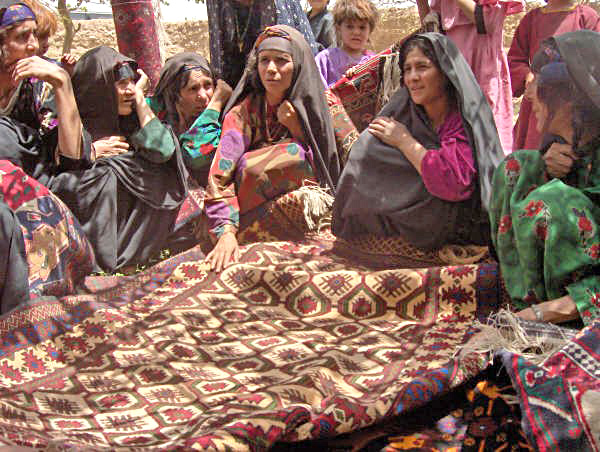
Afghan carpet making

(Wikipedia image)
I'm at the end of another busy week: busy but interesting! Thursday afternoon I was listening to a talk given by Hanneke, an enthusiastic member of CFUW-Ottawa's UWHAW group, who in the 1970s had made multiple trips to Afghanistan to buy carpets and other woven goods (she ran a wholesale warehouse in the Netherlands). She told us about the importance of the wool and weaving traditions in central Asia, in particular in the area around Herat, the place she most frequently visited in those days. As part of the talk she brought several items from her collection to show to us.

Some of the weavings displayed by Hanneke
Hanneke spoke about the different sheep rearing tribes of Afghanistan, of their originally nomadic culture and the importance of woollen artifacts in their yurts and tents. She showed us one weaving that wasn't a carpet but a door to a yurt––you'd just push it aside to go in. Apparently there are five types of sheep bred for their wool, in Afghanistan, and the best wool comes from the karakul sheep of Turkestan who have a long, lustrous outer coat and a fine, soft inner coat. They are sheared twice a year, and from their easily spun wool, low in lanolin content, the art of felting evolved.

Natural dyes are used for the carpet fibres, some made from remarkable ingredients, walnut shells, camel hair, crushed insects. Two women work at the construction of a carpet; they start at the ends, making the flat woven border (kilim), then begin the knotting work, folding the carpet as they go. It can take a year to make a large rug by hand, and any young girl involved in its making might not have time to go to school. Afghan Turkmen weavers use the "Persian knot"––up to 400 knots per square metre. This is a very old skill and the carpet weaving patterns are passed on from one generation to the next, so that the secrets of their art are kept within the family. When the carpet is complete a tiny piece is burned, for luck, and then it's either carried by donkey or bike to the local market for selling or kept aside for the family's own use, or for a dowry––the most carefully worked carpets are the ones used for dowries.
Afghan shepherd's coat

After she had shown us rugs, saddle cloths, woven salt bags and donkeys' neck ornaments, Hanneke also modelled a coat that would be worn "by the most important person in central Asia, the shepherd!" The coat had extremely long sleeves, the purpose of these being to conceal the hand movements of the merchant as he haggles over a price for his merchandise, while holding the hand of the buyer.


Wednesday, March 23, 2011

From the bottom up

This was the theme of a lecture I heard last week at the Delegation of the Ismaili Imamat on Sussex Drive. The topic was democracy in Afghanistan: can it be "built from the bottom up"? The speaker, introduced by the CEO of the Aga Khan Foundation in Canada, was Sujeet Sarkar, Senior Regional Advisor for Governance and Civil Society with the AKF. During the last six years this gentleman has lived in Afghanistan—"the most volatile place in this universe ... the second-most corrupt country in the world"—working in conjunction with that country's National Solidarity Programme to invigorate Community Development Councils (based on the traditional shura) in remote villages where "poverty is more of a concern than violence."

The objective is for each village to identify, plan, manage and monitor its own development projects. The representatives of the Aga Khan Development Network (supported by CIDA), are simply facilitators, sitting deferentially with the village elders at their meetings; the outsiders' role is to influence the council's decisions by offering funding (micro-grants), on condition the local project be planned fairly. "How would you like to see your village in 2015?" each group is asked at the outset, and "Who would you like to have as your leaders?" Our own people, is the usual answer. It turned out that hardly any problems need to be solved outside of the community itself.

In order to be awarded the funding for a new school, for road repairs, bridge building, tree-planting* or whatever, village councils are obliged to participate in role-play games to give them a better understanding of modern approaches to old problems. The men and the women do not "play" these games together, but in some cases the facilitators contrive to give the men concerned a new appreciation of their womenfolk's problems and potential. Sujeet confessed he had been sometimes moved to tears by the frustration conveyed by the women's groups; they had so much to offer and were barred from offering it because of their lower status. However there's a feeling that this will change in future generations because their daughters now get more of an education, and, interestingly, the menfolk seem to encourage the idea of girls going to school. Only 10% of adult women in Afghanistan are literate at present, but 50% of Afghan girls are learning to read. The present day average life expectancy for an Afghan woman is 40 years.

*5 million trees have been planted at the AFK's expense, orchards replacing the former poppy fields

The AKDN has introduced the concept of a social audit to these communities, where those responsible must stand in front of the council and report on how much money is being spent and why. This process is, apparently, acceptable. Women of the village may ask questions but only in writing, and only from behind a screen.

There are also meetings for women-only, for example when micro-loans are awarded for the purchase of sewing machines. The promise to pay back the loan has to be ratified by the women's signatures, or thumb-prints, more usually.

A high-profile journalist from the New York Times came to report on the National Solidarity Program while Sajeet Sarkar was working in Afghanistan. She warned him that if the publicity didn't match the reality she would tell the truth about this, but in the end, having visited one of the the NSP projects in Jurm, she wrote a very positive article about it. The Jurm project was a significant one because it required the co-operation of twenty-two separate Community Development Councils, their delegates sitting together on beautifully woven carpets, to plan a mutual response to the floods which had destroyed some freshwater pipes (18km of pipes having recently been laid). The tricky question of who would be chosen to supervise the teamwork without any of the elders losing face was solved by the drawing of names from a hat!

During question time here in Ottawa, someone asked what proportion of Afghan villages had been supported by the AKF so far, and having seen the somewhat "rosy picture" painted by the documentary film Change in the Making, a Journey in Afghanistan, we were subdued on hearing the answer: "only 3%." But it is a start which, it is hoped, will encourage the remaining 97%.

*****

Before the presentation a group of us had a guided tour of the premises, learning that His Highness, Prince Karim Aga Khan IV (since 1957, the 49th Ismaili Imam) has a suite of rooms in this building where he can stay when he comes to Canada. The building, designed by Maki, an architect from Japan, incorporates traditional Islamic features in its design, such as Jali (lattice) screens and a courtyard garden planted with silverberries and divided by watercourses (rainwater trickles down the warmed tiles into a central hollow).

The AKF also laid on an elegant reception for us in the atrium, with glasses of juice and mineral water and plates of cheese.

Monday, November 15, 2010

Infectious hope

Instability is infectious, but so is hope.
Inside the building
I heard this said on Friday during a presentation at the headquarters of the Delegation of the Ismaili Imamat on Sussex Drive. This blogpost is going to describe what the Aga Khan Foundation Canada (AKFC) does for Afghanistan, a subject in which I've become very interested since I joined a new Ottawa-CFUW group: University Women Helping Afghan Women. Last Wednesday I went to one of those meetings, too.

Anyway, one thing at a time.

The Aga Khan Development Network in Afghanistan joins forces with government agencies to stimulate and support the economy. This includes the financing of new infrastructure (hydro-electricity projects, bridges, clean water, proper sanitation) and of innovative agricultural programmes and education, particularly in remote parts of the country, as well as the offer of microloans. The First Microfinance Bank (FMFB) kick-starts small businesses with these loans, buying the beneficiaries—often women, seeking to supplement their family income—such essentials as flour and wood for a bread oven, or a sewing machine. "Loan officers" then pay regular visits to see how the new enterprise is going and to offer advice. The AKDN has established hundreds of savings groups in northern Afghanistan that serve a similar purpose.

Bridge at Darwaz (photo of a photo)
Farmers' Field Schools in Badakhshan, sponsored by the Aga Khan Foundation, sometimes called "the social conscience of Islam," have persuaded something like a thousand communities to stop growing poppies for the drug trade and to start growing fruit and nut trees instead. As regards the bridge-building and water management, separate villages are obliged to co-operate with one another in "development councils" (there are eighteen of these) so that ancient enmities are forgotten and so that, pooling their resources to improve matters, they become less reliant on help from the outside world. A larger-scale example of this is the construction of the Darwaz Friendship Bridge linking Afghanistan to Tajikstan across the River Panj.

Afghans in council (photo of a photo)
The AKDN provides a more basic form of education in the 200 elementary schools where a "whole school improvement model" has been initiated. A hundred schools have been constructed or rehabilitated after the devastation of war. Local parent-teacher associations urge teenage wives to continue their education before becoming mothers. Through the shura (the Islamic consultation process—illustrated in this picture) in each village, the AKDN has set up literacy classes for women and seed banks for farmers and gardeners.

There are two more agencies in Afghanistan worth mentioning, the Aga Khan Health Services (AKHS) and the Aga Khan Trust for Culture (AKTC). The former makes the needs of women and children a priority, helping to train midwives, usually young women from remote areas, at Faizabad. This initiative has reduced child mortality by 85% in some parts of the country, and in Darwaz, in the north, a health clinic has been established with a staff of three doctors, serving 20,000 patients a year, some of whom travel for hours, for days, even, for their treatments or consultations.

The Aga Khan also takes Afghanistan's cultural needs very seriously, believing that "culture injects hope" into a deprived, traumatised community, or city, or nation. The AKTC uses its funds for the restoration of national monuments, for literacy and vocational training (in traditional weaving, for instance), for the arts and for the creation of parks and gardens. A few years ago, Canada's Governor General, Adrienne Clarkson, visited Kabul and was deeply impressed by the 16th century garden restored by the AKTC. She mentioned it in the speech she made at the Foundation Ceremony for the Delegation of the Ismaili Imamat:
...in only a year, the Foundation had transformed a dusty ruin surrounded by broken walls into a beautiful terraced garden with reconstructed adobe enclosures and the first of a series of fountains. It was astonishing. Nothing could more eloquently express the mission of your Foundation—to improve the material lot of the world's most devastated regions and peoples, yes, but also to respect spiritual and aesthetic considerations. Babur's Gardens serve as a point of hope and illumination for everyone who cares about Afghanistan ...