blending an assortment of thoughts and experiences for my friends, relations and kindred spirit

blending an assortment of thoughts and experiences for my friends, relations and kindred spirit
By Alison Hobbs, blending a mixture of thoughts and experiences for friends, relations and kindred spirits.

Thursday, January 29, 2009

Not calling a spade a spade

This is an uncomfortable subject. In German today we looked at an interview published in Welt Online: Unwörter sind Produkte von Medien und Politik, which was about the way words are invented or distorted to cover up the truth about things. You could translate Unwörter as non-words, perhaps.

The press is particularly prone to coming up with abbreviations like "Gitmo" for Guantanamo Bay or "WMDs" for Weapons of Mass Destruction. If something is too unbearable to contemplate, give it a nickname. Actually people are for ever doing this, from military personnel who can't face the truth of what they really mean by "collateral damage" to the insecure father of a teenage girl inventing a silly name for her boyfriend rather than deigning to call him by his real name.

Insurance companies come up with insensitive inventions like "Todesfallbonus" (a death bonus) and "Langlebigkeitsrisiko" (the risk of a long life), which the philologist Horst Dieter Schlosser feels is an insult to human dignity.

Talking of dignity, what about those nursing homes run by Dignicare, Inc? Doing a Google search for "dignicare" by the way, also reveals this link, a perfect example of how words can sometimes deliberately imply the exact opposite of what they actually stand for.

Then there are the inappropriate exaggerations. Schlosser deplores the recent use of the word "pogrom" in connection with managers' salaries, and haven't animal rights activists gone too far, he asks, by telling us that battery hens live in a "Hühner-KZ" (a concentration camp for chickens)? "KZ" itself is another of those euphemisms invented by someone who couldn't bear to pronounce the actual word.

Well, talking of chickens, here's a quotation from C.S. Lewis that Chris found for me today:

It may be hard for an egg to turn into a bird; it would be a jolly sight harder for it to learn to fly while remaining an egg. We are like eggs at present. And you cannot go on indefinitely being just an ordinary, decent egg. We must be hatched or go bad.

Monday, January 26, 2009

Back to basics

From the book The Arctic Sky, Inuit Astronomy, Star Lore and Legend by John MacDonald, which I've just posted to George for his March birthday (allowing enough of time for a parcel by surface mail to reach Australia), here's a quotation from an Inuit man:

"Even if I did not have a watch, the movement of these stars can tell me the time. The Tukturjuit [Ursa Major constellation] are easily recognized because they have the form of a caribou. When the caribou apppears to stand on its hind legs and its head starts to get higher this is an indication that midnight is approaching." [...] In South Baffin Island the stars of Tukturjuit were also used for orientation: "When you are a long distance out on the sea ice and the shore of Baffin is obscured—raise your left hand and when your fingers and thumb match the constellation's stars your arm points towards the mainland."

Were our clocks and GPS gadgets to fail, who in our 'civilised' world would still be able to use the stars for guidance?

I thought I might find some similar information about Australian aboriginals, and sure enough: although they never had calendars, the Boorong people of Victoria always knew that when, in what we call October, the Mallee-fowl constellation (Lyra) vanishes, to "sit with the Sun" it's time to start gathering the Mallee-fowl's eggs on earth. Other indigenous Australians see the first appearance of Orion in their sky as a reminder that Dingo puppies are about to be born.

Sunday, January 25, 2009

Staff dinner

It was the Rockcliffe Flying Club's free dinner at Friday's for staff and board members and their guests, last night. In photo-journalist mode, as Chris' guest, I brought the camera with me; actually it was Chris who took most of the pictures. Here are the dispatchers and young instructors, René, Marc, Benoit, Stéphane, Stéphane's girlfriend, Joey and Adam. With a view to including this photo in a future edition of Crosswinds, I'm trying it out here in black & white.

I'm reluctant to make any additions to my 12-page January issue, as this is now ready for printing. If I were to add any more material, it would have to fill four more pages; I have only just realised that, for ease of stapling, newsletters need to be prepared in multiples of four pages—obvious, when you think about it, but I hadn't.

Don stood up half way through the meal and told us that 2008 had been a fantastic year, the most active in recent history, with 5,200 hours of flying time on the club aircraft. "As a team, it all works!" he said, praising instructors, staff and maintenance people (chief of whom is 'Red'—in the picture—wearing an extraordinary hat last night that had belonged to his father; someone on our table commented that it made quite a statement of its own). Our achievements have been amazing, said Don, considering the weather, and as we can't possibly have such bad weather this year, we're expecting 2009 to be even better.

Simon, Chief Flying Instructor, also made a speech, telling us that 2008 had been the club's second best year for flying (2003 was the best) and the best year ever from a financial point of view, despite the fact that the management was beset by challenges: not just the weather but also a high turnover of qualified staff, resulting in a severe shortage of instructors last summer. The aviation industry's expansion has slowed down, however, RFC has fast-tracked its Class 1 instructors and we now "have depth", with sixteen instructors employed by the club, eight of whom are currently in training for a higher rating.

At this juncture Simon made a joke about how it was the instructors' job to break the club's aircraft ("...and PHV will be fixed shortly!"), saying how the 'planes are being upgraded, a couple of them acquiring GPS, a new Cessna 182 added to the fleet, and a fully VFR-certified simulator on order to replace the old one. There's even a new toy (the recently acquired tractor-trailer-snowblower) for Steve. So Simon is looking forward to continued progress using all the available new technology. Meanwhile, to nobody's surprise, the clubhouse is in urgent need of replacement, the roof falling in, animals falling in, the walls tilting, the doors sticking, with leaking pipes, frozen pipes ... Never mind; Simon promises to manage the transition to our New Facilities (when we get 'em) and this year is going to focus on developing his staff, rather than standing in for missing instructors, and be altogether more managerial.

He thanked the board of directors for their "unbelievable" amount of support.

Friday, January 23, 2009

Startling the people that matter

I watched three brilliant teachers this week. What they had in common was self-assurance and a passion to share the ideas that drive them.

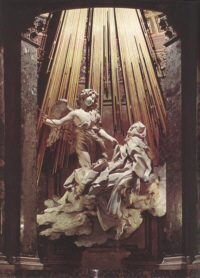
As I said I would, I went back to the National Gallery to watch the documentary film about Bernini, actually Part 2 of the BBC Series Simon Schama's Power of Art, entitled Bernini. In this production Schama presents a dramatised version of Bernini's life story, and shows us "the most daring sculpture in the history of art," the Ecstasy of St. Theresa. He talked about its "rippling cushions of stone," how the nun's habit, sculpted in this way, represents what's happening inside her: "a helpless dissolution into liquid bliss"—!

Schama doesn't pull any punches. Forget the euphemisms, he says, this is the face of sexual euphoria. Theresa was one of the barefoot Carmelites, says the narrator, depicted here, in "molten marble," not as a forty-something old maid, but as an unforgettably beautiful young woman. The artist, adept at "startling the people that mattered," shows spiritual ecstasy as something anyone can relate to:

What Bernini's managed to make tangible is something that we all, if we're honest, know we hunger for, but before which we're properly tongue-tied [...] No wonder when art historians look at this sculpture they tie themselves in knots to avoid saying the obvious, that is, that we're looking at the most intense convulsive drama of the body that any of us experience.

It is not a furtive piece, says Schama. Bernini "wants us to look, and look hard," witness the "audience" that he's incorporated into the ensemble (the faces painted on either side). He has set it up as theatre (apparently Bernini was also known as a playwright, painter and master builder) with "fake lighting", even. On the floor there's evidence that the earth has literally moved for St. Theresa, as there are the dead, arising from their graves. Bernini was not being "crude" however, understanding that for mystics, soul and body are one and the same. The Pope himself—Innocent X—liked it.

My second exposure to good teaching was when my daughter sent me a link to a presentation by Sir Ken Robinson, on the TED website, asking: Do schools kill creativity?, done as a sort of stand-up comedy that has the audience laughing out loud ... and thinking. He's highly provocative. Senior academics, he says, "look upon their body as a form of transport for their heads. It's a way of getting their head to meetings." Yet the modern education system puts this sort of people at the top of the intelligence tree, and treats the creative ones (musicians, artists, dancers) as less worthy of notice. Robinson tells the story of Gillian Lynne, choreographer, who was considered educationally subnormal, until a doctor realised that her lack of attention in school was a symptom not of deficiency but of her natural creativity. "Gillian isn't sick, she's a dancer..."

The third fine teacher this week was Barack Obama, whose Inauguration speech, if you ask me, was a lesson (not just to Americans) on how to think. I was taking notes!—noting that he mentioned the value of curiosity (hooray!) and of restoring Science "to its rightful place." As for national and international security:

Power alone cannot protect us, nor does it entitle us to do as we please ... Our security emanates from [...] the tempering qualities of humility and restraint ... We know that our patchwork heritage is a strength, not a weakness ... People will judge you on what you can build, not what you destroy ... we will extend a hand if you are willing to unclench your fist...

I was impressed by a story that came out in the Guardian about rather less famous Joe Favreau (27) who helps Obama to compose his speeches, working on the word-crafting in coffee shops for hours on end.

I can relate to that.

Monday, January 19, 2009

The writing on the wall

AVAAZ, meaning Voice, is "the world's largest on-line advocacy network" with 20,000 new members joining each week, apparently, most of us having heard about it from a relative or friend; it was my daughter who persuaded me to join about a year ago and I, along with thousands of others, mostly hopeful, have just sent a message of encouragement to Barack Obama on a "virtual wall" that AVAAZ has named The Obama Inauguration Hub. Messages are being posted at a prodigious rate from all over the world, so that mine dropped off the bottom of the screen within minutes. I wonder who will read them (I doubt if the President will have time, although I think people have decided to participate in this are under the impression that he's open to suggestion) apart from the like-minded members of this organisation. An even more imaginative ploy by AVAAZ was to erect a real wall for writing on, in a very public part of Washington, when Mr Obama was first elected.

I don't know whether this sort of action changes minds, but at least the impulse is there and it's indicative of a worldwide longing for change. Some of the people writing on these walls are immoderately emotional and many say "Don't let us down, Mr Obama!"—a terrible burden for the man. It's interesting to see that very few messages relate to the colour of his skin. I've just taken another look at the Hub, and someone has posted:

Obama please talk about compassion as a new weapon.

Saturday, January 17, 2009

Sign of the times?

Just received an email from Greta, who organises our Spanish conversation group, saying:

Hola Señoras,

We have decided to postpone our Spanish meeting, scheduled for Tuesday, January 20th, to the following week, Tuesday, January 27th, due to the Inauguration of the new US President ...

because several of our group don't want to miss watching the ceremony on TV!

Friday, January 16, 2009

Snow-shoe photographers

This morning the temperature reading at Gatineau Airport was MINUS 37°C. This is me (back view) lining up four of the foreign diplomats who had braved the extreme cold to try snowshoeing along the north bank of the Ottawa River this morning. Meanwhile, Carol had borrowed my other camera to take these photos.

Indoors at Louise's house, the scene was warmer. There were sixty-eight people present, apparently. I'm the one in the (Nepalese) striped pullover, on the right.